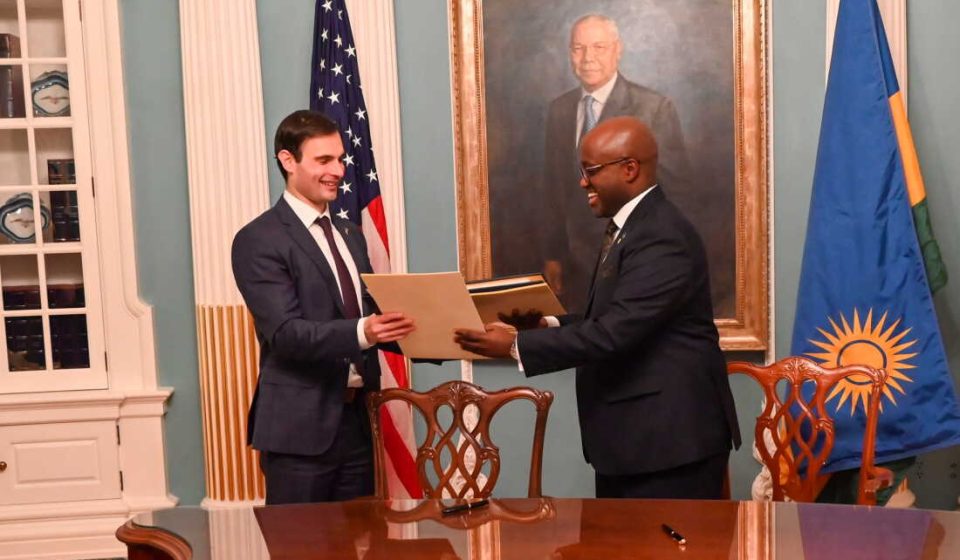


In December, senior State Department official Jeremy Lewin hosted Rwandan Foreign Minister Olivier JP Nduhungirehe for the signing of a multi-year memorandum of understanding on global health cooperation.
U.S. Foreign Assistance Office
hide caption
U.S. Foreign Assistance Office
The Trump administration says October 1 marks the dawn of a new era in global health. This is the age ofAmerica First, the Global Health Strategy“And that means rewriting the rules for financing health care in low- and middle-income countries.
A key part of the “America First” strategy is the idea that the United States should not hand out billions of dollars for health and development programs without reaping concrete benefits – access to local minerals, for example – and without commitments from governments to spend their own money.
To be eligible for U.S. funds, each country must sign a memorandum of understanding detailing the amount of money the United States will invest as well as the country’s financial commitment.
The administration says requiring countries to participate will make them more self-reliant and, ultimately, less dependent on U.S. aid.
It’s an idea that has merit, according to Jocilyn Estespolicy analyst at the Center for Global Development, a think tank based in Washington, DC. But she wonders if the plan is being implemented too quickly. As for the nations involved, reactions have been mixed. Here’s a look at how this new arrangement is supposed to work – and the potential obstacles that lie ahead.
The American justification for the new strategy
The United States has been – and still is – the largest donor to global health programs, despite the Trump administration’s drastic funding cuts in 2025 and the dismantling of America’s premier aid agency, USAID.
Previous administrations viewed global health spending as an important way to build strong relationships and influence with recipient countries and as a key part of U.S. soft power – using donations to generate goodwill.
“Historically, the main focus has been on everyone benefiting. Better health and development in low- and middle-income country regions lifts all boats, and the United States benefits,” says Tom Bollykydirector of the global health program at the Council on Foreign Relations.
Here’s how the State Department describes the new strategy on its website:
“It will protect the homeland by preventing infectious disease outbreaks from reaching U.S. shores; strengthen our bilateral relationship by entering into multi-year bilateral agreements that require co-investment from recipient governments, saving millions of lives and moving countries on the path to reduced dependence on foreign assistance; and promote American health innovation around the world.”
What is new is what Bollyky calls a more transactional view of health assistance.
“The United States wants to be clearer about what American taxpayers receive in return, beyond just whether countries are doing well in their health and development goals,” he says.
This could mean “preferential access to essential minerals,” he says – or direct access to patient data from other countries. This request for confidential documents is perhaps the most controversial part of the administration’s approach, he said. According to the Trump administration, the United States will benefit from an increased ability to identify outbreaks and protect itself.
Who participates? And who isn’t?
The United States has signed memorandums of understanding with 35 countriescommitting approximately $14 billion in health investments over five years.
They span the globe and include Nigeria, Rwanda, the Philippines, Tajikistan, Bolivia and El Salvador.
In the case of Rwandathe United States will provide $157 million and Rwanda $70 million. In exchange, Rwanda will share patient data with the United States — and accept U.S. Food and Drug Administration approval of drugs for use in outbreaks without requiring additional approval from Rwandan regulators.
So far, three countries have refused to sign memorandums of understanding with the United States, citing sovereignty concerns: Ghana, Namibia and Zimbabwe. Negotiations between United States and Zambia blocked for months on provisions allowing the United States access to essential minerals.
On September 25, during an event at the United Nations General Assembly, The President of Ghana, John Dramani Mahama said the country rejected the US proposal after seeing the stipulations requiring Ghana to hand over patient medical records and pathogen data, and accept the FDA as the final authority on medicines.
“It was humiliating,” Mahama said. “Ghana is a sovereign nation and we have our processes. We are a democratic country.” He called the U.S. funding proposal “a pittance, $100 million and something.”
The consequences of not signing can be very serious. Also September 25 The US ambassador to Zimbabwe, Pamela Tremont, said the US was ending all global health funding in the country because it had rejected the deal for the same reasons as Ghana. Instead, she said the United States would reorient its relationship with Zimbabwe from health to economic investment and trade.
According to Bollyky, the question is whether other countries that refuse will also be completely excluded.
With the rollout expected this fall, Bollyky says it’s only a matter of time before “we know if the administration is really willing to follow through on this.”
What the experts say
Global health specialists interviewed for this article say American First represents a pragmatic approach to health care assistance.
“When it comes to public health, it makes sense to coordinate closely with governments, and countries should ultimately manage and finance their own health systems,” says Jocilyn Estes of the Center for Global Development.
Still, she said, “the scope and scale of this turning point is truly unprecedented, and the pace at which the administration wishes to move forward seems quite inconsistent with the kind of careful planning required when the stakes are this high.”
On the ground, implementation of the agreements was initially scheduled to begin in April 2026. When the administration was unable to meet this goal, it extended the start by six months to October 1. But it’s not yet clear whether the State Department money will be delivered on time.
Estes says this rapid deployment represents a high-risk moment for the future of U.S. global health assistance.
“They’re kind of building the plane as they fly it, and so if this administration’s gamble on this new approach doesn’t work, there will be real patients and real people who will suffer the consequences.”
And there’s another concern: The amount of U.S. aid will be much lower than in previous years, he says. Stephen Morrisonwho oversees global health policy at the Center for Strategic and International Studies.
“Ultimately, the core funding that the United States provided was significantly reduced. So if you’re a country with a large population at risk for HIV, you’re going to be upset about what happened in the United States,” he says.
Yet many countries may feel they have no choice but to sign: “You’re going to continue to engage with them because it’s still the biggest game in town,” Morrison says.
One of the biggest questions is whether countries will be able to meet the targets they have set for their own contributions and also increase their health spending to make up for the decline in U.S. funds.
Take Rwanda, for example. It is expected to receive $157 million from the United States over the next five years. In 2024 alone, Rwanda received more than $200 million from the United States for health programs. But Rwanda, like many countries, faces economic difficulties due to high inflation and the fallout from the war in Iran.
“We have looked at the national budgets announced by these countries and whether or not we see any sign that they are closing the slowdown that is expected to come from the shortfall in U.S. development assistance,” Bollyky said. “And it seems like (they’re) not.”
The speed with which the administration rolled out this system hasn’t left countries much time to adapt, he says — and that makes it more difficult to create “a more stable environment for countries to take on the burden of meeting their health needs, which is what everyone wants, including governments themselves.”
NPR contacted the State Department for comment on criticism of its America First strategy. The State Department sent this statement:
“Rather than investing in “standing aid,” the United States is working directly with recipient countries to advance shared global health goals, save lives, and help countries build more self-sufficient, locally-led health systems through the Memoranda of Understanding (MOUs) of the Trump Administration’s America First Global Health Strategy (AFGHS). This is what a long-term partnership looks like.
For stories about life in our changing world, Subscribe to NPR’s Global Health newsletter.
Gn world