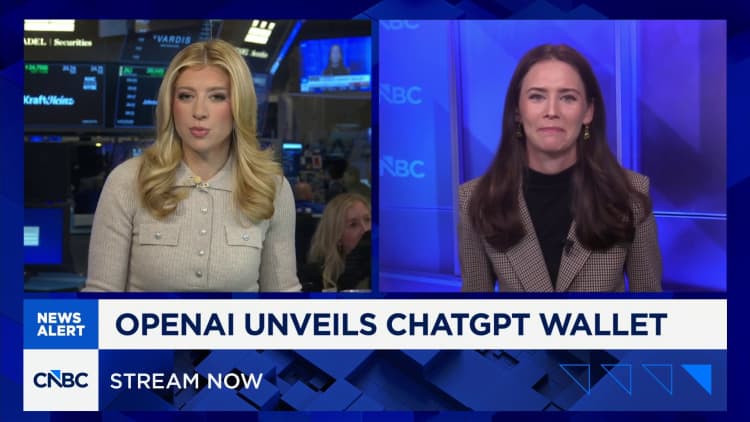

OpenAI ChatGPT Wallet announced Friday, a new payment feature that allows its “points” artificial intelligence agents to make purchases on users’ behalf.
The company created ChatGPT Wallet in partnership with American Express, MasterCard And Visaand it allows cardholders to keep their existing credit card rewards and protections. Eligible users enter their card information once, prompt their point to find items to purchase, and approve each purchase with a security check.
OpenAI said its Dots agents will never access a user’s card details. Instead, their payment networks will provide the point with a “payment token,” which contains a limited card number, security code, and expiration date specific to a given transaction.
“Our goal here is to really focus on merchants and our network partners and start building a really good, secure, easy-to-use foundation,” Chaya Nayak, head of monetization and payments products at OpenAI, told CNBC in an interview.
ChatGPT Wallet comes as a growing number of consumers explore how to use personal AI agents to manage their calendars, book travel and perform other everyday tasks. OpenAI introduced Dots Agents at its annual developer conference in late September, shortly after Meta’s Muse offering topped the App Store charts.
Purchases made through ChatGPT Wallet could eventually generate a new revenue stream for OpenAI, but the company said it would not require a reduction in transactions to get started. With its initial launch, OpenAI is working to build relationships with merchants and position itself as a serious platform for buyers, especially as sellers begin experimenting with personal agents.
OpenAI has delved deeper into AI-based commerce over the past year, but some of its early attempts failed to take off. The company introduced an “instant payment” feature last fall, which it quickly moved away from. In March, the company rolled out a revamped shopping experience aimed at making it easier for users to find and compare products.
Nayak said ChatGPT Wallet builds on OpenAI’s previous efforts, particularly in product discovery.
“We think this is the next step, where if someone finds something that they’re really excited to buy, then we want to be able to take it to that end point,” she said.
ChatGPT Wallet is initially available to OpenAI Pro subscribers in the United States over the age of 18. The limited rollout is intentional and “the right approach to make sure things work,” Luke Gebb said., executive vice president and global head of innovation at Amex.
OpenAI’s ChatGPT chatbot supports more than 1.2 billion weekly active users and nearly 100 million paid users as of the end of the third quarter. With such a large user base, Gebb said OpenAI can decide to “turn up the volume” on ChatGPT Wallet whenever it wants.
“It just makes sense to watch it, start it in a contained environment, and then go from there,” Gebb told CNBC in an interview.
Marketers and sellers are still grappling with the rise of AI personal agents, and some businesses have chosen to do without them altogether. United Airlines said Wednesday it would block agents from accessing its systems to book tickets, and Amazon prevents agents from purchasing products on its platform.
OpenAI said Friday that agent commerce is still in its “early stages” and released tools and guidance alongside its ChatGPT Wallet announcement to help businesses begin navigating the transition. The company explained how merchants can ensure their websites don’t inadvertently block OpenAI agents, for example.
“It will take time for the ecosystem to build the right infrastructure to be able to make this experience truly amazing and seamless across all of its locations,” Nayak said. “Really, we’re talking to networks and merchants here.”
WATCH: OpenAI raises $15 billion at a valuation of $1.25 billion, sources say. What this means for the IPO

Gn bussni