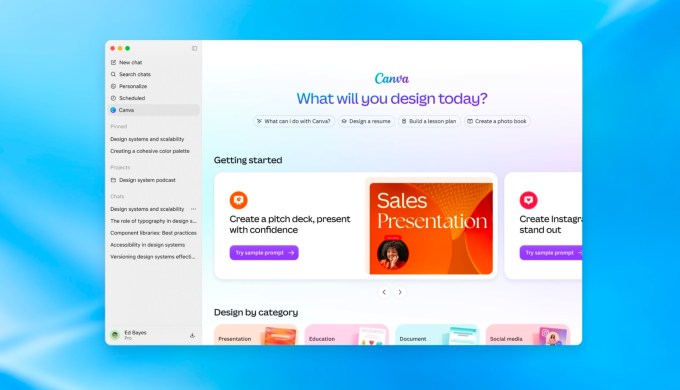

OpenAI’s Dev Day on Tuesday may have been focused on its assistant agents known as Dots, or its new AI models, but combined, the AI company’s announcements pointed to a larger plan: a disruption of the traditional App Store model. Taken together, today’s announcements make ChatGPT the place where software can be discovered, launched and used by people and agents.
Additionally, OpenAI introduced a way for users to bring their ChatGPT identity with them, while also allowing them to use their existing AI allocation in third-party applications.
This isn’t the first time OpenAI has experimented with how apps could work within its familiar chatbot interface, but the current vision seems more fleshed out than before.
For starters, the company is turning ChatGPT into an app launch surface. The chatbot, which the company says now has 1.2 billion weekly users, has yet to fully realize its potential as a discovery mechanism for finding and using apps that work with AI.
To change this, ChatGPT will start making app suggestions in the conversation flow when it recognizes that a particular app could help the user complete their task. From there, the user will be able to connect the app and start using it directly in ChatGPT.
This is also facilitated by the expansion of the ChatGPT plugin architecture, which now supports extensions.
This allows app developers to create interactive panels where users can work with their tools while chatting with ChatGPT. This essentially turns apps and services that users would have previously used via the web or through a native desktop or mobile app into something that works directly within ChatGPT.
Developers who log into the system can create AI-native versions of their apps through ChatGPT, the same way they would through the open web or a mobile app store. As more and more discoveries are made via AI chat, it’s a difficult distribution channel to pass up.

Users are also incentivized to use this channel, as “Connect with ChatGPT” will allow them to bring their AI allocation with them. (OpenAI has 16 launch partners for the effort, including Devin, Notion, Vercel, T3, OpenClaw and Cognition’s Dactyl, but plans to add more soon, it says.)
In a demo at OpenAI’s Dev Day event, the company showed how its own new meeting app could work in ChatGPT, displaying upcoming meetings from the user’s calendar. Here, the user can easily choose to use AI to take meeting notes and then receive a summary of follow-up items once the meeting is over.
In another example, users would work with design-focused apps like those from Figma and Adobe to work on revisions to their current project or use a particular feature that would have otherwise required a standalone app.
Applications can be shared with others, such as work colleagues, on the lightweight websites that ChatGPT now produces. From these ChatGPT sites, a user’s colleagues can log into the app with their own credentials and permissions, making the software experience personalized for them.
OpenAI also talked about improvements in the way developers submit plugins for review – OpenAI’s version of Apple’s app review process, if you will. Now developers will be able to track their review, see what needs to be fixed, request a human review, and update their plugin’s tools without starting their entire submission again.
The company also announced a new enterprise apps marketplace where partners can market their services. At launch, more than 30 partners are offering their application through OpenAI Marketplace, including Adobe, Figma, Sierra, Decagon, HubSpot, Salesforce, ServiceNow, Harvey, Legora, Palo Alto Networks, CrowdStrike, Baseten and others. Eligible customers can apply a portion of their OpenAI commitment to approved partner software, OpenAI said.
Beyond transforming ChatGPT into an app discovery tool where users connect directly to apps, OpenAI’s adoption of agents is gently pushing users into a new era where they don’t have to think as much about which app to use or why, instead relying on suggestions from their AI agents.
With the launch of its autonomous AI agents known as Dots, the agents will browse the web for you, performing tasks that need to be done in their own cloud infrastructure. Each Dot has its own cloud computer and browser, and can also use connected applications. Compare that to the old model, in which users wanting to manage a certain type of project — like building a website or coordinating a meeting schedule — had to download different apps to their computer or phone to do so.

Now, users will tell an AI agent what they want to do, and it will simply do it for them. In some cases, the agent’s work may require access to another AI model or a particular application. But it’s something that the agent can provide to the user, rather than the other way around: it’s the user who fetches the particular tool for the job.
As OpenAI explains, Dots will be able to connect to its ecosystem of more than 4,000 applications.
Additionally, Dots can be proactive, perhaps stepping in to offer help on a project or bug, or handling a task forgotten by the user, but all of this is done with the user’s approval. Dots will perform what OpenAI calls “proactive searching” in the background using connected apps in read-only mode, but users will still have control over the actions they take.
This system could give app creators another way to reach customers outside of Apple and Google’s app stores. For example, users can subscribe to a service through the app creator’s website, then connect that account to ChatGPT or Codex for their agent to use. OpenAI did not, however, say that these features would eliminate the need for separate third-party subscriptions or other fees.
Notably, OpenAI didn’t announce any projects on this front today, instead focusing on how it builds the discovery, distribution, and interface elements to counter the app store model, as well as an identity layer and a mechanism for sharing a user’s existing ChatGPT AI allocation. It did not announce Tuesday plans to implement a billing or revenue-sharing system comparable to the economic layer of traditional app stores.
When you purchase through links in our articles, we may earn a small commission. This does not affect our editorial independence.
Gn tech