Partial vision restored in some blind patients thanks to new experimental treatment: ScienceAlert

Night vision often fades first, followed by narrowing of peripheral vision. In retinitis pigmentosa, this progressive loss can eventually lead to blindness.
An experimental treatment has now helped some patients regain limited visual abilities.
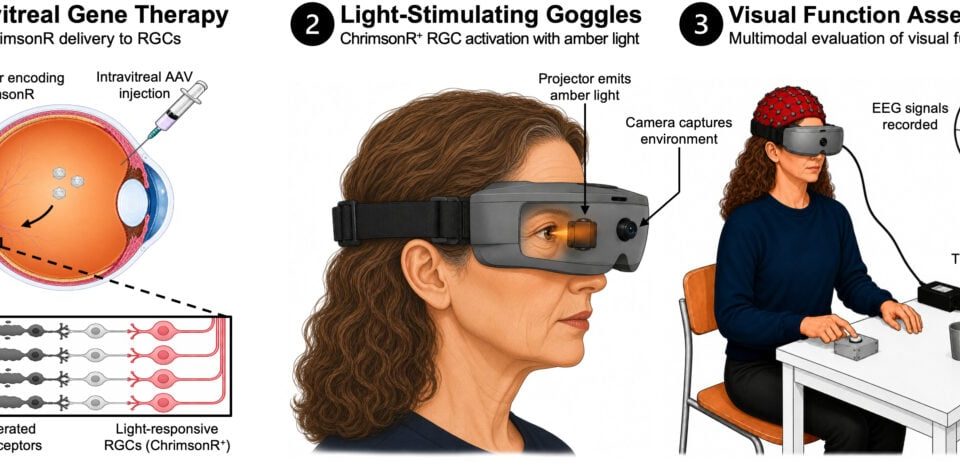
The approach combines a gene injection with special glasses. In a small trial involving 10 people with profound vision loss in both eyes, some participants became better able to detect objects, locate them, and reach for them while using the device.
The study in The New England Journal of Medicine was co-authored by ophthalmologist José-Alain Sahel of the University of Pittsburgh and vision researcher Botond Roska of the Institute of Molecular and Clinical Ophthalmology in Basel, Switzerland.
Retinitis pigmentosa is a group of inherited diseases in which genetic changes damage the retina’s photoreceptors, the cells that normally detect light.
Symptoms may begin in childhood or later, and their progression varies. People without affected relatives can also develop the disease.
Variants in more than 100 genes may be the cause, complicating efforts to develop treatments for each genetic cause. This approach, called optogenetic therapy, gives nerve cells that survive the disease a new way to respond to light.
Each participant received an injection in their less seeing eye. An engineered virus provided instructions for producing a light-sensitive protein called ChrimsonR in retinal ganglion cells, the nerve cells that transmit visual signals to the brain.
“The gene therapy delivers a light sensor to the blind retina, making it sensitive to light again. The glasses provide light stimulation at the wavelength that this sensor responds to,” Sahel and Roska told ScienceAlert.
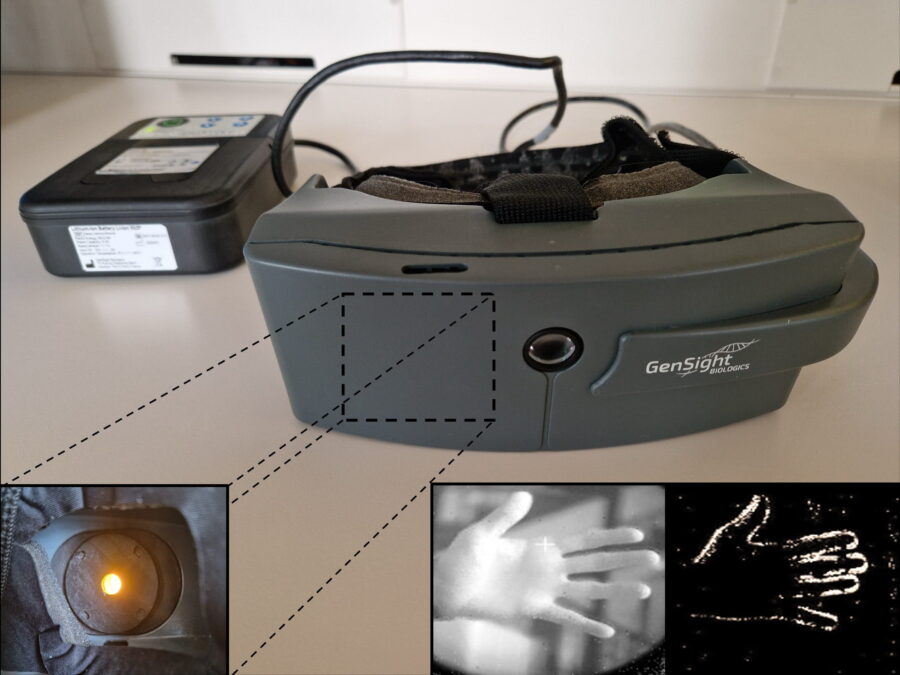
A camera in the glasses captures changes in brightness. A processor transforms these changes into patterns of orange light, which a spotlight shines onto the retina to activate the protein.
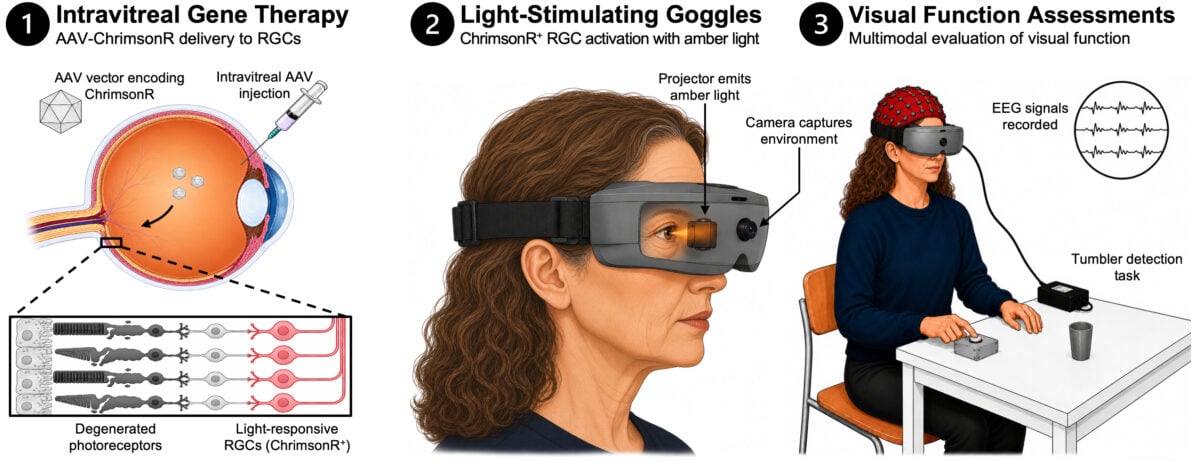
“In addition, the glasses adapt to external light conditions and modify the signal to ensure optimal stimulation of the retina,” specify Sahel and Roska.
Participants practiced using the glasses. During vision testing, their untreated eye was covered.
The trial primarily evaluated safety, but researchers also looked at light sensitivity and object detection.
They measured the faintest light the participants could detect through the glasses before and after the treatment. Seven showed increased sensitivity, ranging from about two times to 62 times. Six of them increased fourfold or more, which the team considered clinically significant.
This threshold came from previous research and was not previously specified in the trial protocol.
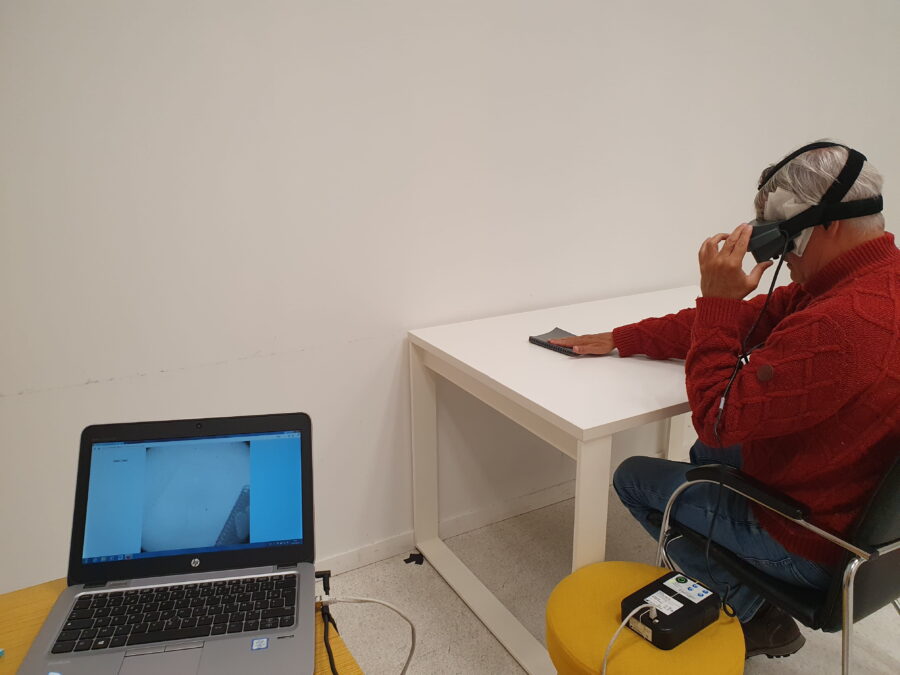
Eight participants performed object testing with and without glasses. They attempted to detect, locate and touch a notebook or a small box of staples, and to distinguish the orientation of a bar.
Four of them were consistently better at detecting the laptop with the glasses over repeated sessions spanning about a year to a year and a half. Others showed no consistent improvement over testing.
The criteria for classifying participants as responders were not previously specified.
“Patient differences in increased sensitivity may reflect how the gene therapy vector reaches the retinal cells, or the number of retinal cells remaining, or other variables such as glasses training,” Sahel and Roska explained.
Better performance was associated with more training sessions, but the range of possible values had no association.
Brain recordings from five selected participants confirmed the possibility that visual signals reach the brain. Four had already responded to behavioral tests. For some estimates, the confidence interval included zero.
“Security was very good and not a limitation,” Sahel and Roska said. The authors cautioned that the safety results came from 10 participants.
Researchers recorded 34 eye-related adverse events in nine participants, most of them mild or moderate. Seven developed inflammation inside the eye, which resolved with treatment without lasting consequences. One serious event involved temporary blockage of the central retinal artery immediately after injection; it resolved within minutes of treatment.
There were also 70 systemic adverse events, including six serious events. The principal investigator, under the supervision of a data and safety monitoring board, did not judge any of the systemic events to be related to the gene therapy or the injection. Three mild systemic events were related to glasses.
Four participants completed five years of follow-up. Several others were followed for two to four and a half years, while two withdrew earlier.
The report expands on a 2021 study involving one participant, the results of which are included in the current group.
GenSight Biologics funded the trial, helped design it, and managed the data. The trial was not randomized and had no control arm. Further research is needed to assess its benefits and risks.
“What is still missing is the ability to recognize faces and read; greater sensitivity of the optogenetic sensor would also be valuable,” said Sahel and Roska.
“We are working to address these limitations.”
The research was published in The New England Journal of Medicine.
This article was fact-checked by Fiona MacDonald and edited by Fiona MacDonald. Although we are proud of our process, we are only human. If you spot an error, please let us know.
Gn Health