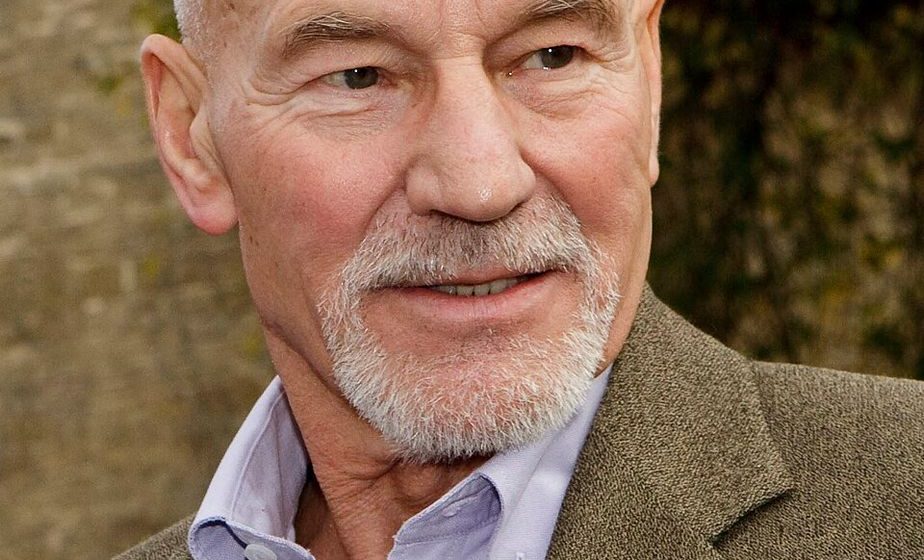
Grief over the recent death of actor Patrick Stewart, aged 86, was widespread. His great talent has been rightly celebrated, but the personal respect accorded to him by millions internationally speaks to larger issues.
Proud of his working-class background, Stewart used his celebrity status to speak out against discrimination and domestic violence. His open and continued identification of himself as an “absolute fundamental and emotional socialist” (he was a long-time supporter of the Labor Party) made him attractive to a younger audience radicalized by his own experience. He always presented himself as a fundamentally honest person and this quality permeated his best-known roles.

A distinguished classical actor, Stewart became internationally recognized in the Star Trek And X-Men franchise. It is significant that the two roles for which he is best known, Captain Jean-Luc Picard and Professor Charles Xavier, are authoritative but humane and moral leaders, committed to equality and the fight against injustice.
Their appeal to him is clear, as is their appeal to the audience. These figures embodied a quest for fairness, for something better, in contrast to the official venality and corruption visited upon audiences around the world. Stewart responded with serious, deep performances that made them more engaging. The continued loyalty of the fans was a response to something honest.
Stewart was born in a West Yorkshire industrial town in 1940, the third child of Alfred, a postman and labourer, and Gladys, a textile worker. Stewart spoke about the domestic violence he witnessed at home, which led him to advocate for victims of domestic violence.
He also spoke openly about his emotional conflict in seeing his mother hurt by a man he “respected, admired and feared.” Stewart’s domestic life was shaped by the experiences of a working class emerging from the trauma of war (Alfred suffered traumatic stress from his war experiences) and seeking some reorganization of society within the reformist framework of the Labor Party. Stewart took his own starting point politically from the post-war Labor government of 1945 – associating the Labor Party with the nationalisations, social reforms, creation of the National Health Service and building of council houses which he carried out to appease radicalized workers returning from the front and stem class antagonisms dangerous to British imperialism.
Stewart described his father as “a superstar” in the military who was now “a nobody” in civilian life. At the same time, he said, Alfred was “a very convinced trade unionist and fundamental labor issues were ingrained in me.”
Patrick skipped the 11+ exam that could have taken him to high school. Although he doubted whether he had succeeded, he was grateful for the circumstances that led him to a secondary modern school and the teaching of Cecil Dormand. Stewart was scrupulous in crediting the individuals who supported and guided him, but he was the product of an education system that the working class fought for and won as part of a post-war overhaul of social provision and welfare.
Stewart thanked Dormand for recognizing his imaginative escape from things at home. Dormand introduced 12-year-old Stewart to Shakespeare: “I barely understood a word, but I loved the feel of the words and sounds in my mouth. »
Dormand also chose Stewart for her first performance, in a production largely performed by teachers. “I felt fearless,” Stewart said, “and entirely at ease. I felt safe on stage and have done so ever since.”
It was Dormand who allowed Stewart to develop his theatrical talents beyond amateur theater. Dormand called Stewart to meet “another influencer from my youth,” Yorkshire County Theater Advisor Gerald Tyler. They sent Stewart on an eight-day residential drama course at Mytholmroyd, where he received his first acting lessons. There he became friends with Brian Blessed.
Stewart later learned that Dormand likely paid for him to take the course. He also encouraged Stewart’s older brother to attend a technical college and restored some of Alfred Stewart’s dignity by encouraging him to lead the school’s parent-teacher association. Years later, as chancellor of the University of Huddersfield, Stewart acknowledged his debt by awarding Dormand an honorary doctorate.
Stewart left school at 15, selling furniture and working in local journalism, but he and Blessed both won scholarships to study at the Bristol Old Vic drama school. It indicates the class change that his career represented that Stewart’s drama school scholarship was the first awarded by the West Riding Council to someone who had not graduated from Oxford or Cambridge.
He worked regularly in performance before joining the Royal Shakespeare Company (RSC) in 1966, where he remained until 1982 and returned triumphantly in 2006. He worked in theater when he could throughout his career.
Stewart had lost his hair when he was 20. He was told it would affect casting and that he would never be a leading man. This was hardly true: the year before joining the RSC, he had played the main character in Brecht’s film. The life of Galileo and Shylock in The Merchant of Venice in performance, but he was a compelling supporting actor before these roles materialized within national society.
Physically imposing and blessed with a richly sensual voice, he established himself as a vital member of the company, gradually rising through the senior ranks, including an award-winning Enobarbus in Antony and Cleopatra– to certain main roles each season.
His first experience on Broadway was in the famous Peter Brook film. A Midsummer Night’s Dream (1970). During the 1970s he combined RSC work with television and forays into the United States.
It was a period of serious television drama, and Stewart’s generation of classic actors enriched and profited from it. Inside the 13-part BBC historical drama Fall of the eagles (1974), he played a rather humorless Lenin, notably in an episode written by Trevor Griffiths about the 1903 split within the Russian social-democratic Labor Party.
His continued identification as a socialist will have had some influence on his choice of work. He played Shakespeare in Bingo by Edward Bond, another of this generation of radical playwrights.
He also appeared in Griffiths’s Professions, playing a fictional Bulgarian communist (Christo Kabak) sent to Turin during the worker occupations of the Fiat factories. The play concerns arguments between Kabak and Antonio Gramsci (Ben Kingsley in this production) over the tensions between the need for discipline in a revolutionary movement and the inspiration of the revolutionary moment. Griffiths called it “a sort of Jacobin response” to the failure of 1968 in France.
In 1976, Stewart played Sejanus in the extraordinary Me, Claude (also featuring Blessed in his best serious work), a career-defining series for many great actors, including Derek Jacobi and John Hurt. It was an almost theatrical production, with many of the actors having RSC experience.
There were equally impressive casts in Handyman, tailor, soldier, spy (1979) and Smiley people (1982), adapted from the novels of John le Carré. The first was a masterpiece of understated performances, led by Alec Guinness as spymaster George Smiley. Stewart had the thankless task of playing Karla, Smiley’s KGB counterpart, a silent role that was at the heart of Smiley’s crisis. Stewart brought the presence and depth that Karla needed to be a critical character rather than just a vague enemy.
Further film and television work showed that the quality of work available was becoming increasingly variable, with Stewart playing minor roles in John Boorman. Excalibur (1981), by David Lynch Dune (1984), Tobe Hooper Vital force (1985) and that of Trevor Nunn Lady Joan (1986), written by David Edgar. The options were changing for classic actors.
After a performance in the early 1970s, Stewart was invited by Homer Swander, an English professor at the University of California, to speak to students about the play. Stewart was reluctant: “I don’t do that sort of thing. How I work is my business,” he said, but he agreed, making the first of many visits to Swander’s students in Britain and America.
Stewart expressed gratitude to Swander for the opportunity to examine the actor’s working processes and illuminate “aspects of Shakespeare in performance that I had never considered before.” This led to an American college tour by Stewart and other RSC players, an educational outreach program that continues.
It also had a more practical impact. In 1986, Stewart attended another American conference on Shakespeare. In the audience was producer Robert Justman, who was then working on plans for a revival of the Star Trek franchise with Star Trek: The Next Generation (TNG). Justman says he turned to his wife and said, “We found the captain.” » Stewart played Picard for seven years in this series and for a total of 36 years in four films and a series of revivals. Star Trek: Picardwhich ran from 2020 to 2023.
Stewart didn’t like television work, much less science fiction. Repeat TV Hamlet in 1980, he asked Doctor Who star Lalla Ward “Why don’t you do proper things like theater… why would you want to do science fiction?” »
It took him some time to relax with the material and get used to the demanding television schedule, but he brought an unusual discipline to it. Co-star (and later director) Jonathan Frakes, who had worked on shows where actors showed up without even having read the script, said Stewart had set “the bar high for preparation.”
THE…
Gn entert