
JERUSALEM (AP) – The Washington Post photographer who was attacked by Jewish settlers in the Occupied West Bank So badly that several vertebrae were broken, she said Sunday that she was increasingly angry that the Israeli military appears to protect settlers more than the Palestinians it threatens.
The attack on Heidi Levine and the Palestinians during the delicate olive harvest – followed a day later by an attack on European diplomats in a Christian village – once again highlights the endemic settler violence that Prime Minister Benjamin Netanyahu has blamed on a small number of troublemakers.
Levine, from her hospital bed, told The Associated Press that she was “shocked and insulted” that Netanyahu called the attack on her and others “alleged,” adding that the prime minister “has all the evidence on the table.”
Instead, she described the strong condemnation of settler violence expressed to her in a call from the Israeli president and in a letter signed by several of the country’s former security and intelligence officials. Everyone expressed their shame at this attack.
Netanyahu, two weeks from close the elections which could end his mandate, is once again facing a problem that is drawing growing international condemnation. Much of the world considers West Bank settlements illegal, and yet construction and expansion continues.
Hundreds of Palestinians were attacked and some killed during the olive harvest alone, which began in late September, rights groups said. Olive trees, a central element of Palestinian history and heritage, have been destroyed.
Levine blamed Friday’s attack on “Jewish terrorists” and added: “I’ve been covering this area for over 40 years, and I’ve never seen this country in a state like it is today.” »

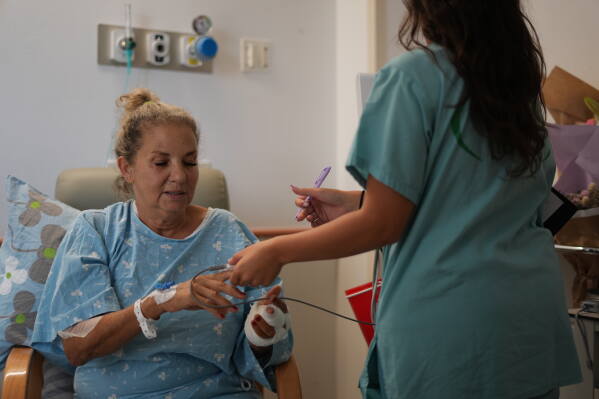
Washington Post photojournalist Heidi Levine receives treatment at Beilinson Hospital in Petah Tikva, Israel, Sunday, Oct. 18, 2026, after she was injured in an attack by Israeli settlers while covering clashes that broke out Friday during the Palestinian olive harvest in the West Bank village of Abu Falah. (AP Photo/Ariel Schalit)
License for this photo
Levine welcomes Israeli president’s call
Levine was recovering Sunday from injuries that included what appeared to be stab wounds to his buttocks, which required stitches. There is nothing new from police in this case, she said.
U.S. Ambassador Mike Huckabee, whose recent comments have condemned settler attacks on U.S. citizens but not Palestinians in general, called the attack on Levine “a despicable act of terror carried out by masked cowards” and said they should spend years in prison.
Separately, Israeli President Isaac Herzog called Levine, and Yair Golan, former general and leader of the opposition Democratic Party, visit. Netanyahu’s main rival in the elections, Gadi Eizenkot, declared on X that “a handful of criminals are burning the last shreds of legitimacy left to the State of Israel.”
Herzog was “actually very nice,” Levine said Sunday. “He’s down to earth, calling them thugs, inviting me for a personal hug. He’s ashamed of what happened: ‘These people are a stain on Israeli society.'”
She said she had not heard from Netanyahu. His outgoing government is dominated by West Bank settlers and their supporters.
Levine did, however, receive a letter signed by more than a dozen former Israeli security, intelligence and other officials, including former Defense Minister Moshe Yaalon, former Mossad Director Tamir Pardo and former Shin Bet Director Ami Ayalon.
“We are deeply ashamed that Jewish terrorists in the West Bank continue to inflict suffering on innocent Palestinians, attack those who speak out in their defense, and target those who document and expose their despicable conduct,” said the letter shared with the AP.
“Their brutality brings shame to Israel and the Jewish people. Such acts undermine Israel’s security, its regional and international standing, and the moral fabric of our society. They represent a betrayal of everything we have dedicated our lives to defending.”
The letter noted that “sadly, with encouragement from the highest levels of government,” only a fundamental change in policy can end this “shameful phenomenon.”
Levine says she plans to return to work
Levine told the AP that “I never wanted the story to be about me but about the people I tried to document” for decades. She said she sought to show how violence “is increasing, becoming more and more dangerous.”
She said the attackers – armed with bottles and slingshots – “kicked me for about 10 minutes and I was trying to hold on to my cameras and my bag.” Her helmet and protective vest, marked “PRESS,” likely spared her from more serious injuries.
But she and others openly question who will protect the Palestinians. Rights groups have said few settlers are being punished for attacks that have increased in recent years.
“It’s time you did something, Mr. Prime Minister,” Levine said.
As for herself, she plans to return to work.
“I have put decades of blood, sweat and tears into this project,” she said. “They broke my bones, but not my spirit.”
___
Associated Press writer Sam Mednick in Tel Aviv, Israel, contributed to this report.
___
This version corrects to say the attack took place on Friday.
Gn headline