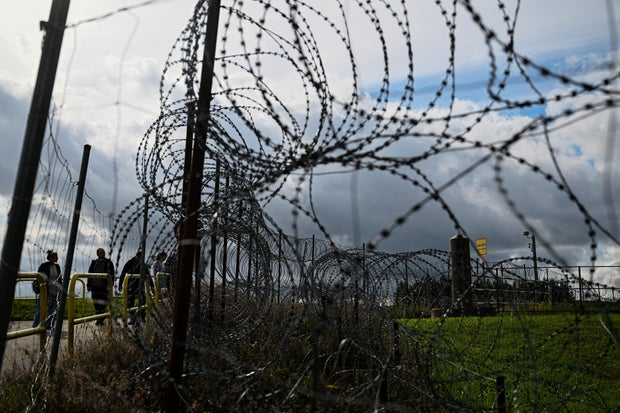
Poland launches major border operation as Russian activity fuels concerns of possible ‘serious provocation’

Berlin — Poland launched a large-scale security operation this week along its border with the Russian enclave of Kaliningrad, the country’s national police chief said, and Poland’s prime minister said the effort could have prevented a sabotage or provocation operation targeting the NATO member.
Additional police and counterterrorism units, as well as troops from the elite military special forces unit GROM, have been deployed as part of the operation, which National Police Chief Marek Boroń said will run from Monday until at least November 8.
Polish and allied intelligence agencies had warned of possible sabotage and provocation operations during the first half of November, particularly along the Polish-Kaliningrad border, including possible border incursions by armed groups.
These warnings had already put internal security agencies on alert even before the additional security forces were deployed to the northeastern regions of Warmia-Masuria and Podlaskie.
Sergei GAPON/AFP/Getty 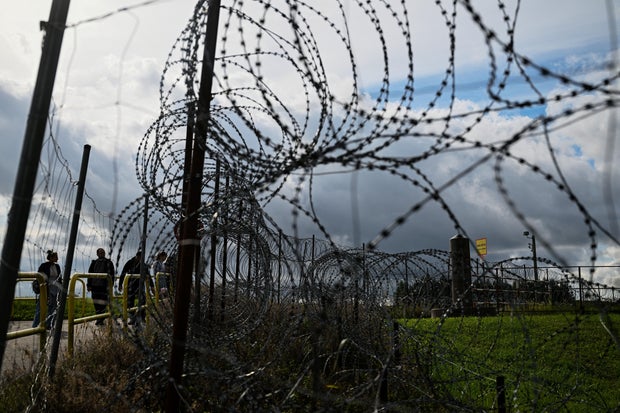
Prime Minister Donald Tusk said Tuesday that suspicious movements were observed overnight near Kaliningrad, including individuals carrying flashlights near the border area.
He said the quick response of Polish security forces could have prevented an unspecified provocation this week.
“We very quickly mobilized the necessary forces and security means on site, and we managed to prevent any attempted provocative act, if that was our intention. Of course, we will never be able to completely confirm this,” Tusk said on Tuesday, adding that intelligence had been pointing for weeks to possible “more serious acts of diversion or provocation” against the European Union, including “the intrusion of armed individuals into Polish territory.”
A special command center was established at the Polish National Police headquarters to coordinate the new security operation.
The goal is to protect the public, quickly detect suspicious activity and prevent attacks on critical infrastructure, police said Tuesday.
The Russian enclave of Kaliningrad, bordered only by NATO members Poland and Lithuania and the Baltic Sea to the west, is of considerable military and strategic importance. It is widely believed that Russian security agencies, including the FSB and GRU intelligence agencies, are present on the territory of Eastern Europe.
Peter Hermès Furian/Getty 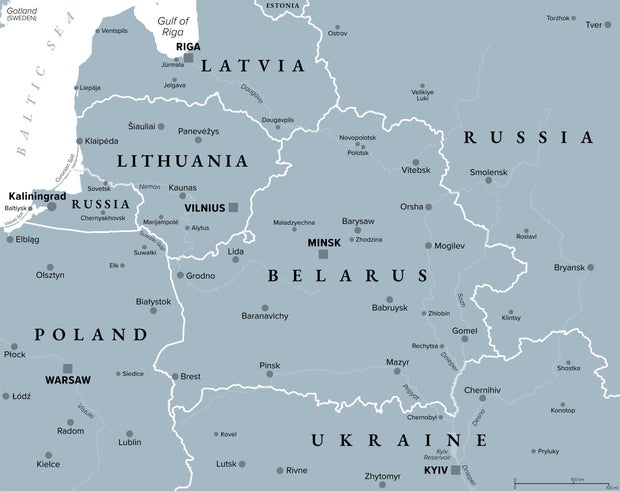
To the immediate east of Kaliningrad is the strategically important Suwałki Corridor – the only land border connecting NATO’s Baltic states to the rest of the alliance, where Poland and Lithuania share a short border sandwiched between Russian and Belarusian territories.
As of Tuesday afternoon, Polish authorities had not released any evidence of specific sabotage or attack plans originating from Kaliningrad, but the alert comes after months of sabotage, aerial incursions and other low-intensity incidents across Europe, largely blamed on Russia.
At a joint press conference with the Lithuanian prime minister on October 13, Tusk discussed a conversation he recently had with NATO Supreme Allied Commander Alexus Grynkewich and said it reinforced his own concerns about growing threats of sabotage, including possible provocations involving aircraft or attacks on border crossings.
Around the same time, the head of Britain’s domestic spy agency MI5, Sir Ken McCallum, painted a bleak picture of the security threats facing the United Kingdom and Europe, and he said that among state threats, “Russia remains the number one aggressor.”
“Russian military and intelligence services are once again escalating their attempts at hybrid warfare,” McCallum warned, adding that Moscow was “taking care to stay below NATO’s Article 5 threshold” with its actions, which would trigger the alliance’s principle of collective defense.
“It would be foolish of them to cross” that line, he said, and until now Russia had stuck to “tactics that stray — although sometimes far away — from conventional conflict.”
Among the numerous incidents attributed to Russia This year in Europe alone, there was a fire in August at a Polish factory that produces drones and other military components, as well as an arson attack on a Starlink satellite ground station that Polish authorities blamed directly on Russia in September.
Russian drones also repeatedly entered NATO airspace in Eastern Europe during World War II. war in Ukraineand just this week, the British Royal Navy announced that it had intercepted a Russian spy ship off the northern coast of Scotland.
The navy said helicopters had been sent to track the intelligence-gathering ship, which was “closely monitoring” a NATO exercise taking place near Scotland’s Outer Hebridean Islands.
Gn headline