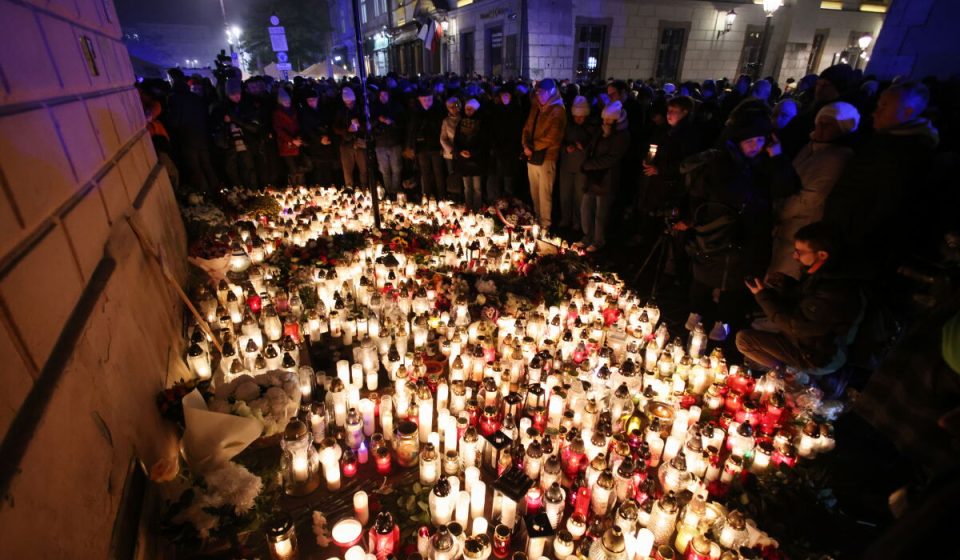
KRAKOW, Poland (AP) — People gathered in Krakow London’s main square on Monday evening for a silent march in memory of the victims of Saturday’s shooting, in which a 24-year-old Polish gunman killed six people and injured 15 others.
Shoulder to shoulder, people walked solemnly across the crowded square, some clutching flowers. They placed candles where the bullet marks were visible. Polish President Karol Nawrocki and Prime Minister Donald Tusk, also political rivals, walked side by side.
The melody of “The Sound of Silence” by Simon and Garfunkel echoed from the tower of St. Mary’s Basilica in the main square. The night after the attack, the call of St. Mary’s trumpet, a traditional five-note melody played hourly from this tower, was interrupted for the first time since World War II. A prayer was read after the song was finished.
The attackerwearing military-style clothing and a bulletproof vest, went to the main square of Krakow’s Old Town on Saturday and opened fire. The square is a major tourist destination in Poland’s second largest city. Several foreigners were among the dead and injured.
AP AUDIO: Polish shooter who killed 6 people in Krakow square dies in hospital
AP correspondent Charles de Ledesma reports that Polish police say a far-right gunman who killed six people has died in hospital.
The shooter, Michał Oksiński, died at 4:30 a.m. Monday, authorities said. He had been in critical condition since the attack and had undergone several operations.
Authorities also found the bodies of his sister, mother and father at the family home in Ostrowiec Świętokrzyski, about 150 kilometers northeast of Krakow. Authorities said they believed Oksinski killed his family, possibly while they were sleeping, before traveling to Krakow.
Authorities investigating motive
Interior Minister Marcin Kierwiński said on Saturday that Oksiński had “very radical” and “ultranationalist” views.
“First of all we’re looking to see if he was inspired by someone, if someone helped him,” Eryk Stasielak of the national prosecutor’s office in Krakow told the Associated Press.
He said authorities were still investigating the attacker’s motives and trying to access his electronic devices to get more information.
Interior Ministry spokeswoman Karolina Gałecka said authorities were examining the meaning of numerous symbols and badges sewn onto Oksiński’s clothes or found at his home.
Prosecutors said they found a yellow flag emblazoned with a black snake, known as the Gadsden flag, hanging on the attacker’s bedroom wall. The flag originated during the American Revolution and was later adopted by the American Tea Party movement.
Authorities recovered 11 weapons from Oksiński, in his car or at his home, including two AR-15 semi-automatic rifles, prosecutors said.
Both Oksiński and his father held firearms licenses. He had trained at a local shooting club, which said in a statement that he “was never trained at our club in the areas of dynamic, tactical or combat shooting.”
The world faces threats from isolated actors
Mass shootings are rare in Poland. However, by mid-October three attacks in schools in the central province of Mazovia took place within four daysleaving one dead and many injured, including children. The attackers used knives or sharp objects and some are believed to be targeting the far right.
Prime Minister Tusk said attacks on schools were fueled by the “glorification of violence” online. He said these acts could be associated with “nihilistic violence,” a term used by authorities to describe acts of violence motivated by a nihilistic worldview and misanthropy rather than specific political goals.
Oksiński’s military-style equipment and weapons were similar to those of other “far-right lone actors” who have carried out attacks across Europe and the world, said Kacper Rekawek, a senior researcher at the International Counterterrorism Center in The Hague, Netherlands.
He said that even without an explicit link between the Krakow and school attacks, they could be seen as part of a “series”.
Tomasz Safjański, a security expert, told the Rzeczpospolita newspaper that Poland had experienced its first case of an “active shooter” and that the perpetrator was Polish, although authorities remain focused almost exclusively on external threats such as Russian hybrid warfare.
“We are failing to combat the radicalization of young people,” he said. “By focusing on an external enemy, the state neglects the threat growing within our schools, our neighborhoods and online. »
Police officers described as heroes
Officers Jakub Kulik and Artur Morański were patrolling the area when they were called to intervene. Police fired the first shot within three minutes of receiving the initial report. The police chased the attacker and shot him with their service weapons while he fired a semi-automatic rifle. Kulik continued to shoot even after being shot. Both officers were seriously injured.
Tusk called them “true heroes” in an article on X. “They most likely saved the lives of many human beings, without worrying about the risk of losing their own,” he wrote.
Kulik, 24, was in critical condition, prompting authorities to issue an urgent appeal for blood donors. A fundraiser for officers and their families has so far raised more than 6 million zlotys ($1.5 million).
The mayor of Krakow announced that the two officers would be made honorary citizens of the city. Two surgeons who were nearby during the attack helped save the lives of police officers.
Talented artists among the victims
Izabela Woźna, a 53-year-old painter and mother of four, was killed in the attack. She opened an exhibition of her work in Krakow on Friday evening.
The Academy of Fine Arts in Krakow confirmed that Magdalena Oksińska, the suspect’s sister, was one of its third-year students. An employee’s sister was also shot twice.
“Nothing will be the same again. The delicate fabric of our university community has been painfully wounded,” the academy said in a statement Sunday.
“Magdalena Oksińska, 21, a queer person, was an absolutely talented painter, photographer, poet and writer,” wrote architect Pavko Krajka in a social media post alongside images of her colorful paintings.
“His death is a great loss for Krakow, Polish, European and queer culture.”
Among those killed in the square were Polish, British and Austrian citizens. Among the injured were people from Britain, Portugal, Russia, Germany and Austria.
Gn world