Poll: Voters demand change and control over Trump, fueling clear Democratic advantage in midterms

Democrats have a significant advantage in the battle for control of Congress just days before the midterm elections, a new national NBC News poll finds, with voters demanding change and expressing unprecedented disapproval of President Donald Trump.
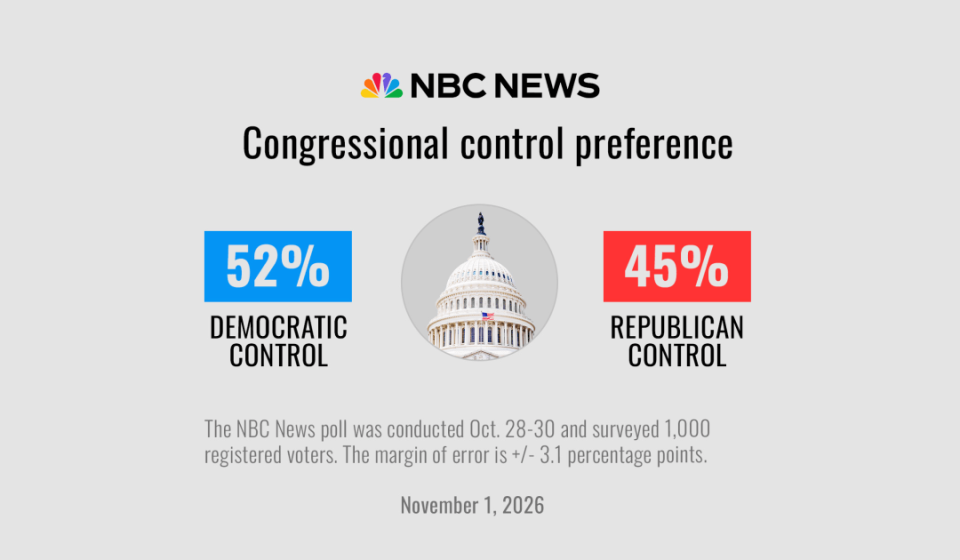
Registered voters prefer a Democratic-controlled Congress by a 7-point margin, with Democrats leading Republicans 52 to 45 percent, 2 points higher than in last month’s poll. That includes a 21-point lead among independents.
Three percent of voters remained undecided as voting unfolded Oct. 28-30, and their shifts in recent days could tip the scales in inconclusive House and Senate elections across the country. Although the overall poll suggests that Democrats are ready to capitalize on their dissatisfaction with the president and his policies, some results complicate this favorable picture.
When it comes to which party handles key issues best, voters give Republicans and Democrats roughly equal marks, and the Democratic Party remains deeply unpopular. Meanwhile, Republican voters in GOP-controlled districts and states Trump won in 2024 remain loyal to their party — which is notable because much of the battle for control of the House and Senate is taking place on this red turf.
But there are also plenty of signs of trouble for the Republican Party, with Trump at the center of a tough political environment for Republicans and their slim majorities in both houses of Congress. The president’s disapproval rating has climbed to 60 percent, a new high for his two terms in the NBC News poll, and his approval rating stands at 40 percent.
After Trump won a second term in 2024 by promising to lower prices and restore the economic conditions of his first term, about three in four voters are heading into the midterms dissatisfied with the state of the economy. Nearly two-thirds of voters are calling for a change from the direction Trump has led the country, with 50% calling for “a lot” of change, a new high according to NBC News polling data.
And for the first time in 30 years of NBC News polling, more voters say they are dissatisfied with their financial situation (51%) than satisfied (49%).
“The Trump presidency can be summed up as the promise of two years ago and the peril in two days,” said Democratic pollster Jeff Horwitt of Hart Research Associates, who conducted the survey with Republican pollster Bill McInturff of Public Opinion Strategies.
Horwitt noted that Trump returned to the White House after promising economic prosperity and peace. But today, voters are expressing widespread concerns about the economy, with prices rising during the Iran war.
Amid these concerns, 64% of voters – including a third of Trump voters – believe the president has failed to meet their expectations, and 34% believe he has lived up to their expectations. Seventy percent of voters believe the country is on the wrong track, an increase of 9 points from last year.
Voters continue to rank inflation and the cost of living as the most important issues facing the country, followed by government corruption, threats to democracy, immigration and border security.
“Democrats are in complete control of the 2026 agenda,” said McInturff, the Republican pollster, noting that only voters who think immigration is a priority issue will currently rally to his party.
Democrats have a one-point lead on which party would best control inflation, a slight decline from September but still a wake-up call for the Republican Party, which led on the issue in 2024. Republicans have a 2-point advantage on the economy, a marked decline from the party’s double-digit advantage on the issue in recent years.
Voters are also reporting that they are excited about the midterm elections, with 70% ranking themselves a “9” or “10” on a 10-point scale of interest in the election. Democrats have a 12-point advantage among the most engaged voters, while Republicans have a 2-point advantage among voters least interested in the election.
Self-described MAGA Republicans also say they are significantly more interested in elections than Republicans who don’t identify with the MAGA wing, as Trump and his party work to turn out voters who typically don’t participate in midterm elections.
This dynamic could be one reason why Republicans have relied on culture war arguments in key races, attacking Democrats on transgender issues. The new poll shows a potential limit to this strategy: Democrats have a 5-point advantage on the question of which party would be best able to handle transgender issues, despite Republican attacks.
It’s not all good news for Democrats, and the poll shows new signs that a number of voters are opposed to the Republican Party, instead of falling in love with the Democratic Party, which remains deeply unpopular.
Only 29% of voters have a positive opinion of the Democratic Party, while 38% have a positive opinion of the Republican Party. About half of voters have a negative opinion of both parties.
Yet some voters who distrust Democrats still plan to support them this year.
“Republicans have proven that they can’t be trusted. So I’d rather see the balance of power shift than maintain one party’s control,” said a poll respondent from Texas, who voted for Trump in 2024 and is supporting Democrats in Congress this year, in an expanded response.
“I don’t really trust the Republicans or the Democrats,” the man added.
Republican disappointment
Frustrations among voters like this Texas man, who supported Trump in 2024 and generally supports Republicans, are dragging down the president and GOP candidates this year.
Republicans wonder whether the country is heading in the right direction (48%) or the wrong (43%). A year ago, Republicans said the country was moving in the right direction, 75% to 24%.
Now, a majority of Republicans (53%) are dissatisfied with the state of the economy. And 37% of members of Trump’s own party say he hasn’t kept his promises.
Trump still maintains a significant hold on his base, with near-unanimous approval (93%) among Republicans who say they support the “MAGA” movement. But he has slipped considerably among Republicans who do not consider themselves part of the MAGA movement: 54% of them approve and 46% disapprove of his performance. Meanwhile, 20% of non-MAGA Republicans say they prefer to see Democrats control Congress after this election.
The president has also seen other important voting blocs drift away.
His net approval rating fell 18 points among white voters without a college degree compared to the NBC News lead. pThroughout his second term, in 2025. He also saw a significant decline among young voters and Latino voters, groups he outperformed with when he returned to the White House in 2024.
One of the Republicans’ big advantages in 2026 is a favorable political map: Democrats must win back districts and states won by Trump in 2024 to take back Congress. In the Senate, they need to win at least two states that Trump won by double-digit margins.
But the president’s approval rating is undervalued in the states he won in 2024: 53% of registered voters disapprove of his job performance, while 47% approve. As of March 2025, his approval rating in these states was 10 points higher.
Democratic warning signs
There are some warning signs for Democrats, beyond the fact that a smaller share of voters have a positive view of the Democratic Party compared to the Republican Party.
The fight for control of the House and especially the Senate will be in areas won by Trump, and Republicans are leading congressional elections in GOP-controlled districts and in states won by Trump in 2024. The big question is whether that is enough to resist changes in some key places.
Government corruption has been a central theme of Democrats’ messaging this year, but voters trust Republicans by 5 points to better handle the problem. Even so, Democrats lead the congressional poll among the 28 percent of voters who don’t trust either party on the issue.
Republican leaders in Congress are also slightly better off than their Democratic counterparts, but that’s mostly because voters don’t know what to make of them.
Republican House Speaker Mike Johnson, R-La., has the highest positive rating among congressional leaders: 24% have a positive opinion of him and 34% have a negative opinion. Just 10% of voters have a positive view of Johnson’s counterpart on Capitol Hill, Senate Majority Leader John Thune, while 22% have a negative view of him.
The Democratic leader in the House of Representatives, Hakeem Jeffries, is viewed positively by 18% of voters and negatively by 35%. Far better defined is Senate Minority Leader Chuck Schumer, who led Democrats in the body for nearly a decade — to his detriment. Only 13% of voters see it positively and 53% see it negatively.
“It’s not great for the Democrats … “But I don’t see that as an obstacle to their performance in 2026, when the midterm elections are about Trump and these economic numbers.”
Half of voters have a negative view of tech billionaire Elon Musk, who has become one of the nation’s most prolific Republican donors over the past two years, while 34% view him positively.
Voters are more divided around two leading progressives, Sen. Bernie Sanders and Rep. Alexandria Ocasio-Cortez. Sanders is more popular: 41% see him positively and 42% see him negatively, while the numbers for Ocasio-Cortez are between 31% and 42%.
Despite these factors, Democrats hold a significant lead in the battle for Congress. But throughout the poll, it appears the party’s lead is strongly supported by anti-Republican sentiment and not warm feelings toward Democrats.
Voters who want Democratic control of Congress are divided between their vote being more in favor of the Democrats or one motivated more by opposition to the Republicans.
“Get your act together, Democrats,” one Ohio Democratic woman said when asked what message she wanted to send with her vote this year. “I’m voting for you, but make it right.”
The NBC News poll surveyed 1,000 registered voters Oct. 28-30 via a combination of telephone interviews and an online survey sent via text message. The margin of error is plus or minus 3.1 percentage points.
Gn headline