
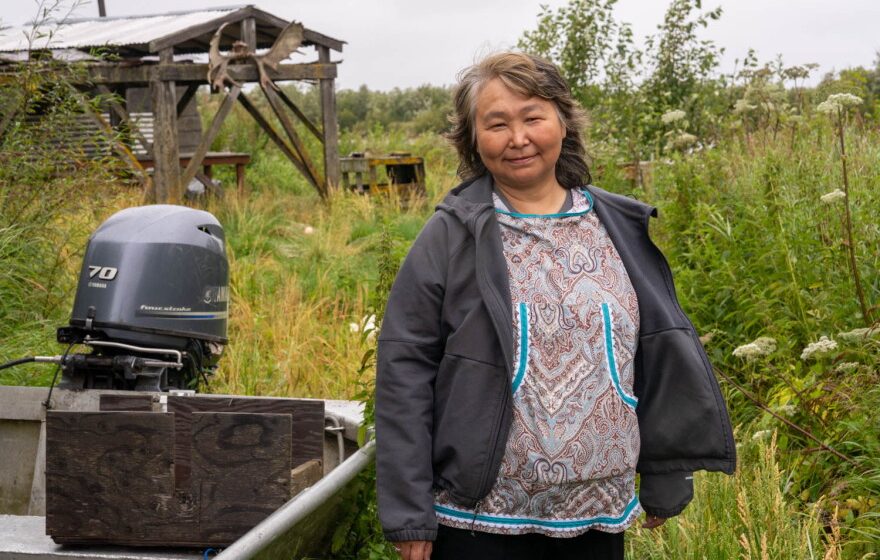

THE KUSKOKWIM RIVER — The Evon Waska fishing camp was too quiet this summer.
“Well, this is my smokehouse,” he says, opening the door to the waterfront plywood structure in Bethel, where, he says, his parents settled when they abandoned their nomadic lifestyle.
It sits next to empty salmon drying racks and fish cutting tables that have seen too few fish for many years in a row.
A few smoked king fillets still hang. Waska caught around 40 at the start of the summer. It was a relief. In some years, subsistence fishermen on the Kuskokwim River were not allowed to harvest them, and the situation is worse in the Yukon. But Waska said he only got half of what his household needed.
His fish traps should now be full of silver salmon. But the return on silver was too low to fish. So instead of harvesting more salmon in late August, his family was already drawing on what they had prepared for the winter.
Waska, like many people along the Kuskokwim River, says the problem is in the Bering Sea, with the trawler fleet. Trawlers pursue pollock, but they are allowed to waste thousands of king and chum salmon, some bound for western Alaska rivers like the Kuskokwim.
“They don’t close the trawlers,” Waska said. “They shut me and my people down first.”
Waska faces a giant. Trawlers in federal waters of the Bering Sea and Gulf of Alaska catch nearly 3 billion pounds of Alaska pollock, the nation’s largest fishery by volume. They can tow nets as wide at the mouth as a football field and a quarter of a mile long.
Subsistence fishermen aren’t the only ones upset about bycatch: other species caught by these nets. Sport, charter and commercial fishermen are also in turmoil and demanding change. In Alaska’s tight U.S. Senate race, bycatch has become a flashpoint, and the race could hinge on which candidate — Sen. Dan Sullivan or challenger Mary Peltola — is seen as more willing and able to rein in the trawlers.
Trawlers say they are not responsible for salmon declines in western Alaska. They point to scientific evidence a heatwave has decimated the Yukon kings and that much of the salmon trawler catch doesn’t even come from western Alaska.
And they say their bycatch rate – relative to the huge pollock catch – is tiny.
Waska has heard these arguments. But last year, trawlers’ bycatch included nearly 13,000 king salmon from western Alaska rivers. Waste exasperates him. Salmon are at the center of Yup’ik communities and Waska believes their way of life is on the brink.
“Remember they hunted the whales to extinction,” he said, “the buffalo and the sacred cow, this is the 21st century and they are going to let that happen.”
Silver salmon are not caught in large numbers in trawls. Yet Waska blames trawlers more generally, for the damage to the seabed and for removing masses of fish from the ecosystem year after year.
The Senate race
Bycatch has been Peltola’s signature issue since his first statewide campaign. In 2021, she spoke out against the pollock trawling industry during a congressional hearing. She said people on the western Alaska rivers weren’t able to catch a king or chum that year to feed their families.
“There really are double standards here,” she testified, “when this year alone the industry caught 12,000 chinook salmon and over 500,000 chum salmon as bycatch. »
She was elected to Congress the following year. She filed two anti-bycatch bills in 2024. They have not moved forward.
She is now calling for a ban on “Lower 48 factory trawlers,” the large catch processors, almost all of which are based in the Seattle area.
Until recently, Sullivan was a favorite of the pollock industry, raking in $300,000 in political contributions. He began publicly speaking out against bycatch late last year. In June, Sullivan introduced a bycatch reduction bill. He spoke about it when it was passed by a Senate committee in September.
“We view it as a general toolbox of measures to reduce bycatch and impacts on seabed habitat, while increasing transparency,” he said.
In a sign of just how central bycatch has become — and how quickly — Sullivan said the word “bycatch” more than two dozen times during this year’s Kodiak fishing debate.
During his previous fishing debate in Kodiak, in 2020, he didn’t say the word at all.
Calls to end trawl bycatch are coming from across the state. But the spiritual heart of the anti-trawling movement is the Yukon-Kuskokwim region.
Kwethluk
Above Bethel, empty fishing camps tell a story of loss.
In Kwethluk, which has 900 residents and few paying jobs, the lack of salmon poses an existential threat.

Gabby Hiest and Salgado
/
KYUK
Tribal Chairwoman Mary Nicolai said there were once 60 active fishing camps around here. A wave of sadness hit her as she walked into a cold smokehouse that seemed to have sat unused all summer.
“Most smokehouses are like that,” she says. “It’s like a slow trend of closing down our workforce.”
His brother-in-law, retired Orthodox priest Martin Nicolai, said that when he was a child in the 1950s and 1960s, children spent all summer at the fishing camp.
“Now our children don’t see it anymore,” he said. “They hardly spend any time in the fishing camps. They barely know how to cut a fish.”
The fishing camp is where skills are taught and values are passed from one generation to the next. Without fish, he fears the chain will be broken.
“For us, it’s our culture. It’s our life. For them,” he said, speaking of the pollock industry, “it’s money. And we don’t think that’s fair.”
He said he hopes the tight Senate race will shine a light on the injustice of bycatch. He wants the world to be aware of the threat they face.

Gabby Hiestand Salgado
/
KYUK
Following: The pollock industry believes it has the facts on its side – if only Alaskans would listen.
Gn headline