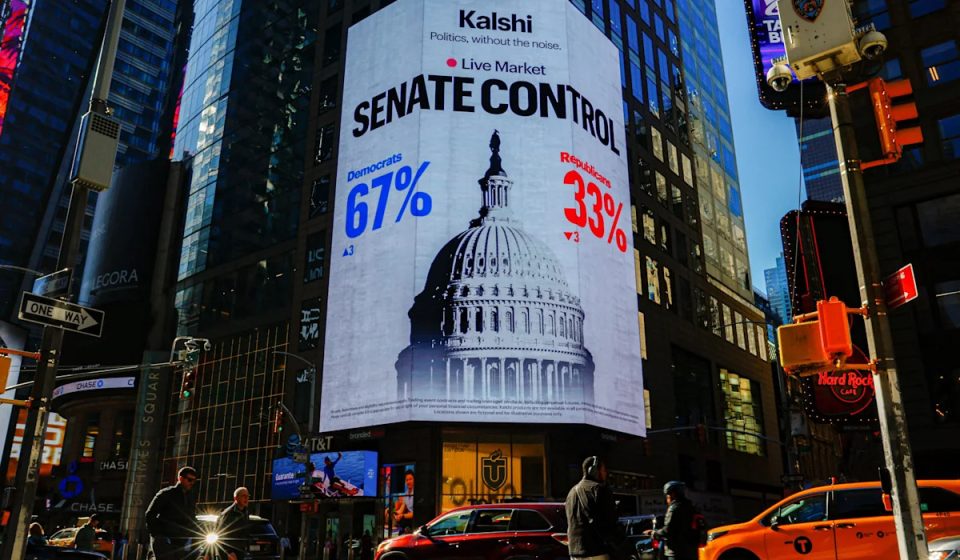

Prediction markets and pollsters both say Democrats are favored to win both the House of Representatives and the U.S. Senate in the midterms. Prediction markets are a little less certain about that, although traders’ odds jumped Tuesday on the odds that Democrats will take control of the Senate.
This opens what could be a new chapter in the burgeoning rivalry between prediction markets and polls following the closely watched 2024 results.
The differences were most evident in the Upper House. A small but consistent gap has been evident for months in the chances of Democrats taking control of the Senate. The gap has averaged about 7.3 percentage points since September 1, according to a Yahoo Finance analysis.
But the gap narrowed as Election Day approached, closing in on 2.9 percentage points as of Tuesday morning. Three prediction markets estimate Democrats taking control at 77.3%, while two polling-based models estimate those chances a bit higher at 80.2%.
The odds are a little more even in the House of Representatives, with an average gap of less than a percentage point in recent months.
The latest reading on Tuesday showed a gap of 2.2 percentage points, with predictive markets suggesting a 94% chance that Democrats would flip the House, compared to 96.2% according to polls.

This analysis was performed by averaging daily odds from three major prediction markets, Kalshi, Polymarket and PredictIt, to create a continuous prediction market metric. These values were then compared to the average of two main survey-based models: one by statistician Nate Silver and another from Harvard called ElectIt.
These gaps have had an outsized effect on public perception in recent years.
This was especially true in 2024, when a 10 percentage point difference between the prediction markets and the polls led to some post-election analyzes claiming that the prediction markets had gotten them right and the polls had them wrong.
The stakes for companies in the prediction market are high. Kalshi and Polymarket have long argued that their markets are more truthful than polls because market participants have money on the line. The markets also experienced a high-profile failure recently when the winner of the Brazilian presidential election had only 20% odds before ultimately winning.
This increased scrutiny also comes as these markets continue to grow rapidly. Kalshi shared new data this weekend that more than $1.2 billion has now been traded on the mid-term markets, surpassing the volume on the platform during the 2024 presidential election.
Gn usa