Preparedness has arrived in Europe, and it is government advice, not just online doom and gloom, that is driving this trend.

European governments are increasingly urging citizens to prepare to live up to 72 hours without access to food, water, electricity or communications.
France, the UK, Ireland and the Netherlands have all launched campaigns encouraging households to take steps to prepare for events caused by extreme weather or cyberattacks that could disrupt digital networks or critical supply chains.
Last month, major French supermarket chains were hit by a cyberattack that sent the temperatures of thousands of refrigerators and freezers soaring, wasting tens of thousands of kilos of food and stoking concerns about food safety.
French officials later accused a cyber unit of Iran’s powerful Islamic Revolutionary Guard Corps was behind this attack, which was mirrored a few weeks later by a nearly identical cyberattack targeting grocery stores in several other European countries. Belgian authorities also blamed Iran for this.
Last summer, Europe was also hit by a record continent-wide heatwave, triggering wildfires and severe droughts, even in areas like northern England, where excessive, sustained heat and lack of precipitation have long been rare exceptions, not the rule.
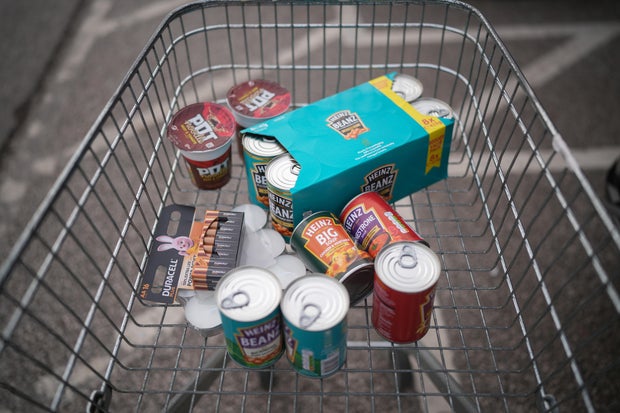
European governments have recommended that citizens purchase and stockpile emergency supplies, including bottled water and canned foods, to last up to three days, as well as AM/FM radios and sleeping bags.
Christophe Furlong/Getty 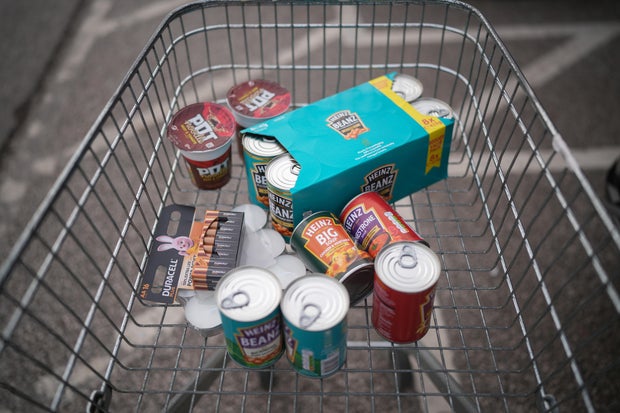
CBS News spoke to residents and tourists on the streets of London to see who, if anyone, was taking this advice to heart.
At the Outdoor Emporium in north London, owner Mehmet Ahmet told CBS News the British government’s campaign had been good for business.
“There is a 100% increase,” he said, noting in particular an increase in sales of flashlights and gas stoves.
According to a report cited by Getty, compiled by retail research firm Worldpanel by Numerator, sales of bottled water soared 67% in the UK following the government’s launch of its ‘Be Prepared’ campaign in late October, while sales of canned and potted foods rose 37%.
But on Oxford Street, the epicenter of central London’s shopping district, some residents simply shrugged their shoulders when asked if they were preparation.
“I think it’s ridiculous. It’s not going to happen,” said Ryan, a south London resident. “What is it about?” If that happens, I’m going to panic.
Other Europeans visiting London said they were taking a more measured approach.
“It’s not a big effort. It’s a small risk, but if something actually happens, the impact is big,” said a Dutchman who declined to give his name but said he was preparing.
In the light of recent Microsoft outage and FAA times grounding of all commercial flights in the United States earlier this month, analysts said The American wholesaler Costco saw its sales increase.
“Consumer anxiety following the Microsoft Outlook outage, the grounding of all U.S. airline flights, and the apocalyptic worries that erupted on social media all contributed to the surge in emergency preparedness sales at Costco,” wrote David Bellinger, an analyst at Mizuho.
In London, a woman visiting from Chicago told CBS News she would stock up as soon as she got home.
“I just decided to start now. We’ve been hit by tornadoes, which have never hit Chicago,” she noted. “People were without power for 7 to 10 days in the summer.”
Gn world