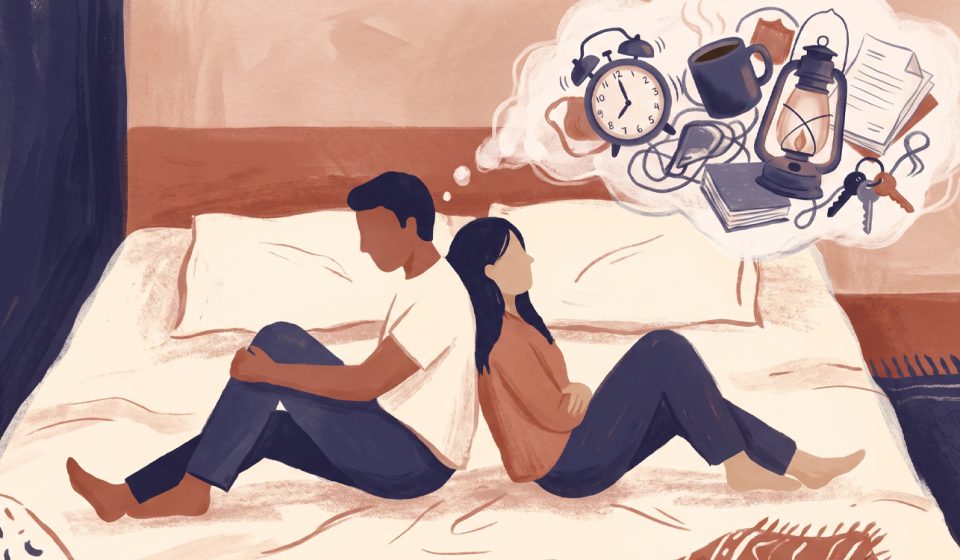
If you’ve ever lay awake wondering why your libido seems to have disappeared for weeks, you know how quickly that silence can turn into self-doubt. You begin to do a silent audit in your head. Is something wrong? Shouldn’t you want this more often?
What tends to sting most about these moments isn’t just the lack of the spark you felt before. Often the heavier part is a quieter fear directed at someone else: the nagging worry about not satisfying your partner.
It seems like a lonely problem, partly because few people talk about it over coffee. Yet this private discomfort turns out to be remarkably common – and it rarely stays cleanly inside the bedroom. Everyday mental health, deep exhaustion, and the quiet pressures of partnership drive how people judge their own desire.
Why worry arises in your relationship
This picture emerges clearly from research published in the Journal of Sex & Marital Therapy by Caroline F. Pukall, a psychology professor at Queen’s University in Kingston, Ontario, and colleagues. To move beyond purely clinical cases and see how ordinary people experience desire in everyday life, the team conducted an online survey combining multiple-choice questions with open-ended prompts where respondents could explain their thoughts in their own words.
Free daily newsletter
Don’t miss the next big discovery in psychology
Every morning, PsyPost sends a short briefing on the most interesting new peer-reviewed research in psychology and neuroscience.
Of the adults surveyed, 57.1% said they had worried about their libido. Most worried that their desire was too low, and among the worried group, 42.4 percent highlighted a mismatch between their own appetite and that of their partner.
When people experiencing low desire were asked what troubled them most, the top answer wasn’t personal frustration, but feeling like they were letting down a partner, while missing how sexual they once felt. “We were also struck by how often people’s concerns were focused not only on themselves, but also on how their desire was affecting their relationships, particularly on satisfying a partner or managing differences in desire,” Pukall told PsyPost.
In their written responses, some respondents described how a decline in desire eroded their confidence, leaving them unworthy of a partner. A few even admitted to fearing feeling pressured into unwanted sex just to make their partner happy.
What’s Really Behind an Off-Color Mood?
It’s easy to treat desire as a standalone switch that either works or doesn’t. Yet when respondents explained why their libido was low, 44.3 percent pointed to mental health issues, as well as body dissatisfaction, medication side effects, and the burden of stress, chronic exhaustion, and parenting.
“Another notable finding was the extent to which participants associated low libido with mental health, stress, exhaustion and parenting, highlighting how sexual well-being is linked to overall well-being,” Pukall said.
If you’re curious about how these trends change across groups, PsyPost’s full coverage of the study details the full range of findings, including how concerns differ by gender, sexual orientation, and relationship length, as well as Pukall’s broader thoughts on the original interview.
Putting quiet doubt in context
The study contributes to scientific understanding of how adults perceive and worry about their sexual desire. However, participants were recruited through the social media accounts of the science podcast Science Vs, and the group focused on young adults and people already in committed relationships, so the patterns may not look identical across all populations. You can explore the full demographic makeup of the sample and survey design in PsyPost’s detailed report.
Even with these caveats, the results offer a calmer view of a very familiar anxiety. Desire naturally rises and falls with the rest of life – whether it’s a difficult time for your mental health, the exhaustion of parenting, or simply navigating a long-term partnership.
When your mood disappears for a while, the worry that follows does not prove that you are an exception. For most adults surveyed, wondering if your desire is “normal” is simply part of the experience.
Gn Health