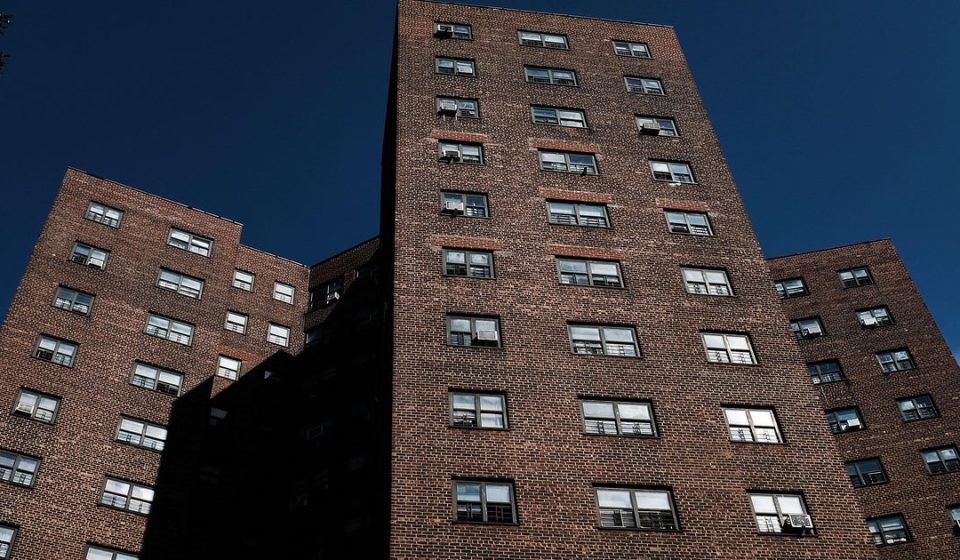
Public housing residents must prove their immigration status under new HUD rule, which could result in thousands being displaced.

Residents of federally funded public housing will be required to show proof of U.S. citizenship or eligible immigration status, under a new rule released Thursday by the U.S. Department of Housing and Urban Development.
The measure could displace nearly 80,000 people, including tens of thousands of citizens from mixed-status families, from their homes, according to the Center for Budget and Policy Priorities, a nonpartisan research and policy institute.
Since 1995, mixed-status families have been allowed to live together in HUD-funded housing provided that federal subsidies cover only eligible household members. The new rule could force these families to decide whether they want to stay together in non-public housing or split their households.
“It tears families apart and sows division,” said Marie Claire Tran-Leung, director of the Eviction Initiative Project and managing attorney for the National Housing Law Project.
The rule’s previous status, which allowed mixed-status families to live together, worked well for all parties, Tran-Leung said. Mixed-status households often paid a higher share of rent because their subsidies were prorated, experts say. If these families are forced out of public housing, HUD will likely face financial hardship, Tran-Leung said.
About 20,000 mixed-status families, or 80,000 people, could be affected by this rule, according to CBPP data. About 37,000 of them are children, most of them U.S. citizens, the CBPP said.
The rule is expected to take effect on December 14.
“President Trump warned that the days of illegal aliens and ineligible noncitizens exploiting government-funded social programs would be over,” HUD Secretary Scott Turner said in a statement. “It is unacceptable that homeless veterans, the disabled, the elderly and victims of domestic violence languish on waiting lists while illegal immigrants and ineligible individuals scam our system. American taxpayers will no longer foot the bill. Promises made, promises kept.”
Turner’s statement said a recent audit identified nearly 200,000 tenants with incomplete or unverified eligibility status. Currently, HUD-funded housing serves only a quarter of eligible households in need.
Families in all 50 states will be affected, with the greatest concentration in New York, California and Texas. The rule would affect more than 7,000 mixed-status households in California and 2,500 mixed-status households in New York, according to a coalition of 22 state attorneys general opposed to the rule.
They wrote in an April letter that it would “inflict significant economic costs on states and exacerbate the affordable housing crisis.”
CBS News reached out to housing authorities in California, New York and Texas to find out how the rule would be implemented and enforced locally.
During the first Trump administration in 2019, HUD attempted to revise the long-standing provision, but the proposed change was withdrawn in 2021. In February 2026, the agency reintroduced the proposed rule, drawing more than 11,000 public comments from individuals, advocacy groups, and members of Congress during the three-month comment period.
Reactions also came from some members of the public.
Claire Stanley, a senior living in public housing in Auburn, Washington, wrote: “There is no justification for this rule: it will not save money, because increasing the number of homeless people will cost more than simply allowing families to stay together.” »
Another commenter, Mark Smith of Oconto Falls, Wisconsin, urged in March: “Please withdraw the proposal and think about what Jesus would do.” »
Gn usa