Cohorts
Recruitment
Blood samples were collected from 2,339 consenting individuals from two Australian biomedical research cohorts: the Tasmanian Ophthalmic Biobank (TOB) (ethical protocol 2020/ETH02479) and the BioHEART study cohort (ethical protocol 2019/ETH08376).
The TOB cohort consisted of 983 individuals (562 women, 421 men) recruited between January and February 2018 from the Royal Hobart Hospital and the Menzies Institute of Medical Research in Tasmania, Australia. Selection criteria for inclusion in the cohort were as follows: (1) age 18 years and older, (2) no evidence of ocular disease, and (3) self-reported British, Scottish, or Irish ancestry.
The BioHEART63 The cohort included 1,356 individuals (561 women and 795 men) recruited between March 29, 2016 and May 2, 2023, presenting to study sites for clinically indicated cardiovascular imaging or ST-segment elevation myocardial infarction. The selection criteria for inclusion in the cohort were as follows: (1) age 18 years and older and (2) with cardiac disorders (or for investigation of suspected cardiac disorders) including: acute myocardial infarction, suspected coronary artery disease, patients undergoing cardiothoracic or vascular surgery, or plastic surgery involving resection of vascularized tissue.
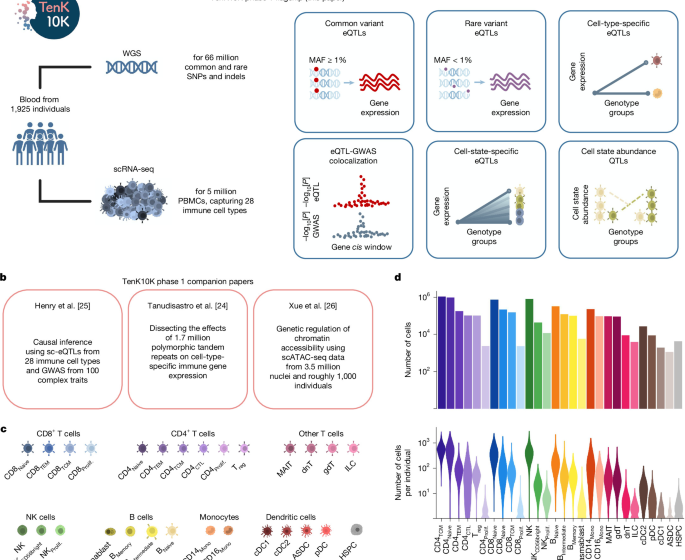
After quality control of donors, variants, and cells, including selection of individuals of European ancestry only, 1,925 individuals remained: 950 from TOB and 975 from BioHEART (Supplementary Fig. 1).
Ethics monitoring
This study complied with all relevant ethical regulations and was overseen by the Human Research Ethics Committees of the Royal Children’s Hospital (Melbourne, Australia), Northern Sydney Local Health District (Sydney, Australia), St. Vincent’s Hospital (Sydney, Australia) and the University of Tasmania (Hobart, Australia). Informed consent was obtained from all participants.
Blood collection and DNA extraction
For the TOB16 cohort, blood samples were collected from each participant and stored in 1 8 ml heparin cell preparation tube and 1 9 ml EDTA tube. For the BioHEART cohort, aliquots were stored at -80°C.
DNA extraction from BioHEART buffy coat samples was carried out by the Australian Genome Research Facility using the QIAamp96 DNA QIAcube HT kit. DNA extraction from TOB samples was carried out at the Menzies Institute of Medical Research (University of Tasmania) using the QIAmp Blood Mini kit. For a subset of TOB samples that failed initial quality checks during sequencing, DNA was extracted from PBMCs a second time using the Qiagen DNeasy Blood and Tissue kit and eluted in AE buffer by Garvan Molecular Genetics Laboratory Service. DNA concentration was measured for all samples by fluorometric quantification with Promega Quantifluor prior to sequencing.
WGS data
WGS data were generated for all individuals in the TOB cohort (n= 983) and BioHEART (n= 1,356).
Library preparation for sequencing and WGS
Sequencing library preparation was carried out using the KAPA PCR-free kit v.2.1 (Roche) for TOB samples and the DNA PCR-free kit (Illumina) for BioHEART samples. Short-read WGS was performed using 2 × 150 bp Illumina chemistry on the NovaSeq 6000 instrument to achieve an average coverage of 30 ×. Library preparation and sequencing were carried out by the Garvan sequencing platform.
Alignment and variant calling
Alignment and variant calling were performed according to GATK-DRAGEN best practices. Reads were aligned from FASTQ (BioHEART) or CRAM (TOB) to the GRCh38 reference genome (masked version, available at https://gatk.broadinstitute.org/hc/en-us/articles/360035890811-Resource-bundle) using a fork of DRAGMAP v.1.3.1 (https://github.com/populationgenomics/DRAGMAP). When aligning from CRAMs, bazam (https://github.com/ssadedin/bazam) was used to first convert the reads back to FASTQ format. SNP and indel calling was then performed using GATK4 HaplotypeCaller in DRAGEN mode. The resulting gVCF files were combined using Hail’s VDS combiner and stored in VDS (variant dataset) format.
Sample quality control
Filtering of hard samples was applied to eliminate individuals presenting: high contamination rates (FREEMIX ≥ 5%); an increased percentage of chimeras (PCT_CHIMERAS ≥ 6.3%); median insert size less than 250 bp and sexual aneuploidy or discordance between reported and observed sex. The dataset was also inspected for outlier samples based on the number of singletons, heterozygous/homozygous variant ratio, transition/transversion ratio, and insertion/deletion ratio, taking care not to exclude ancestry outliers based on these measures.
A set of high-quality sites, defined as an LD-pruned subset of autosomal, biallelic allele frequency greater than 0.01, call rate greater than 99%, and inbreeding coefficient greater than −0.25, were extracted from 1,000 genomes and the Human Genome Diversity Project. Samples with a call rate below 0.85 at these sites were also excluded.
After rigorous filtering of samples, related individuals were identified using Hail’s implementation of PC-Relate and confirmed using Somalier Relation v.0.2.15 (https://github.com/brentp/somalier). For family sets consisting of second-degree or closer relatives, as defined by a relatedness coefficient greater than 0.088, the sample containing the highest quality scRNA-seq data was retained, as determined by cell number and cell type composition. When single-cell data of equal quality were available, the sample with the average genome sequencing depth on chromosome 20 was retained.
Ancestry inference was then performed on the set of unrelated high-quality samples, combining this set with background samples from 1000 Genomes and the Human Genome Diversity Project, then calculating principal components using gnomAD’s run_pca_with_rateds method and the same set of high-quality sites defined for the call rate estimation above. Ancestry labels were assigned based on genetic similarity, identified by principal component analysis, to those of known ancestry in the core datasets. For association tests, only samples assigned to the European cluster were retained (Supplementary Fig. 39).
Quality control of variants
Allele-specific variant quality score recalibration or AS-VQSR (GATK v.4.2.6.1) was performed using all quality controls, unrelated samples (irrespective of ancestry), using default training resources and priorities. For SNPs, these are hapmap (forward, 15), omni (forward, 12), 1000 G (forward, 10), and dbsnp (forward, 7). For indels, these are mills (forward, 12), axiomPoly (forward, 10), and dbsnp (forward, 2). The following features have been included for all SNPs and indels: AS_ReadPosRankSum, AS_MQRankSum, AS_QD, AS_FS, AS_SOR. AS_MQ was used only for SNPs. All sites failing the site-level filter calculated by AS-VQSR were removed.
Within the European-only association call set, we then removed all variants that did not have high-quality genotype calls (defined as genotype quality (GQ) ≥ 20, depth of coverage (DP) ≥ 10, and allele balance greater than 0.2 for heterozygotes) or with an excess of heterozygotes at that site compared to Hardy’s expectations – Weinberg (InbreedingCoeff <-0.3). A final filter to remove sites with missing values greater than 15% was then applied before association testing.
scRNA-seq data
scRNA-seq data were collected from PBMCs from samples from TOB individuals (OneK1K16; n= 1,036) and BioHEART63 (n= 1,012) cohorts. Supplementary Figure 40 illustrates the experimental workflow and key steps.
Sample pooling and cell number estimation
The TOB samples had already been pooled during the preparation of the OneK1K project, with pools consisting of 1,214 individuals.16. To capture more cells per individual (aiming for up to 5,000 cells per individual), two pools (n= 24 to 28) both were pooled (weighted by cell viability) and loaded into three sequencing lanes (targeting 40,000 cells each, or 120,000 total). Additionally, “maxi pools” of four combined pools (96 to 112 individuals) were sequenced in two separate lanes to compensate for possible low cell numbers.
In contrast, BioHEART samples were pooled (weighted based on cell viability) for this project; each group included 8 individuals and was sequenced in a separate sequencing lane. We aim to include 40,000 cells (approximately 5,000 cells per individual) per pool. In some cases, pools with low cell viability were re-sequenced to recover cell numbers and get closer to the target.
Capture and sequencing
Cells were captured using the 10X 3′ High-Throughput Single-Cell Gene Expression Kit (3′ GEX HT) v.3.1 on a Chromium Long-term cryopreservation of these samples led to a lower proportion of monocytes in the TOB cohort compared to BioHEART (Supplementary Note 1). Library preparation and short-read sequencing were performed using the Illumina NovaSeq 6000 machine.
Alignment
scRNA-seq reads were aligned to a genome reference (GRCh38, Gencode release 44, Ensembl 110) using STAR64as implemented in 10X’s CellRanger software (v.7.2.0) which also estimates the number of captured cells (Supplementary Fig. 41). CellBender65 (v.0.3.0) the estimated number of cells differed significantly from that estimated by CellRanger, leading us to reject these results (Supplementary Note 2).
Demultiplexing and doublet detection
To assign cells to their original donor, as well as to remove doublets (droplets containing more than one cell), we used Demuxafy66 (v.2.1.0), a tool to run a number of demultiplexing and double detection software and generate a consensus call for each individual cell. Using Demuxafy we ran vireo67 to demultiplex cells back to their original donor within each sequencing library, using genotypes extracted from SNP array data (available as part of the OneK1K data; for TOB) or using common biallelic SNPs (MAF 5%) from WGS (for…
Gn Health