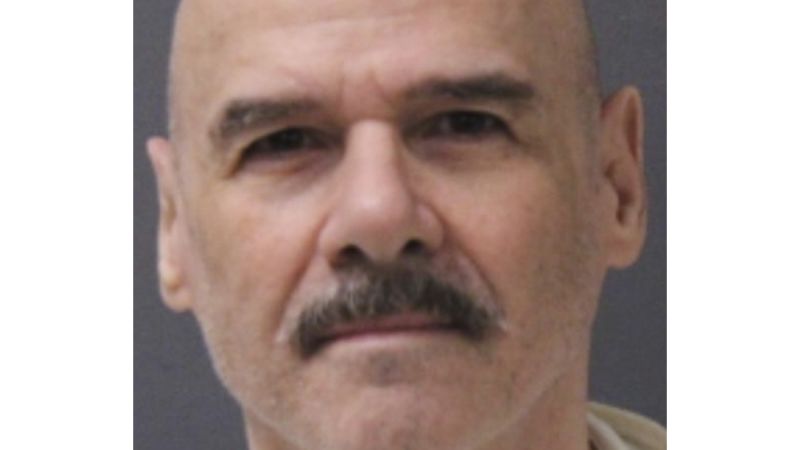
Reinaldo Dennes’ execution lasted more than an hour as staff struggled to find the vein

Huntsville, TX
Texas executed Reinaldo Dennes on Thursday in a procedure that lasted more than an hour as prison staff struggled to find a suitable vein for the two intravenous needles carrying the lethal dose of the sedative pentobarbital.
And once it started, he groaned several times from the pain, groaned several times and asked God to take him away from the pain. Prison officials said all procedures were followed appropriately.
The execution follows renewed scrutiny of capital punishment in the United States following the failed execution in Tennessee in September of Christa Pike, who survived two doses of pentobarbital that her lawyers say likely did not enter her bloodstream properly and instead pooled in her arms, leaving them burned and blistered.
Dennes, who was convicted of capital murder in the death of Janos Szucs, a diamond merchant found shot multiple times in his Houston office in January 1996, was the second person put to death in the country that day, after Florida carried out the record 20th execution of the year of Thomas Mitchell Overton.
Dennes issued a brief statement in which he said he wanted those close to him to know that he had been blessed over the past 30 years “by knowing the love of the father.” Then he said to the director: “Come on, director! »
Almost immediately, he exclaimed, “Pain! Go! Go!” He uttered a curse and implored “the father” to “bear this pain.” “Let me go, father,” he said again and again. “Let me go. …I’m here. I’ve been your son all these years.”
Then he shouted, “My right leg is killing me!” » and described it as a cramp. After another profanity, he growled, then said, “I don’t think this is right. Take me, father. Don’t let me suffer like this. Come on.”
After three loud moans, Dennes began snoring – eight of them – which gradually subsided before one final loud snore. Then he began to breathe slowly, about a dozen breaths, also gradually becoming less pronounced.
The procedure ended at 7:07 p.m., 63 minutes after he was strapped to the stretcher. A minute later, after being examined by a doctor, Dennes was pronounced dead at 7:08 p.m. at Huntsville Penitentiary.
Prison officials said all procedures were followed appropriately. Spokeswoman Amanda Hernandez acknowledged a number of failed attempts to find a suitable vein before the execution team managed to insert the needles into Dennes’ left foot and the left side of his neck.
She doesn’t know how many attempts failed, but said the sites ultimately used complied with state procedures.
Hernandez also suggested that Dennes may have exaggerated the pain, saying he began complaining before the drugs started flowing and also of pain in places where there was no IV.
Asked if he was faking, she said, “I think so, there were allegations. … There was nothing out of the ordinary on our part.”
“This isn’t the first time we’ve had to insert IVs in other places. It’s also not the first time an inmate has immediately made allegations of pain,” Hernandez said.
Witness Janice Copeland’s husband, David, was a security guard shot during the robbery. He survived his injuries and died five years ago.
“David always thought Reinaldo would outlive him. Unfortunately, he was right,” she said Thursday. “Finally, after 30 years, justice has been served.”
Earlier in the day, Florida carried out the execution of Overton, 71, convicted of killing a pregnant woman and her husband, Susan and Michael MacIvor, during a home invasion.
Overton was pronounced dead at 6:19 p.m. from a three-drug injection at Florida State Prison. In a final statement, he denied breaking into the couple’s home and attacking them, saying: “I never killed anyone.”
Florida has now carried out more than half of the nation’s 39 executions so far this year under Republican Gov. Ron DeSantis, who has made aggressive use of the death penalty like few other governors.
DeSantis, who leaves office in January, said he wants justice for families who have waited decades for death sentences to be carried out. He signed the death warrants that led to a record 19 executions in 2025, the most in a single year in Florida since the death penalty was reinstated in 1976. After a record Thursday, Florida plans two more executions in December.
Texas set a record for executions in this country, with 40 people put to death in 2000.
The executions of two men in their 70s have once again highlighted the aging population on death row in the United States.
Florida husband and wife strangled
In Florida, Overton was strapped to a gurney with an IV in his arm when the death chamber curtain rose at 6 p.m.
“I never sexually assaulted anyone. I never killed anyone,” Overton said, denying ever being in the MacIvor home or gated community. “I didn’t kill the MacIvors.”
The injection began immediately afterwards with Overton panting and breathing heavily before all movement ceased. A guard then shook Overton and shouted his name without response before a doctor pronounced the inmate dead.
The MacIvors’ bodies were found in their Tavernier, Fla., home on Aug. 22, 1991, according to court records. Autopsies revealed that they had been strangled and that Susan MacIvor, who was eight months pregnant, had been raped. The medical examiner said her unborn male child likely survived about a half hour after her death.
Investigators collected DNA evidence but found no matches to the state database. But when Overton, who worked at a gas station near the MacIvors’ home, was arrested on an unrelated burglary charge in 1996, his DNA sample matched that from the MacIvors’ home.
Overton was later convicted in 1999 of two counts of first-degree murder and was sentenced to death for each of them.
Michael MacIvor’s sister, two brothers and cousin witnessed the execution. The man’s sister, Sharon MacIvor, said seeing Overton die gave her a sense of relief but not satisfaction.
“One of the hardest things I’ve ever had to hear is how my brother Michael fought to stay alive,” Sharon MacIvor said. “Michael was my little brother. He was loved, he had a family and he had his whole life ahead of him.”
Dennes, a jewelry designer, had an office in the same building as Szucs, according to court documents. A housekeeper testified at trial that Dennes arranged for her to open the back door of the building after hours, allowing Dennes and his brother in the night of the shooting. Records show she also distracted the security guard at Dennes’ request.
The guard was shot twice, but recovered and identified Dennes as his attacker.
Police found the jeweler’s body in his office, but his safe was empty, with no trace of the diamonds or the approximately $200,000 in cash he was believed to have kept there, according to court documents. Authorities said the diamonds were never located.
Dennes’ lawyers later argued there was not enough evidence to prove he killed Szucs.
A year after Dennes’ conviction, his brother, José Albert Dennes, pleaded guilty to murder in the case and was sentenced to 45 years in prison. He was conditionally released in 2019.
This story has been updated with additional information.
Gn usa