
The emperor is a symbol of Bulgarian national identity whose repatriation has fueled tensions with Greece.
Published on October 3, 2026
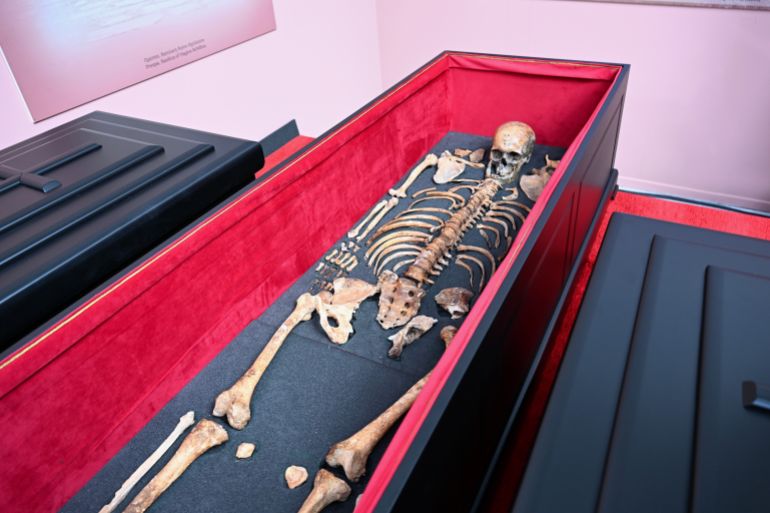
More than 1,000 years after his death, the remains of the medieval ruler Tsar Samuel arrived in Bulgaria.
A symbol of Bulgarian national identity, Samuel was a warrior emperor who fought the Byzantine Empire to expand his kingdom before suffering defeat and dying soon after in 1014. His supposed remains were discovered in a Greek border area in the 1960s.
Recommended Stories
list of 4 elementsend of list
The coffin and remains were transported to the Bulgarian capital, Sofia, on Saturday aboard a military plane surrounded by air force fighter jets.
Thousands of people gathered in a public square to honor the tsar’s arrival, which ended years of tense negotiations between Bulgaria and Greece until a deal was reached this week.
Bulgarian politicians from all sides paid tribute to the medieval ruler with the national anthem and a 21-gun salute.
“Today we Europeans are learning to read history with the desire to belong not only to our homeland, but also to the culture that unites us across the entire European continent,” said Bulgarian Prime Minister Rumen Radev.
“That is why Europe must not reopen old wounds but must work for peace, which is the highest good,” Radev continued, referring to the centuries-old rivalry between neighboring Greece and Bulgaria.
The crowd cheered as the fighter jets performed a flypast.
Martin Nestorov, a 42-year-old software engineer, told the AFP news agency that he attended the ceremony “to welcome Tsar Samuel to Bulgaria, where he belongs.”
“I am here because I am Bulgarian and a Bulgarian returns to his native country,” added Tsanka Zlatkova, 65, a retired art historian.
A procession brought the remains to rest in the Hagia Sophia, a 6th-century basilica named for the capital and where, church officials say, Samuel was baptized.

Competing claims
The handover of Samuel’s remains is part of a broader agreement between the Greek and Bulgarian culture ministers.
In exchange, Greece is expected to receive 48 items that Bulgarian troops looted from churches and monasteries in Greece during the First World War.
Speaking before the handover, Greek Prime Minister Kyriakos Mitsotakis said he hoped the ceremony would boost Greece’s campaign to repatriate the Parthenon Marbles, a collection of 2,500-year-old marble sculptures taken from the Acropolis in Athens and later exhibited at the British Museum.
“The global community is reassessing its long-standing position on the protection of cultural heritage,” Mitsotakis said, adding that historical legacies “cannot be treated as spoils of war.”
Bulgaria is not the only country with claims to Samuel. A huge statue of the tsar stands in Skopje, the capital of North Macedonia, and Macedonians claim him as “their” leader.
In 2022, a bilateral commission recommended presenting Samuel as the head of a state that “most contemporary historiographers consider to be the Bulgarian Empire”, based in present-day North Macedonia.
Gn world