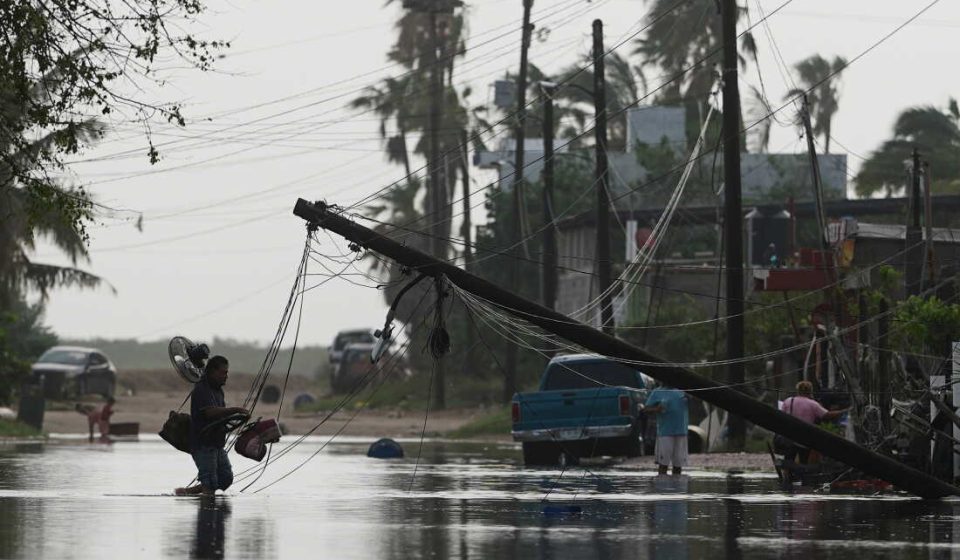


A man carries items through floodwaters past downed power lines after Hurricane Polo in Puerto San Carlos, Baja California Sur state, Mexico, Tuesday, September 29, 2026.
Eduardo Verdugo/AP
hide caption
toggle caption
Eduardo Verdugo/AP
PHOENIX — As former Hurricane Polo weakened Tuesday evening over northwest Mexico, the storm’s remnants slammed into the southwest United States, flooding roads and forcing residents of small New Mexico towns to evacuate amid concerns about a dam failure.
Polo had hit the Mexican state of Baja California Sur in the morning with maximum sustained winds of 110 mph (177 km/h). It crossed the Gulf of California and weakened to a tropical storm as it moved inland to the northeast.
As of Tuesday evening, the New Mexico Department of Transportation reported flooded roads and debris on highways across the state, while parts of Arizona had become particularly flooded, leading to several water rescues.
It follows storms that hit parts of the southwestern United States overnight Monday, saturating the ground, which could worsen flooding.
Later in the week, the risk of flooding is expected to shift to parts of the central United States, with heavy rain hitting Texas and Oklahoma beginning Tuesday evening, according to the National Weather Service.
Southwest U.S. experiences heavy rain and flooding
Bands of rain continued to sweep across the southwestern United States, causing desert rivers to rise and generally dry arroyos to rage with floodwaters.

A resident enters his house surrounded by water brought by Hurricane Polo in Puerto San Carlos, Baja California Sur state, Mexico, Tuesday, September 29, 2026. (AP Photo/Eduardo Verdugo)
Eduardo Verdugo/AP
hide caption
toggle caption
Eduardo Verdugo/AP
The potential dam failure in south-central New Mexico has prompted the evacuation of three small communities with hundreds of residents along the Rio Grande. Residents of Rincon, Salem and Garfield were urged to immediately seek higher ground “before conditions worsen.” Residents were then asked to evacuate nearby Hatch, home to prized green chile crops, and further north to Placitas.
Large swaths of the southwestern United States were under a flood watch as the complex tropical weather system extended into northeastern Mexico, with Polo as the main event.
“We’re definitely looking at urban flooding risks,” said Carter Greulich, a meteorologist with the Albuquerque Weather Service. “Do not drive on flooded roads. Stay out of arroyos, especially in our urban areas.”
A person stranded on top of a vehicle in floodwaters west of Phoenix was rescued Tuesday morning. Video taken by Arizona Fire and Medical Services showed a helicopter lowering a rescue worker to a person clinging to their overturned car. And in Utah’s Zion National Park, a helicopter rescued three people from Heaps Canyon after a flash flood.
North of Phoenix, a truck was swept away by water. The driver escaped unharmed, Maricopa County sheriff’s officials said.
The rocky, desert area typically receives less than 10 inches of rain per year with little vegetation to absorb it, making flash flooding a perpetual risk.
The Arizona Bureau of Land Management also reported significant flooding and damage to access roads in a national conservation area and sand dune recreation area in the southeastern part of the state.
Back in Utah, the East Fork of the Virgin River near Zion was rife with chocolate floodwaters and a shipping container was floating downstream.
In the small town of Orderville, Utah, where flooding began Monday evening, Sabrina Dubay was driving home when her partner called her and told her to stay away.
“The river came in and swept away our entire house,” Dubay said.
A camper, snowmobile trailer and other items from Dubay’s yard were swept away by the river. Neighbors and friends arrived to dig a trench around the house as water rose around their house.
“He would come in through our front doors,” she said.
An unusually soggy September in the region set the stage: When the ground is saturated, precipitation has no choice but to run off.
“Runoff will likely start much more quickly and lead to flooding more quickly,” Greulich said.
By Tuesday evening, rain had begun in parts of the Oklahoma and Texas panhandles. Parts of Colorado, Kansas, Nebraska and Iowa were under flood watches, with flooding possible at least through Thursday.
The inhabitants of Baja California were “lucky”
Hurricane Polo hit Baja California Sur with powerful winds and rain when it made landfall.
After Polo passed through the small fishing town of Puerto San Carlos on the Baja California peninsula, residents waded among downed trees in ankle-deep water that flooded some homes. Seeing their community largely intact brought relief to those who had prepared for the worst.
Trader Elbia María Bachomo, 40, rummages through furniture scattered around her house. She and her three children quickly gathered their clothes and headed to a shelter Monday as water began to flood their home. Her husband was fishing for sardines when Polo struck. Bachomo said he was lucky to make it out alive.
“I thought, ‘Oh no, what are we going to go back to? There’s nothing left for us.’ But we were lucky,” she said.
Hundreds of people were in shelters in Baja California Sur on Tuesday, but are expected to return home.

Meanwhile, the hurricane center reported Tuesday that Tropical Storm Rachel was moving parallel to the Mexican coast and was expected to strengthen into a hurricane soon. The storm was about 300 miles (482.8 kilometers) west-southwest of Lazaro Cardenos with maximum sustained winds of 70 mph (112.6 km/h). It was moving northwest at 13 mph (20 km/h).
In the central Pacific Ocean, Hurricane Nolo was beginning to slow Tuesday, but still threatened dangerous conditions for parts of the Papahanaumokuakea Marine National Monument, a marine conservation area. The storm moved north after flooding parts of the Big Island over the weekend.
Storm activity in the Pacific has been above average this year. This corresponds to El Niño years.
Gn usa