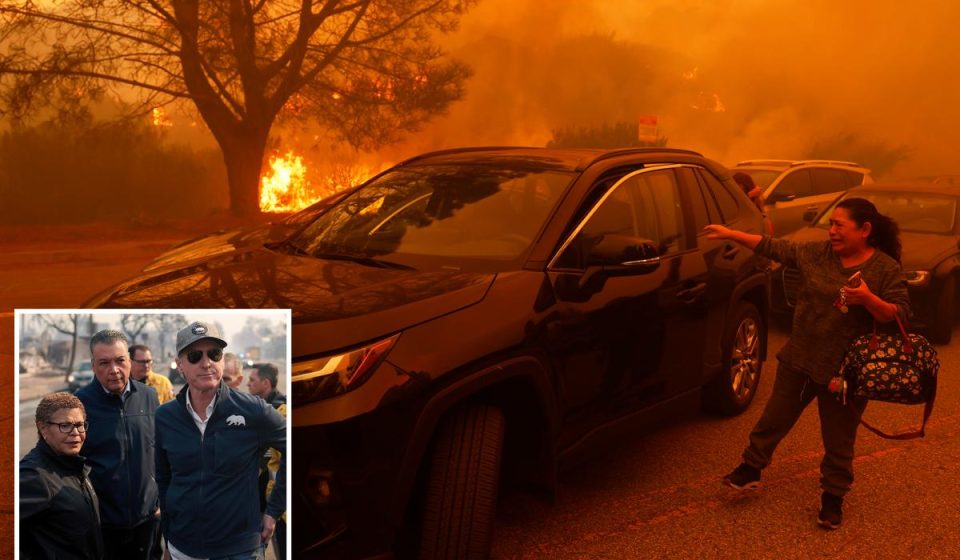

A damning new report from Palisades Fire does not blame any person or agency, but reveals that Los Angeles sent firefighters home despite dangerous winds, while some residents did not receive evacuation alerts until 40 to 90 minutes after homes began burning.
The explosive 724-page analysis of the fire incident was released Friday, nearly 21 months after the January 2025 fire ravaged Pacific Palisades, a coastal Los Angeles neighborhood, and killed 12 people.
It says the destruction “was the result of multiple interconnected factors rather than a single decision, event, or system failure.” However, it is the Los Angeles firefighters who are hardest hit.
The independent review was conducted by the Fire Safety Research Institute of the UL Research Institutes at the request of Governor Gavin Newsom.
The delay in warning residents is one of the report’s most striking findings.
Some residents closest to where the fire broke out didn’t receive an evacuation alert until about 40 to 90 minutes after homes had already started burning, investigators found.
At 10:46 a.m., 16 minutes after the fire was reported, a fire helicopter radioed that flames would hit homes “in a few minutes.” By the time an LAFD deputy chief radioed for an “evacuation to PCH,” Pacific Coast Highway, at 11:29 a.m., spot fires were already burning on both sides of a main road out of the neighborhood, according to the report.
The first evacuation order for the city was not issued until 12:09 p.m.
The delay appears to have been caused by outdated manual processes and software transitions, as well as a rapid wind-driven fire, the report said.
The city was still transitioning to new alert software. Staff drew evacuation zones by hand from street names read on the radio and sometimes had to check the spelling of streets, investigators found.
Jeremy Padawer, 52, a toy maker who lost his Palisades home in the fire, said he was not surprised by the report and that lawmakers are spreading the blame.
“It’s a disaster on their part,” he told the California Post.
“What made me angry wasn’t the fact that a fire burned down my house. It made me sad,” Padawer said. “They said it was climate change. They said it was human impact. They said it was hurricane force winds.”
“The fire wasn’t over yet before they decided to blame us and God,” he said.
LAFD officials were also “cautious when issuing evacuation notices,” investigators wrote, because such decisions “are often subject to intense public and government scrutiny.”
Download the California Post app, follow us on social media and subscribe to our newsletters
California Post News: Facebook, Instagram, TikTok, X, YouTube, WhatsApp, LinkedIn
California Post Sports Facebook, Instagram, TikTok, YouTube,
California Post Notice
California Postal Service Newsletters: Register here!
California Post app: Download here!
Home delivery: Register here!
Page Six Hollywood: Register here!
The report calls California’s public alert process “too complex.”
Elderly people and people with limited mobility were disproportionately affected, the report said. Many deaths occurred when the chances of evacuating were “limited, delayed or diminished.”
In one case in nearby Malibu, a relative told authorities “no evacuation orders had been given” as they watched the fire move closer to the home, according to accounts compiled in the report. She begged him to leave. He stayed.
The problems began before the fire, according to the report. LAFD sent its original crew home on the morning of January 7, 2025, instead of keeping those firefighters on duty, despite the dangerous winds.
The department added only three engines at the city’s expense and staffed them with fire inspectors removed from other duties, according to the report. The city’s staff recruitment and recall actions “did not follow their own written procedures and appear to be largely driven by budgetary constraints,” investigators wrote.
Los Angeles County took a different approach that morning, according to the report.
The county fire department maintained its on-duty crew, doubling its staffing levels from about 1,500 firefighters to nearly 3,000. This allowed the county to put more than 20 additional emergency engines into service.
Once the fire broke out, the LAFD’s attempt to call off-duty firefighters failed, according to the report.
A recall ad aired on television and radio reached well beyond its target audience to include “anyone with firefighting experience,” according to the report. The internal telephone number for ministry staff has been published with.
Thousands of calls from around the world scrambled those lines for more than 48 hours, investigators found.
Los Angeles Mayor Karen Bass, who ousted then-fire Chief Kristin Crowley weeks after the fire, said the report “confirms a lot of what we already knew.”
“That’s why I’m putting new leadership in place within the Los Angeles Fire Department,” Bass said in a statement to The Post.
“Under the leadership of Chief Jaime Moore, 92 percent of the recommendations from the LAFD’s internal review have been implemented,” Bass said, and the department “is much better prepared today to fight large-scale urban wildfires.” She said the leaders of the LAPD, Department of Water and Power and the city’s Department of Emergency Management assured her that “every recommendation in this report will be addressed.”
“We must use these lessons learned to strengthen preparedness and help every community be better equipped to respond to the growing climate-driven threat of wildfires,” Gov. Gavin Newsom said in a statement to the California Post.
Officers also received conflicting orders, according to the report.
At around 5:56 p.m. on Jan. 7, the LAPD fire commander told officers they would not perform rescues or evacuations in “hot zones,” areas that firefighters had flagged as too dangerous. But almost all of the areas that needed to be evacuated were in or near active shooting, the report said.
“Officers failed to comply with the directive and continued to conduct evacuations and rescues where residents remained in danger,” investigators wrote. The report does not attribute any deaths to this directive.
Investigators also looked into the Lachman Fire, a small New Year’s Eve fire nearby that, according to a federal ATF affidavit, smoldered underground and resurfaced as the Palisades Fire. LAFD crews removed their hoses on Jan. 2, and records reviewed by investigators showed no documented plans to recheck the area before the winds hit.
The magazine also covers the Eaton Fire, which killed 19 people in Altadena, near Pasadena, the same night. The order to evacuate neighborhoods near a main street crossing the city was issued at 3:26 a.m., when the fire there was “already well established,” according to the report.
The review also pointed to a statewide problem: California’s system for ordering fire engines from other agencies still operates on essentially the same technology and methods it was built on in 1970.
The report’s recommendations call for stronger regional preparedness, clearer evacuation priorities, better coordination between agencies, stronger infrastructure and standard procedures for controlling and patrolling fires once they are out.
Several agencies did not submit complete files, the report said. Evacuation plans, radio recordings and reports from LAPD officers, requested in March 2025, are still listed as pending.
Gn usa