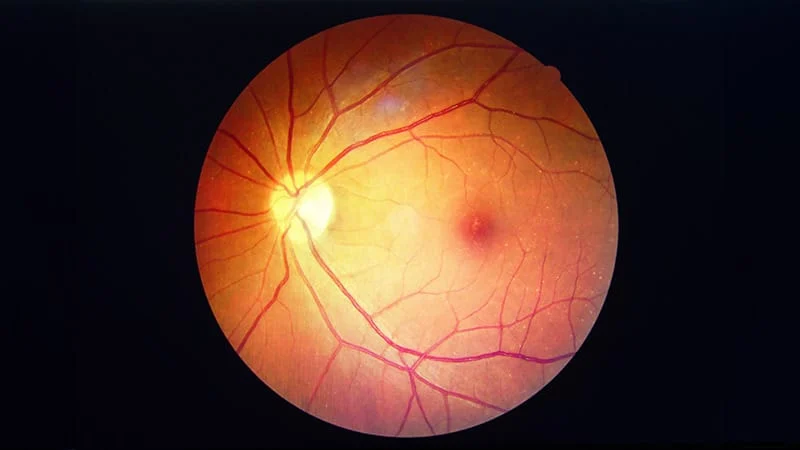

MILAN — Retinal neurodegeneration may begin at A1c levels below the threshold currently used to define prediabetes, according to an analysis of more than 32,000 participants from the UK Biobank.
The investigators identified a turning point at approximately an A1c of 5.4 in the relationship between A1c and ganglion cell inner plexiform layer thickness (GCL-IPL), below the threshold of 5.7 used to define prediabetes and the diagnostic threshold of 6.5 for diabetes. For total macular thickness, the estimated inflection point was even lower, at approximately 5.3.
“This means that neuronal loss – and this is important – takes place before the current diagnostic criteria for diabetes,” said study leader Rafael Simó, MD, PhD, of the Diabetes and Metabolism Research Unit, Vall d’Hebron Research Institute, Barcelona, Spain, presenting the results at the 2026 annual meeting of the European Association for the Study of Diabetes (EASD).
To put into context the magnitude of the study’s findings, participants with diabetes had an approximately 1 µm reduction in GCL-IPL thickness compared to those with normal glucose levels, which equates to approximately 6.5 years of physiological age-related retinal thinning. Among participants with prediabetes, total macular thickness was reduced by approximately 1.5 µm, comparable to age-related retinal thinning of at least 4 years.
Looking for a Retinal A1c Turning Point
The diagnosis of prediabetes and diabetes is based on glycemic thresholds associated with the development of microvascular diseases. However, diabetic retinopathy is increasingly understood as a complex neurovascular disease, with neurodegeneration occurring early in its development, Simó explained.
There is “strong evidence,” he said, that “thinning of specific retinal neuronal layers can occur before overt microvascular abnormalities are detectable by ophthalmoscopic examination.” If this is the case, “why do we have to wait for microvascular damage to appear?” » he asked.
Simó and colleagues therefore investigated whether retinal neurodegeneration could begin at A1c levels below current diagnostic thresholds and, if so, whether they could identify an A1c threshold associated with thinning of neuroretinal layers.
The analysis included 32,581 UK Biobank participants without a prior diagnosis of diabetes. People with eye diseases that could affect retinal thickness and neurodegenerative diseases were excluded. Retinal thickness was assessed by optical coherence tomography (OCT) in the spectral domain.
Researchers used restricted cubic spline analysis to examine nonlinear relationships between HbA1c and retinal thickness, with changes in slope assessed using the Davies test. Analyzes were adjusted for age, sex, mean blood pressure, waist circumference, ethnicity, smoking status, and alcohol consumption. A sensitivity analysis was conducted on 20,380 participants with retinal data segmented according to the Early Treatment Diabetic Retinopathy Study system.
Retinal thinning before prediabetes
The relationship between HbA1c and retinal thickness was not linear. In GCL-IPL, retinal thickness initially increased slightly before reaching a turning point at an A1c of approximately 5.4, after which progressive thinning was observed as A1c increased. A similar pattern was observed in the neuronal layers of the retina, whereas the retinal pigment epithelium behaved differently.
When total macular thickness was used as an integrated measure of all neuronal layers of the retina, significant differences were observed not only between people with prediabetes and diabetes, but also between those with prediabetes and normal glucose levels. The estimated inflection point for total macular thickness was at an HbA1c level of approximately 5.3.
The results support the concept that neural changes in the retina may precede vascular abnormalities traditionally associated with diabetic retinopathy.
“Our data expand and strengthen the concept that neurodegeneration is an early event in diabetic retinopathy,” Simó said, adding that, overall, these results “suggest that the current diagnosis of diabetes based on HbA1c levels may need to be reexamined.”
What could motivate the changes?
Observational analysis could not establish that A1c levels around the identified turning points caused retinal neurodegeneration, nor do the turning points represent clinical thresholds at which an individual patient develops retinopathy, the researchers emphasized.
Additional longitudinal research will be needed to determine whether retinal thinning at these lower HbA1c levels predicts diabetic retinopathy or subsequent diabetes and whether OCT-derived retinal measurements could ultimately play a role in identifying individuals at increased metabolic or ocular risk.
Simó also stressed that the study was not intended to establish the mechanism underlying the association. However, he pointed out that insulin resistance is a potential factor.
Previous experimental evidence suggests that intraocular insulin resistance may contribute to retinal neurodegeneration, he explained. Retinal neurons express insulin receptors and impaired insulin signaling could affect neuronal survival. Simó also mentioned evidence linking systemic insulin resistance to thinning of the neuronal layers of the retina.
All of this indicates “that insulin resistance is the most important element explaining these results,” he said.
Could early intervention help?
Commenting on the findings, session moderator Lena Thorn, MD, PhD, noted that the early onset of neuroretinal thinning raised the question of whether earlier intervention could alter its course.
“You show that neuroretinal thinning occurs quite early in the disease process, but is there evidence that interventions done at an earlier stage can slow retinal thinning?” she asked.
Simó said there was evidence from experimental studies, but when Thorn asked specifically if it had been demonstrated in humans, he said no.
Simó revealed his relationships with Novo Nordisk, Abbott, Dexcom, Bayer, AstraZeneca, Menarini and D-Sight. Thorn has not declared any relevant disclosures.
Becky McCall is a UK-based medical journalist and researcher who writes for Medscape Medical News and other medical and scientific publications. His research at University College London focuses on antimicrobial resistance and the use of digital storytelling in health research.
Gn Health