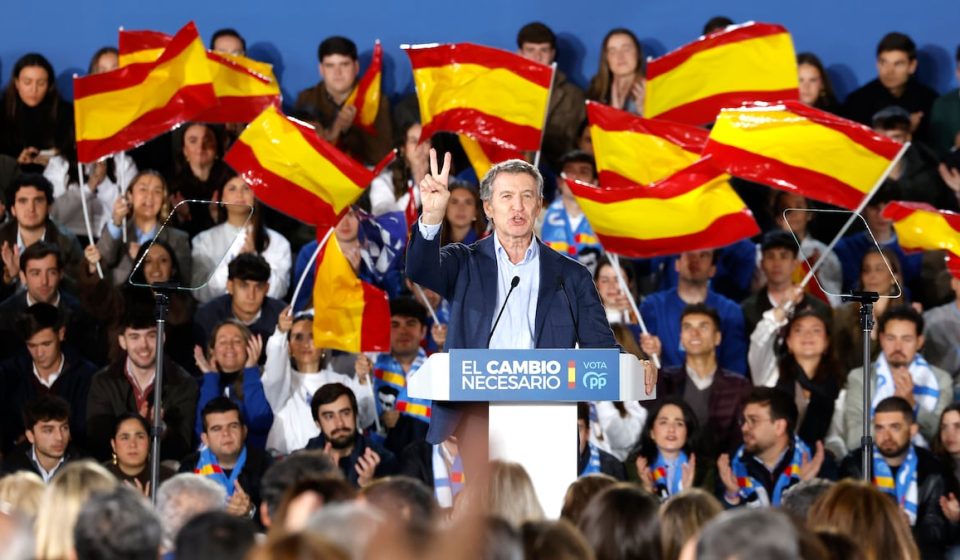
With 75% of the votes counted, the conservative People’s Party (PP) is the leading party and won 134 of the 350 seats in Congress (an absolute majority requires 176 seats). With the far-right Vox party (50 seats) and the Navarrese Popular Union (UPN, 2), the bloc would total 186 seats. The PSOE is expected to win 117 seats, the Republican Left of Catalonia (ERC) 11 and the left-wing Frente Amplio (Broad Front) 10. Podemos will have no representation, while EH Bildu will have 7 seats, the Catalan party Together for Catalonia (Junts) 5, Adelante Andalucía 4 and the Basque Nationalist Party (PNV) 3.
In the Senate, according to preliminary results, the PP won 109 seats, which, added to the 23 regional seats it already holds and the five regional senators from Vox, places the right-wing bloc above the 134 seats needed to obtain an absolute majority. However, this total is still far from reaching a three-fifths qualified majority in the upper house.
Top political leaders, with the exception of Spanish Prime Minister Pedro Sánchez, have already gathered at their party headquarters to follow the vote count. The electoral participation rate has broken all records since the advent of democracy in Spain. As of 6 p.m., 68.1% of eligible voters had cast ballots – 15 percentage points higher than in the 2023 election and more than 4.5 percentage points higher than the all-time high set in March 1996, when 63.45% of eligible voters cast ballots at the same time.
The elections were called shortly after Sánchez dissolved parliament following a political crisis triggered by the housing issue that had dominated public debate for months. The immediate catalyst was the eviction of Maricarmen Abascal, an 87-year-old tenant who died shortly thereafter, sparking nationwide protests over housing affordability and access. The government’s subsequent legislative defeats in Congress convinced Sánchez to seek another term rather than continue governing with a fractured parliamentary majority.
Housing emerged as the defining issue of the campaign, reflecting broader concerns about stagnant wages, job insecurity and the rising cost of living. As property prices and rents continue to outpace incomes in many parts of the country, parties across the political spectrum have sought to present competing solutions to what has become one of Spain’s most pressing social and economic challenges, particularly for young voters.
The campaign was also shaped by a highly polarized political climate. Supporters on both the left and the right presented the election as a defining moment for the country’s future, with debates focusing on the state of the welfare system, immigration, regional autonomy, women’s rights and Spain’s place within Europe. The prospect of the far right entering central government for the first time since Spain’s return to democracy added to the sense of historical significance surrounding the vote.
Beyond Spain, the elections were closely watched across Europe. It comes at the start of an election cycle in which several of the European Union’s largest member states go to the polls, as nationalist and populist forces seek to expand their influence across the continent. The result will therefore likely be interpreted not only as a verdict on Sánchez’s government, but also as a signal about broader political trends in Europe.
Register for our weekly newsletter to get more English media coverage from EL PAÍS USA Edition
Gn world