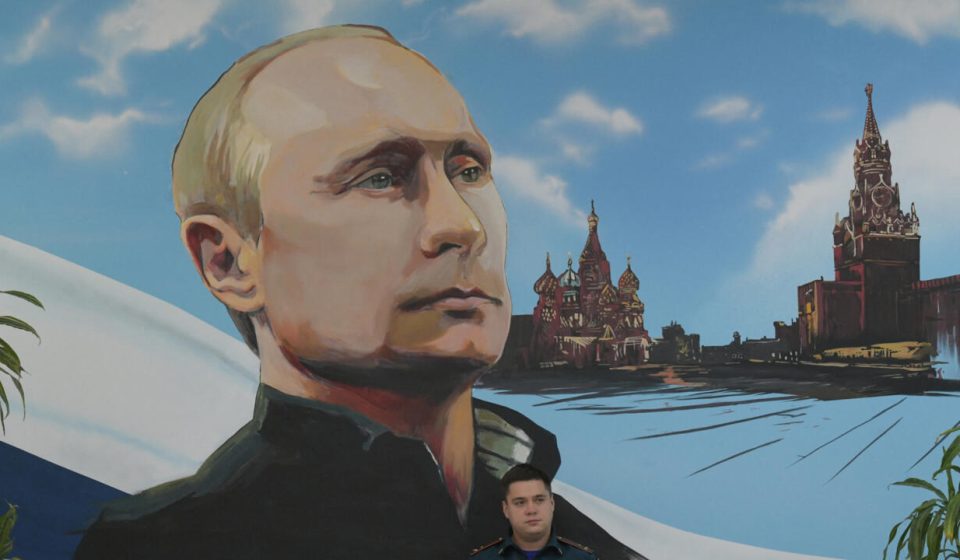
An ever more Putinian Duma acquired by Vladimir Putin. The first Russian legislative elections since the start of the large-scale war against Ukraine saw clear progress by the United Russia party, subservient to the Kremlin, following the counting of almost all the votes on Monday September 21.
United Russia obtained 57.83% of the votes, which should give it an unprecedented majority of 355 seats out of the 450 available in the Russian parliament. The movement chaired by former Russian President Dmitri Medvedev is well ahead of the Communist Party and the Liberal Democratic Party of Russia, classified on the far right.
Zero tolerance
A “success” without much surprise, as the result seemed a foregone conclusion in this election whose integrity is often called into question.
The balance of power within the next Duma does not fundamentally differ from that established during the 2021 legislative elections. United Russia dominates, while the role of opposition acceptable to the Kremlin is reserved mainly for communists and nationalists. These are the two most important systemic parties, that is to say which agree to pass the laws wanted by the Kremlin, while providing a democratic alibi for power.
An extension in your browser appears to be blocking the loading of the video player. To be able to watch this content, you must disable or uninstall it.

Cover image: Russia is holding parliamentary elections throughout the weekend, a first since the start of the war in Ukraine. ©France 24
This continuity does not prevent some changes in dynamics. First, the range of opinions tolerated on the part of opposition deputies has been further restricted. “In 2021, the Communist Party served as a catalyst for the protest vote, which was therefore able to express itself. This time, there was absolutely no opportunity to vote for a party expressing the slightest grievance against the war and its consequences, which represent the main concerns of the Russian population,” underlines Jussi Lassila, Russia specialist at the Finnish Institute of International Affairs.
“The hunt for candidates considered dangerous for power was not carried out individually as in 2021, but the censorship targeted the liberal and anti-war Yabloko party as a whole,” continues this expert. Result: the Duma is less representative than ever of popular sentiment. “It was already a chamber for recording Vladimir Putin’s wishes, it is now a super-recording chamber,” summarizes Jussi Lassila.
Elected officials from the occupied territories in Ukraine
This is not the only development. “This is the first time that 11 deputies come from regions that are not internationally recognized as belonging to Russia,” said Derek S. Hutcheson, a specialist in Russian politics at Malmö University, Sweden, and author of a book on the history of parliamentary elections in Russia.
Before this election, the Russian authorities carried out an electoral division freeing these seats for elected officials from the regions occupied by Russia in Ukraine. “The Kremlin thus reinforces its narrative seeking to normalize the process of annexation of these regions,” underlines Derek S. Hutcheson.
Russian power has also struck hard. The participation rate there exceeds 70% and the success of United Russia is even more striking than at the national level. “This not only inflates this party’s score, but also reinforces the Kremlin’s rhetoric according to which the population of these regions supports the Russian war effort,” analyzes Derek S. Hutcheson.
Also readElections in Russia: the 1,001 sleight of hand to eliminate cumbersome candidates
This election was also presented and orchestrated as a referendum on “the special operation in Ukraine”, the official name in Russia for the large-scale invasion war launched in 2022. Consequence: the results suggest “the most warlike Duma possible”, assures political scientist Alexander Morozov, interviewed by the Sueddeutsche Zeitung. He estimates that before these elections, only 20% of the deputies were war thunderbolts with violently anti-Western rhetoric, compared to almost half of the members of the Duma since the September 20 election.
“There are certainly more openly hawkish MPs than in 2021, but it is still difficult to determine precisely the proportions,” nuance Matthew Blackburn, specialist in Russian politics at the Norwegian Institute of International Relations.
This surge of an assumed and unqualified pro-war sentiment is certainly largely due to the role of complacency to which Russian deputies are relegated. “They are showing this posture mainly because the Kremlin is pro-war,” emphasizes Derek S. Hutcheson.
But not only that. Russian power is also pushing United Russia party deputies to be as pro-war as possible “to control the entire spectrum of discourse on the war”, notes Jussi Lassila.
Always more bellicose
Indeed, after having pushed out of the public debate any semblance of criticism of the conflict, Vladimir Putin is now seeking to make a takeover bid on the pro-war discourse by stifling the most bellicose voices. “An important objective for the Kremlin is to control pro-war bloggers, who are very influential and occasionally criticize the errors of the army and its military failures,” assures Matthew Blackburn.
By pushing United Russia deputies to be more hawkish, “the Kremlin wants to regain absolute control over the pro-war discourse,” adds Jussi Lassila.
An extension in your browser appears to be blocking the loading of the video player. To be able to watch this content, you must disable or uninstall it.

Cover image: © France 24
This is also one of the main reasons for promoting applications from veterans of the conflict in Ukraine. “The aim is to present this assembly as the ‘Duma of heroes’,” says Stephen Hall, a Russia specialist at the University of Bath in the United Kingdom. The Kremlin hopes that no one will dare contradict the positions on the war of those who participated in it. While hoping that these war “heroes” will follow the party’s directives. “It will be interesting to see if these veterans will try to make a different voice heard, because unlike the other deputies, it will be more difficult to replace them if they do not do what the Kremlin wants,” underlines Matthew Blackburn.
Will these changes in the face of the Duma have an impact on what Vladimir Putin can do? Certainly, with such a majority, “United Russia no longer needs anyone to decide on a constitutional amendment, if necessary,” notes Stephen Hall. But the other parties represented in Parliament have never failed to support the legislative or constitutional wishes of the Russian president, say the experts interviewed.
The new pro-war climate blowing through the Duma could allow Vladimir Putin “to intensify the war effort by asserting that the Russians are behind him”, believes Stephen Hall.
This intensification could involve a vast future mobilization campaign. “It was not possible before the elections, because the Kremlin wanted to avoid worrying the electorate,” notes Derek S. Hutcheson.
This obstacle has now been overcome and the specter of mobilization seems to worry the population more and more, assures Bloomberg. For the experts interviewed by France 24, however, nothing has been done and the authorities may still prefer to relaunch “shadow mobilization”, that is to say multiply financial and regulatory incentives to find ever more “volunteers”.