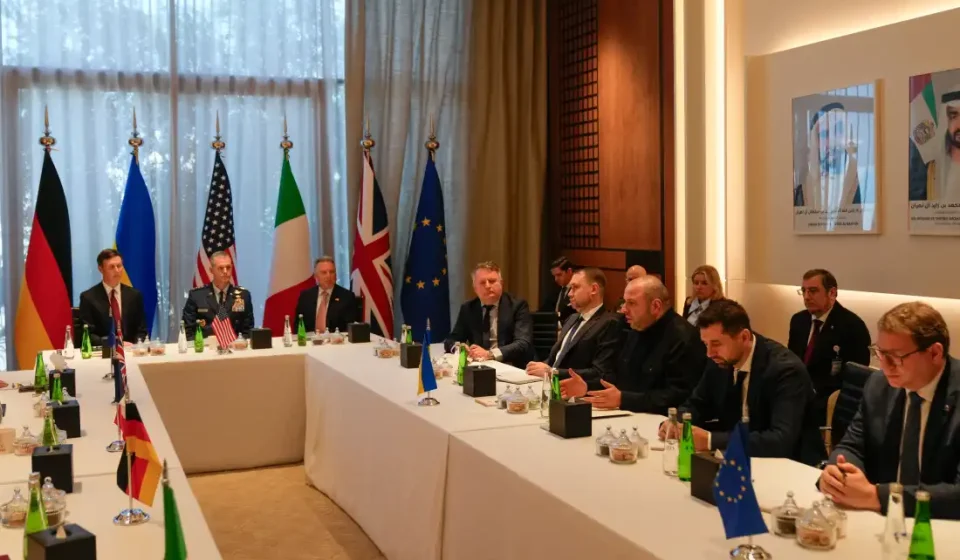
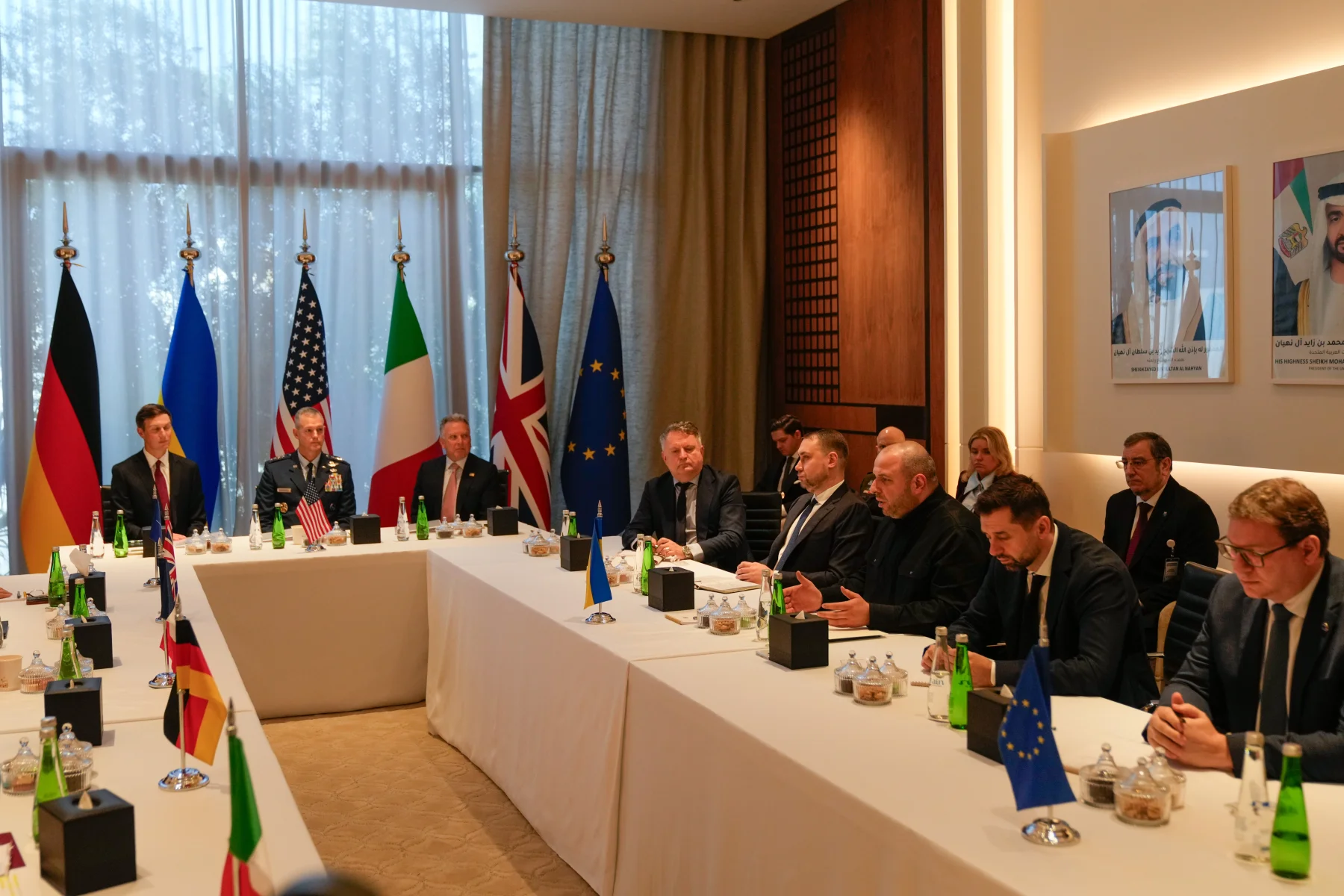
Rustem Umerov, head of Ukraine’s foreign intelligence service, third from right, speaks during the coordination meeting ahead of the U.S.-mediated trilateral talks between Russia and Ukraine in Abu Dhabi, United Arab Emirates, Tuesday, Nov. 10, 2026.
Altaf Qadri/AP
hide caption
Altaf Qadri/AP
ABU DHABI, United Arab Emirates — Russia and Ukraine have agreed to a massive exchange of prisoners of war, both sides announced Wednesday, as two days of U.S.-mediated talks concluded without any major progress toward ending Moscow’s nearly five-year-old full-scale invasion.
Hopes for significant development were low at the first meeting in nine months between the delegations. Russia and Ukraine have exchanged prisoners of war from time to time, but have remained widely divergent in their demands for acceptance of a peace deal.
US officials say they are determined to revive Washington’s peace efforts which have so far failed to produce significant results.
Besides post-war security guarantees for both countries, other major obstacles are the fate of Russian-occupied Ukrainian territory and the role European countries will play in a possible settlement.
US envoys to meet Putin and Zelensky
It was the first such meeting since February on the Russian invasion, which analysts and aid organizations say has killed hundreds of thousands of troops and thousands of civilians.
The talks lasted just under two hours on Wednesday, following a four-hour session the day before.
“One of the positive things is that we have agreed that we are going to do the largest humanitarian release of prisoners, the numbers for which we will finalize tomorrow,” Jared Kushner, son-in-law of US President Donald Trump, said after the end of the Abu Dhabi talks.
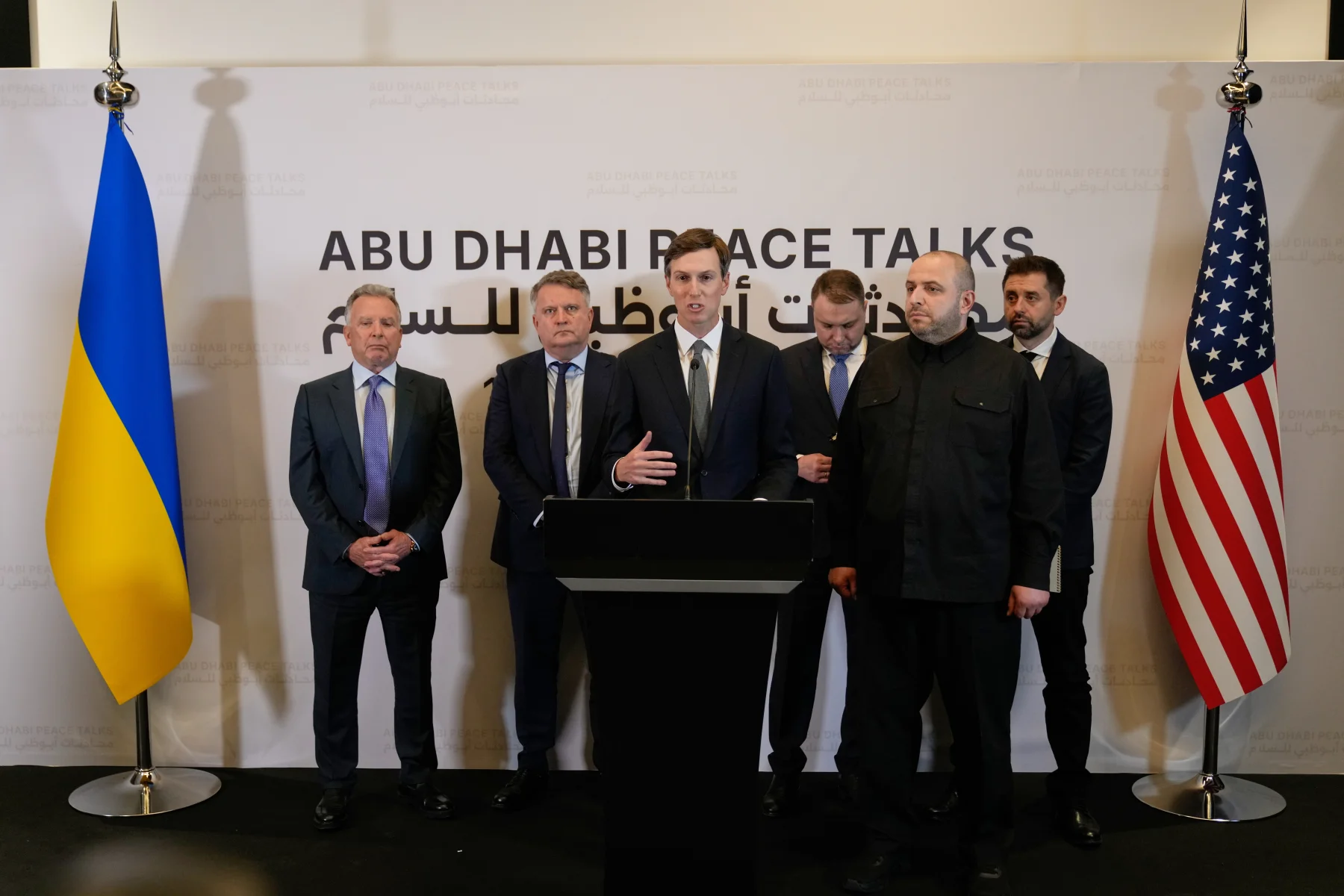
President Trump’s son-in-law Jared Kushner speaks during a news conference Wednesday during the U.S.-brokered Russia-Ukraine talks, alongside U.S. envoy Steve Witkoff, left, and Rustem Umerov, head of Ukraine’s foreign intelligence service, second right, in Abu Dhabi, United Arab Emirates.
Altaf Qadri/AP
hide caption
Altaf Qadri/AP
Vladimir Medinsky, head of the Russian delegation, and Rustem Umerov, who led the kyiv contingent, confirmed the planned exchange of prisoners of war, although Medinsky stressed that the agreement was “in principle.”
Alexander Zorin, deputy head of the General Staff’s information department who attended the negotiations, told Russian state television that it would be one of the largest such exchanges after all 1,000 troops returned home last year.
The final exchange could take place in the next two or three weeks, he said.
Kushner said he and U.S. envoy Steve Witkoff would travel to Moscow on Thursday to meet with President Vladimir Putin, then fly to Dublin, Ireland, to meet with Ukrainian President Volodymyr Zelenskyy.
Medinsky said he believed the meeting helped Moscow and kyiv move closer to peace, while Kremlin foreign affairs adviser Yuri Ushakov called the talks “substantial and very useful.”
European officials were excluded from negotiations by Moscow
Umerov said the kyiv delegation was due to meet later on Wednesday with representatives of European governments, the European Union and NATO who were in the UAE capital but did not take part in the three-way talks.
Moscow does not want European countries, concerned about Russia’s behavior and its broader intentions on the continent, to be involved in direct negotiations. Kushner said one of the goals of the Moscow meeting was to try to include the Europeans in the negotiations.
“Ukraine’s priority is to end the war as quickly as possible through a dignified peace,” Zelenskyy said on
Kremlin spokesman Dmitry Peskov said European representatives could eventually join peace talks, but added that their current statements “do not indicate any desire on their part to contribute to progress on the path to peace.” Moscow complains that Europe finances and supplies weapons to Ukraine.
Kushner said Ukraine and Russia needed clarity on post-war security arrangements. He said European countries, the EU and NATO must be involved in these discussions in order to reach consensus on next steps.
Ukraine wants to ensure Moscow does not invade again, and EU officials say any discussions on European security arrangements could only begin after a ceasefire. Many in Europe view Russia’s inclusion in these plans as a concession to Putin, who has described NATO’s eastward expansion as a major threat to his security. Russia demanded that the alliance withdraw its troops from its borders.
Russia’s security concerns were addressed during the discussions, Kushner said, adding that Moscow had been asked to present different de-escalation proposals acceptable to Europe.
“The reality is that there is currently no trust between the parties. And that is normal after a conflict like this,” he said. But he later posted on X that the POW exchange “will reunite families, build trust and create momentum toward peace.”
The talks took place in a new political atmosphere
The context of the negotiations has changed since the February meeting in Geneva. The Trump administration must now reckon with Democrats taking power in the US Congress in January after the US mid-term elections, and it may demand more support for Ukraine.
Additionally, Russia’s wartime economy is under severe pressure and Ukraine is reeling from devastating air attacks on its power grid.
Fighting continues on the front line, where little territory has changed hands this year. The two countries are confronting each other with long-range missiles and drones.
Three people died and 11 others were injured after Russia launched a daytime attack on a market in the southern Odessa region, local authorities said. Residential buildings were damaged, said Oleh Kiper, head of the regional military administration.
Overnight, Russia struck the Zaporizhzhia region in southern Ukraine as well as the eastern city of Kharkiv, injuring seven civilians and damaging property, Ukrainian officials said.
The Russian Defense Ministry said it shot down 627 Ukrainian drones overnight, including 150 over the region around St. Petersburg. Regional Governor Alexander Drozdenko said the drones started a fire at the port of Ust-Luga, a main Russian oil export facility, injuring three workers.
Indonesian reportedly captured on battlefield
Meanwhile, a 49-year-old Indonesian man was reportedly captured on the battlefield in southern Ukraine’s Zaporizhzhia region after claiming he was unknowingly recruited to fight in the Russian army.
The Indonesian embassy in kyiv was seeking access to the man, who was detained in Ukraine, according to Yvonne Mewengkang, a spokeswoman for Indonesia’s foreign ministry.
According to the Ukrainian project “I want to live” which offers Russian troops the possibility of surrender, the man was taken without military training to occupied Donetsk, then to the Zaporizhzhia region, where his unit was attacked and captured, according to the group’s message on Telegram.
The man said he signed what he thought was a contract to work in construction for a year in Moscow, the group said.
Ukrainian and Russian officials had no immediate comment.
Gn headline