Russia, China should ‘lead’ transition to multipolar world, Xi says at APEC summit | Economic and commercial news

Putin says Western powers are “former hegemonies,” with Europe in the midst of a “humiliating decline.”
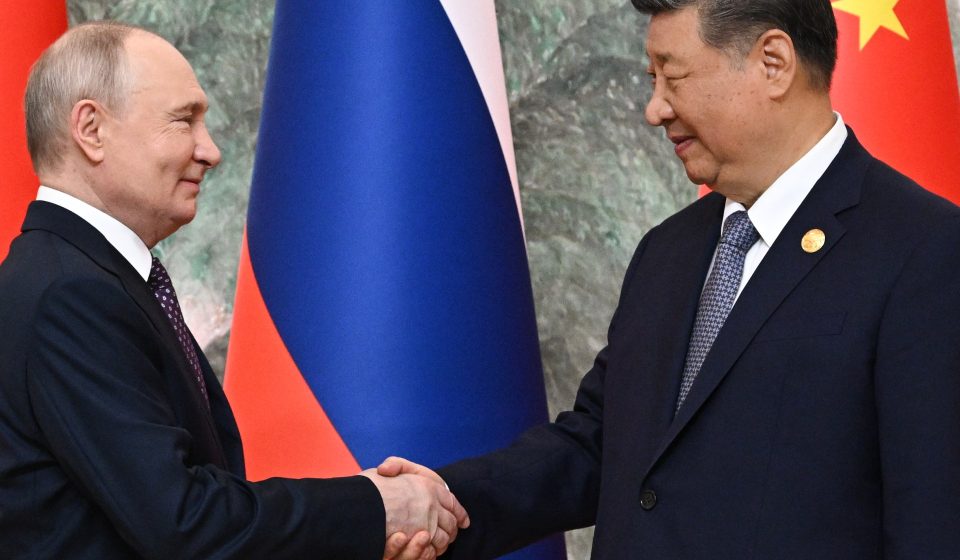
Chinese President Xi Jinping said Beijing and Moscow should “lead and advance the trend toward a multipolar world” following a meeting with Russian President Vladimir Putin on the sidelines of the Asia-Pacific Economic Cooperation (APEC) summit.
Xi and Putin held bilateral talks on Wednesday in Shenzhen, southern China.
Recommended Stories
list of 3 itemsend of list
After Xi, Putin took the stage, declaring at the summit that Western powers were “former hegemons,” adding that Europe was in the midst of a “humiliating decline.”
“Experience has shown that traditional tools of economic domination and de facto coercion have largely outlived their usefulness, having lost much of their power to intimidate,” Putin said.
“While sanctions, tariffs and export restrictions may still provide some deterrent effect, they are incapable of stopping growth – let alone crushing the economies of competitors. »
Russia’s economy has been heavily sanctioned by the United States and Europe over its war against Ukraine, which began in February 2022 when Moscow invaded its neighbor.
Al Jazeera’s Katrina Yu, reporting from Shenzhen, said Xi and Putin called for a “more just, multipolar world order and both leaders also said they would maintain close ties amid what they both described as global uncertainty.”
She added that Xi and Putin “enjoy a close personal relationship, and they have met more than 40 times over the years, and these two countries are also strategically aligned,” with China remaining Russia’s largest trading partner, and Russia providing Beijing with much-needed energy resources.
“Putin clearly attacked European countries, in particular, which imposed sanctions on Russia,” Yu added.
But in Shenzhen, “Putin spends a little moment in the sun” at the APEC summit, where he is treated as a guest of honor.
Different expectations
Robert Kelly, a political science professor at Pusan National University in Busan, South Korea, said the three leaders “are coming with quite different expectations and desires for what they want.”
“It’s going to make it very difficult for them to come to an agreement,” he said. “Nuclear weapons are an area where the three leaders could really make great progress,” he argued, adding that “the current tripolar world of nuclear powers is different from the Cold War.”
“It would be great if all three of them could actually bring (the arms race) under control,” Kelly told Al Jazeera.
“But the different parties are in different places: for the Russians, their weapons are very important to reinforce their perception as a great power, despite their problems in Ukraine,” he noted.
“The Chinese are engaged in a major buildup, and it doesn’t seem like they want arms control, nuclear weapons at least in their 10 years; and the United States has been pretty indifferent to any kind of deal,” Kelly said.
“There is a very strong argument for a positive outcome, for an arms control agreement, but it is simply not going to happen,” he added.
APEC was established in 1989 and has 21 members, accounting for more than 50 percent of the world’s gross domestic product (GDP) and representing approximately 2.7 billion people.
The organization aims to support economic growth and prosperity in the Asia-Pacific region.
Leaders are expected to discuss a range of important issues at this year’s summit, including artificial intelligence (AI) and trade – two areas in which the United States and China play dominant roles.
A key issue for APEC members and the rest of the world is the trade truce between Washington and Beijing and its extension beyond January.
Gn world