The Russian navy was once a symbol of the Kremlin’s ambitions to restore its status as a post-Soviet superpower. But after Ukraine’s humiliating losses in the Black Sea and the destruction of a warship in the Mediterranean port of Benghazi this week, the Russian navy is finding almost no place safe from drone attacks.
Although it lacks a conventional navy, Ukraine has demonstrated the formidable range of its unmanned marine drones – remote-controlled speedboats loaded with explosives.
On Sunday, Ukrainian maritime drones rammed the hull of a Russian corvette in Benghazi, Libya, sinking it, and also hit a cargo ship used to transport weapons off the Libyan coast.
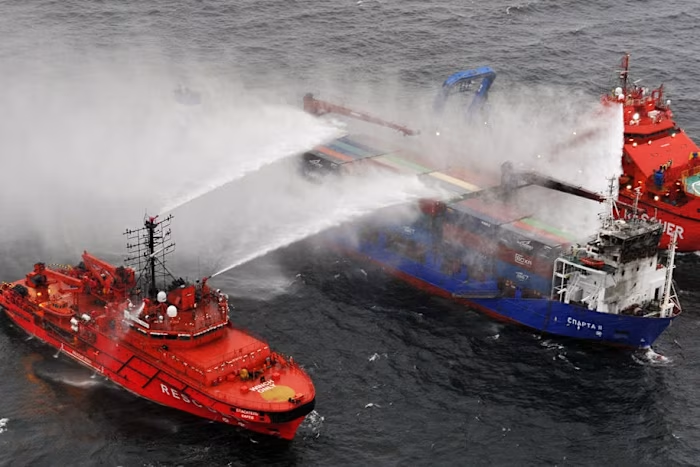
Meanwhile, a drone strike on a Russian cargo ship off the coast of Finland, claimed by Ukraine on the grounds that the vessel was carrying weapons, showed that even in its well-defended north, the Russian navy struggles to protect its own merchant fleet.

“On paper, Russia has a very good fleet, but I think in practice it is quite difficult,” said John Foreman, a Royal Navy veteran and former British defense attaché in Moscow, adding that the setbacks have exposed Russia’s inability to adapt to modern maritime warfare in which drones and speedboats pose deadly threats.
Video footage released by Ukraine on Monday showed Ukrainian naval drones loaded with explosives crashing into the side of the Merkury, a corvette due for service in 2023, triggering massive explosions.
Naval experts said most ships would be equipped with anti-drone defenses such as floating barriers called booms when in port. “They’re being attacked because they haven’t put up the boom and there are no harbor defenses. It’s a pretty basic thing,” Foreman said. “So it doesn’t really seem like a learning organization to me. »
“I think the problem they have is they have this weird idea that the Ukrainians can’t attack them,” he said, adding that Russian ships continued to operate without protective measures, which has become second nature to navies facing similar threats from maritime drones, like the British and U.S. navies operating against Yemen’s Houthi militants in the Red Sea.
“I would say don’t sit next to (a dock) or sit in an anchorage where you know the Ukrainians are operating,” he said. “Stay at sea, maintain depth and give yourself plenty of warning time to deal with threats.”
The Black Sea provided the most striking demonstration of Russia’s naval failures. Ukraine, which saw its conventional navy destroyed in the weeks following Russia’s 2022 invasion, has revolutionized naval combat with its use of maritime drones like the Magura, a remote-controlled speedboat carrying 600 kg of explosives and having a maximum range of 800 nautical miles.
Since the start of the full-scale invasion of Ukraine, Russia has admitted loss or damage to at least eight military ships, including the flagship cruiser Moskva, which sank in April 2022 after being hit by Ukrainian anti-ship missiles. Experts estimate that as many as 21 Russian warships, including smaller craft and tugboats, may have been sunk.
These losses forced Russia to withdraw its Black Sea Fleet from its historic base at Sevastopol in occupied Crimea and relocate its ships to ports further east like Novorossiysk, where they continue to be attacked.
“The Black Sea Fleet has largely lost not only its combat capability but also its ability to operate. It is not going to sea,” said Pavel Luzin, a visiting scholar at the Fletcher School of Law and Diplomacy.
Following the Black Sea debacle, Russian President Vladimir Putin in 2024 fired Nikolai Yevmenov, an admiral who had commanded the navy since 2019, and replaced him with the commander of his Northern Fleet, Admiral Alexander Moiseyev, a submariner.
After coming to power three decades ago, Putin embarked on ambitious plans to modernize the navy and replace much of its Soviet-era equipment. And in April 2025, he announced that four new Borei-class nuclear-powered missile submarines and four Yasen-class attack submarines had been commissioned, part of an ambitious 8 trillion rupee (about $100 billion) plan to rebuild the navy. Few additional details have emerged since.

In addition to direct losses, the Russian Navy’s logistical problems have become chronic, slowing down the construction of new ships as well as the maintenance and modernization of existing ones. What Russia lost at sea in this war cannot be replaced, Luzin said.
Even small ships such as corvettes and patrol boats could take seven to eight years to build, he said. The Navy’s only aircraft carrier, the Admiral Kuznetsov, has apparently been withdrawn from service.
“If Russian leaders showed a little more common sense, they would radically rethink their entire approach to the navy,” Luzin said.
The Russian Navy’s difficulties are particularly pronounced in closed waters, where ships can be tracked and attacked from shore and have limited room for maneuver.

Still, Foreman said its Northern Fleet, based on the Kola Peninsula, remained the cornerstone of Moscow’s military power, operating nuclear-powered submarines armed with ballistic and cruise missiles. “Just because they do poorly in the Black Sea doesn’t mean they will do poorly in the North Atlantic, especially with their submarines,” Foreman said.
Unlike surface ships vulnerable to Ukrainian attacks, these submarines represent a formidable challenge to NATO forces in the North Atlantic, he said.

The result is a Russian navy increasingly divided between a vulnerable surface fleet that is struggling to adapt to new threats and a submarine force that remains one of the most dangerous elements of Moscow’s military arsenal.
Luzin said Russia’s main naval force was concentrated in the Arctic and the Pacific. “For now, it is not the Ukrainian armed forces that are working against them, but time and the deterioration of Russian industry and the education system,” he said.
Gn headline