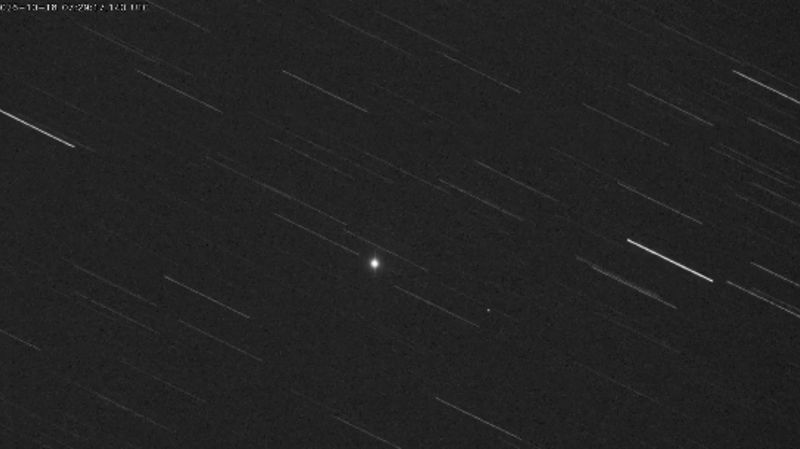

A rare movement of a Russian-made satellite could have brought it within a mile of a commercial Earth observation satellite that could be used to provide national security services to countries like Ukraine.
It’s unclear what exactly the Russian satellite, called Kosmos 2612 or Cosmos 2612, intended to accomplish with its close approach. But this behavior was consistent with rendezvous and proximity operations, or maneuvers performed in orbit intended to bring two spacecraft closer together, orbital surveillance services company LeoLabs, which tracks space debris and activity in Earth’s orbit, said in a statement.
“While the intent remains unclear, the behavior warrants continued monitoring,” LeoLabs added in the statement.
While rendezvous or docking of two vehicles happens all the time in space, Kosmos 2612’s actions could mark the first time one spacecraft approaches another without permission, Jonathan McDowell, an astrophysicist and space analyst, noted in a social media post.
The observation satellite, called Iceye-X36, is operated by Iceye, a multinational company with offices in the United States, Finland and several other countries in Europe and Asia.
The company said in a statement Monday: “We are aware of the situation and are monitoring it closely. Our constellation architecture is designed for continuity and resilience.” A spokesperson declined to comment further.
Iceye-X36 uses synthetic aperture radar, or SAR, technology, which “can create high-resolution images night or day, regardless of weather conditions,” according to NASA.
Iceye’s satellite constellation was used to support “the Ukrainian armed forces with persistent situational awareness on tactical timelines,” according to a January press release detailing an expanded agreement between the company and Ukraine. It was not immediately clear whether ICEYE-X36, in particular, had been used to support Ukrainian military operations. Iceye declined to comment.
Signs that Russian military spacecraft may have sought to close in on satellites operated by Iceye have emerged since May, when four Russian-controlled satellites adjusted their orbits to align with Iceye-X36, according to a June report from the Royal United Services Institute, or RUSI, a U.K.-based defense and security research organization.
Then, on October 15, the Kosmos 2612 satellite made a rapid approach to Iceye-X36, reducing its distance from 350 kilometers (217 miles) to less than 5 kilometers (3 miles) early on the morning of October 16, according to LeoLabs.
Kosmos 2612 then appeared to keep its distance, “making small adjustments” to “maintain a close relative position” throughout the weekend, LeoLabs said Monday.
“Analysis indicates that it approached within approximately 500 meters during part of the event. However, it is important to note that exact separation estimates have uncertainty due to repeated maneuvering and difficult tracking geometry,” LeoLabs said.
CNN has contacted the Russian Ministry of Defense and Aerospace Forces and the Russian space agency Roscosmos for comment.
On Monday, the Kosmos 2612 satellite had begun moving away from Iceye-X36, LeoLabs said. The maneuvers demonstrated by the Russian vehicle could have been used to “inspect, characterize, observe, or potentially interfere with another spacecraft,” according to the company.
“While this event and the capabilities demonstrated do not establish hostile intent,” LeoLabs said, “it does, however, demonstrate capabilities that could support intelligence collection, on-orbit inspection, coercive signaling, interference, or preparation for future counterspace operations.”
The RUSI report also details several potential targets that Russia could achieve by getting up close and personal with one of Iceye’s satellites. The maneuver could be an intimidation tactic or an attempt to interfere with Iceye’s operations through “jamming,” an interference technique that uses radio noise to prevent satellites from communicating.
“The range of options for protecting the ICEYE satellite is currently limited,” the RUSI report states, “and satellite defense and protection presents a well-known dilemma.”
Gn headline