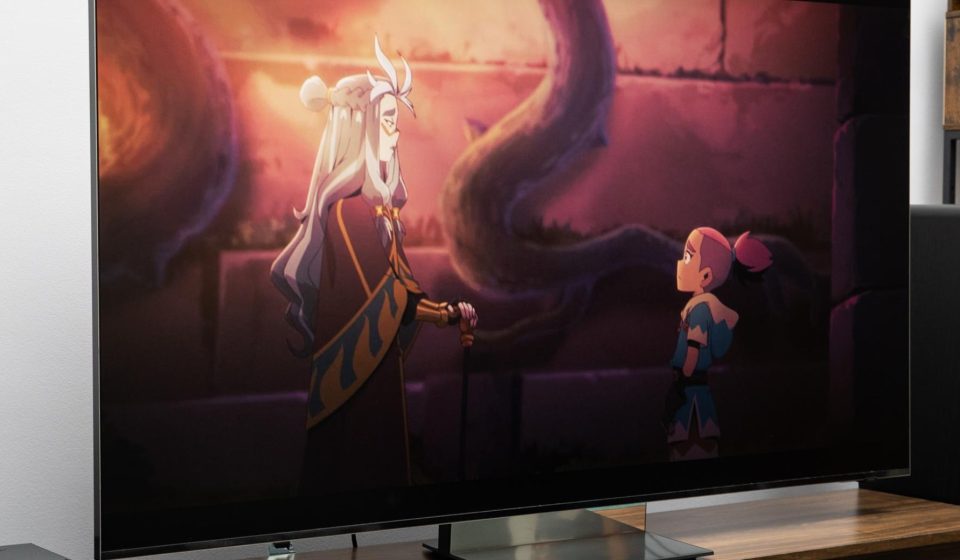

RGB LED TVs finally became affordable in 2026, and there’s always a lot of promise when new TV technologies emerge. More colors, higher brightness, improved performance: RGB LED TVs have a lot to prove. The Samsung R95H does a lot to deliver on some of these promises. It can display more colors than other TVs I’ve seen so far this year, and the combination of light output and its matte screen makes it ideal for a bright room. RGB LED TVs may still be in their infancy, but the R95H is a solid TV that shows off the benefits of new backlight technology.
Because RGB LED TVs use individual red, green, and blue LEDs for their backlight (instead of a field of white or blue LEDs), they can provide more colors than LED TVs. The Samsung R95H is one of the best examples when it comes to RGB LED TVs. It can fully display all colors used in the vast majority of films (which use the P3 color space) as well as a few that use the wider BT.2020 color space.


$ 2500
The Good
- The matte screen handles reflections incredibly well
- Good color accuracy in Filmmaker mode
The bad
- Some color crosstalk in white text
- Grayscale leans a bit towards cyan
- No Dolby Vision support
The accuracy of these colors is also very good in HDR (it’s not as good in SDR, because the TV overbrightens most of them). Some previous reviews called out poor color accuracy on the R95H, which I experienced with the first sample Samsung provided me in June. Samsung replaced this sample because I was concerned something was wrong. But in Filmmaker mode with firmware version 1247 on my current 65-inch TV, I was pleasantly surprised by the R95H.
HDR formats: HDR10 Plus, HDR10, HLG
HDMI inputs: 4 x HDMI 2.1 (one with eARC), up to 8 with Wireless One Connect box (sold separately)
Audio support: Dolby Atmos, Dolby Digital, Auracast, Q-Symphony
Game Features: VRR (up to 165 Hz), ALLM, Game Bar, FreeSync Premium Pro
Available sizes (inches): 65, 75, 85
The colors are wonderfully realistic. The green of the jungles Planet Earth IIwhich uses the BT.2020 extended color gamut, is beautifully vibrant, just like the hummingbirds that populate the trees. With films that use P3, the foliage in the demo material on the Spears and Munsil Ultra HD Reference The record doesn’t have quite the same sparkle, but it still sounds precise and realistic. Skin tones are natural. White and gray tones, like those in snow scenes, have a slight blue tint. It’s still pretty minor.
The R95H also has a good amount of light: a full-field white screen measured 694 nits, while specular highlights reached 2,206 nits in Filmmaker mode (the TV’s sharpest picture mode). It’s similar to the Sony Bravia 7 II but falls short of the Bravia 9 II by a few hundred nits and well short of the TCL X11L. The 2026 flagship OLEDs also have brighter highlights but darker all-white displays, as is expected of OLED panels. Black levels on the R95H are really good for an LED display. There is some blooming, but not as excessive as I’ve seen on some RGB LED TVs this year. Overall, the Samsung R95H delivers a punchy picture.
The anti-glare matte finish of the screen limits reflections. I’ve never been distracted by the reflection of overhead lights, as I can be with bright screens. The increased black level issue – where ambient light is captured behind the matte coating, making the screen look more gray than black – is much better. In a bright room, the black level increases slightly, but it’s not washed out and dark images still have depth.
I also had a great time playing it. Some past reviews have reported smearing issues, but recent firmware seems to have largely resolved this issue. During the race in F1 24 in 120Hz mode, movement was smooth. The TV struggled a little more when I set the Xbox to 60Hz, but I still enjoyed playing.


However, an inherent problem with RGB LED TVs is color crosstalk – I’ve seen it to some extent on all RGB LED TVs, although it’s least obvious on the Sony Bravia 9 II. This can happen when there is a dominant color on the screen close to a lighter color, such as white text, lighter skin tones, or white clouds. The dominant color can blend into these lighter colors, influencing their hue. This happens a bit on the Samsung R95H. This is more visible with white text. I’ve seen it with news tickers on red backgrounds, making the text subtly pink, and with games, especially playing No Man’s Sky. The text displayed above a large yellow hologram has a slight yellow coloring that disappears if I move my view away from the hologram. In fleeting moments it’s not too distracting, but when the color around the text is consistent the effect is noticeable.
Some TVs avoid this by defaulting the backlight to white and relying on the color filter, as LED TVs have done for years. While eliminating any possibility of color crosstalk, this also decreases the color brightness and wider gamut of the TV. So with RGB LED TV technology, where it currently is in its development cycle, there will be a trade-off between some color crosstalk or a more limited color gamut.
The R95H still has the same limitations as all Samsung TVs. There’s no Dolby Vision support (Samsung is an original supporter of HDR10 Plus and will likely never support its competitor Dolby Vision). It also runs on Tizen OS, which is still one of my least favorite interfaces. Everything is buried a click or two deeper than it should be, including input selection, making it tedious to use. The remote, rechargeable via USB-C and the solar panels on the back, is small and I’m not a fan of the button layout – they’re grouped together and the volume control feels clunky.


The R95H also remains more expensive than most of its competitors. The Sony Bravia 9 II has better processing and is brighter, although it also has more bloom than the R95H. If you can fit a 75-incher in your space, the TCL X11L is significantly cheaper since its launch. I think it’s a better TV overall. Then there are the flagship OLEDs – Samsung’s S95H and the LG G6 – which are both lower than or the same price as the R95H, depending on their size. And OLED is still a step ahead of RGB LED in terms of overall picture quality due to its better contrast.
There is still room for improvement in RGB LED TVs. With its wide color gamut, good out-of-the-box accuracy, and excellent matte display, the Samsung R95H is one of the best to come out this year. Against these RGB competitors, this constitutes a solid argument. But OLEDs still perform better overall with higher contrast, and even cheaper non-RGB LEDs can help you get there. less.
Photography by John Higgins / The Verge
I installed every TV in my living room on my home theater credenza. I stream movies and shows through the TV’s apps, and from an Apple TV 4K I play discs on my Oppo UDP-203 4K Blu-ray player (including the Benchmark Spears & Munsil Ultra HD disc) and play games on my Xbox Series Although I am an ISF Level 3 Certified Calibrator, I do not calibrate TVs prior to measurement, as the overwhelming majority of TV owners do not care about this. So it’s important to know how the TVs perform right out of the box, with minor menu changes anyone can make.
For measurement, I use Portrait Displays’ Calman color grading software, a Murideo 8K Seven pattern generator, an
Gn tech