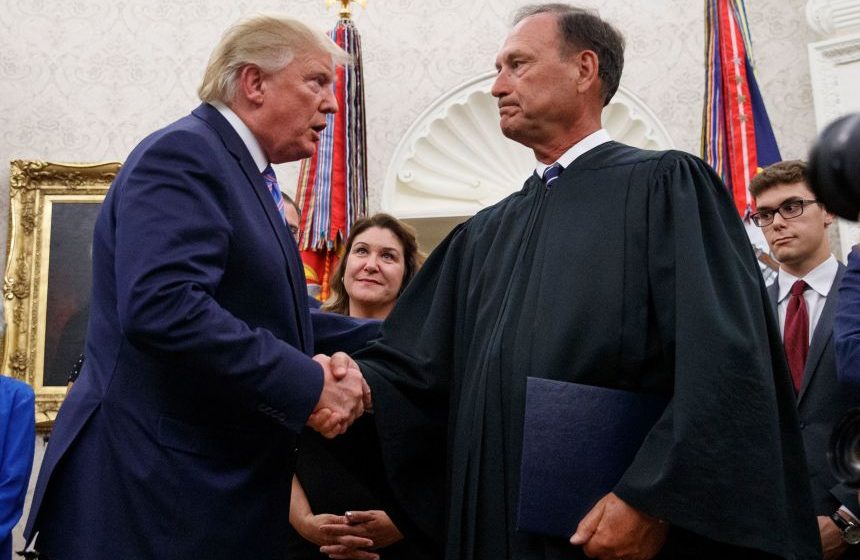
Samuel Alito and Clarence Thomas: the Democratic wave arouses concern in the Republican Party about the future of the Supreme Court

The Democratic rout in Tuesday’s midterm elections triggered an immediate sense of unease on the right about the future of the Supreme Court and a new wave of Republican anxiety over the decisions of Justices Samuel Alito and Clarence Thomas to hold out rather than resign.
Several sources close to the two conservative justices who were granted anonymity to speak freely told CNN on Wednesday that they did not expect either man to leave the court because of the election results.
But while it might dampen speculation about a judge’s confirmation attempt during a lame-duck session of Congress, it will nonetheless leave some conservative legal scholars in suspense for years.
“I hope Clarence Thomas and Sam Alito have historically great health insurance plans,” Josh Hammer, lead attorney for a group that helps support conservative judicial nominations, said on social media Wednesday.
As it became clear that Democrats were going to capture the Senate, some Republicans began to openly worry that President Donald Trump’s opportunity to solidify the 6-3 conservative majority on the Supreme Court had slipped through his grasp. They noted that Alito, 76, and Thomas, 78, could be over 80 by the time the next GOP president has a chance at the high court with a Republican Senate.
The Supreme Court’s conservative majority has been a defining feature of the Trump era, pushing abortion law, guns and religion to the right at breakneck speed. Although Trump played a major role in this dynamic – appointing three justices during his first term – it is possible that he will now finish his second term without a single appointment.
“No Supreme Court justice will be confirmed under President Trump’s administration unless something happens in the next six weeks,” Florida Republican Gov. Ron DeSantis said Wednesday. “That’s not just true for those two years, it would probably be true for the next four years.”
Alito and Thomas, the court’s most senior justices, made clear before the court’s current term began in October that they had no plans to retire. Alito also told Bloomberg News that he would stay even if Democrats took over the Senate.
But that belief will be tested in the coming days as Republicans try to pick up the pieces from the Democrats’ landslide victory and others inevitably draw comparisons to Justice Ruth Bader Ginsburg, a liberal whose decision not to retire when Democrats controlled Washington allowed Trump to solidify the court’s conservative leaning by appointing Justice Amy Coney Barrett. Ginsburg died in September 2020, a few weeks before that year’s presidential election.

Alito, who has served on the Court since 2006, will be 78 when the next presidential election is decided in 2028. If a Democrat wins the White House, the New Jersey native will have to wait at least four more years — until age 82 — for the chance to be replaced by a Republican president. Thomas, who has served on the Court since 1991, will be 80 in 2028 and 84 when voters choose a president in 2032.
These ages are not at odds with recent retirements at the Supreme Court, where justices serve for life but often resign after age 80. Justice Reagan nominee turned swing judge Anthony Kennedy was 82 when he retired in 2018 during Trump’s first term and was replaced by Justice Brett Kavanaugh. Liberal justice Stephen Breyer was 83 when he resigned and gave President Joe Biden the opportunity to nominate Judge Ketanji Brown Jackson.
Both Alito and Thomas appear to be in good health, although the court rarely provides details about the justices’ care. CNN reported in April that Alito was taken to the hospital after falling ill at a Federalist Society dinner in Philadelphia. He was evaluated and given fluids for dehydration at that time. Thomas missed several disputes in 2022 after being hospitalized to receive treatment for what a court spokesperson described at the time as an infection.
Both are eligible to enroll in the same health care plans as other federal employees.
Over the weekend, Thomas celebrated his 35th anniversary on the Supreme Court, and Chief Justice John Roberts deviated from the normal flow of oral arguments Monday to take note.
“Three and a half decades later, Justice Thomas is only the second justice in the history of this court to take this historic step,” Roberts said.
Thomas would become the longest-serving justice in 2028.
Alito and Thomas consistently vote for conservative outcomes and are figures beloved by the right and often criticized by the left.
Alito wrote the majority opinion in 2022, overturning Roe v. Wade, completing a decades-long project of the conservative legal movement. Earlier this year, Alito authored a 6-3 opinion that largely gutted the Voting Rights Act when it came to redistricting, a decision that helped the GOP to some extent. Thomas authored a landmark opinion in 2022 expanding Second Amendment rights and is widely considered a jurist who refuses to compromise his beliefs.
Dismay over their seats is sure to reignite speculation that either justice will step down during the lame-duck session of Congress, in which Republicans will retain control of the Senate. After Ginsburg’s death, Trump, aided by then-Senate Majority Leader Mitch McConnell, rushed Barrett’s confirmation in just over a month.
But this approach would carry risks. Ed Whelan, a conservative legal commentator who writes regularly about confirmations, noted that any attempt at confirmation before the new Senate is sworn in could backfire given that a number of lame-duck senators such as John Cornyn of Texas and Thom Tillis of North Carolina “won’t be eager to oblige Trump.”
Asked by Bloomberg News last month if he was a “definite no” to the idea of retiring in a lame-duck Congress, Alito responded: “Yeah.”
At the same time, Alito acknowledged in an interview with CBS News in October that he had at least considered retirement as “something that I think someone my age needs to think about every term.”
There is no indication yet that Republicans in the White House or Senate are considering a lame duck confirmation battle.
There was also little indication that Alito or Thomas were distracted by political calculations being made on their behalf as they took the stand Wednesday to hear a case involving a Texas death row inmate. Alito entered the ornate courtroom with a tight smile and a few questions. He spent more time than usual leaning back in his black leather chair, rocking as the hour-long technical discussion on habeas corpus unfolded.
Thomas was particularly engaged, asking pointed follow-up questions that indicated skepticism that the inmate, Dexter Johnson, should be able to file a new habeas suit to challenge his sentence. Thomas even made his colleagues laugh with a tongue-in-cheek question about whether the seminal 1803 decision in Marbury v. Madison could be considered “new” under the theory raised by Johnson’s lawyer.
Gn headline