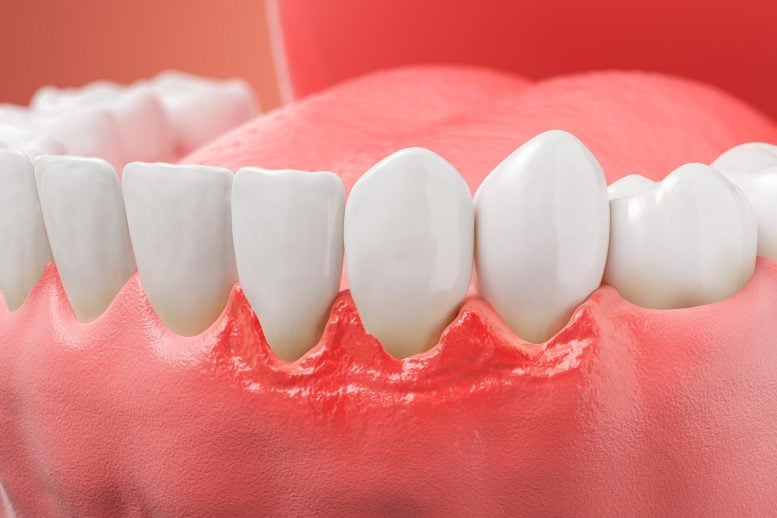
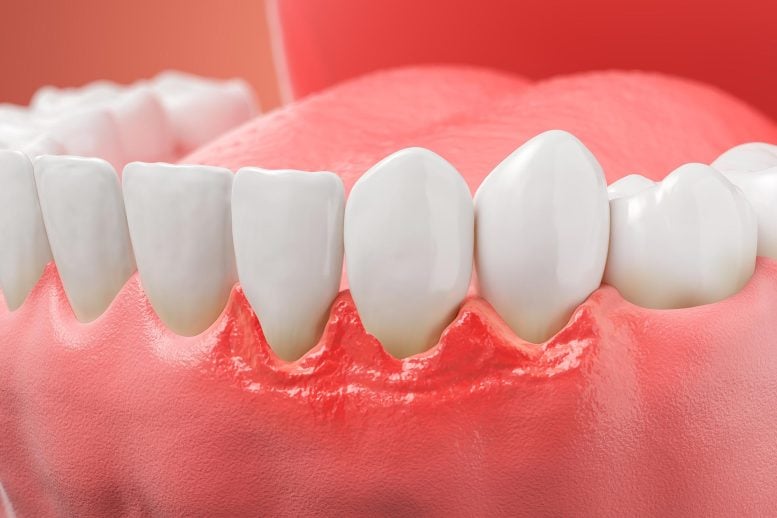
Gum disease can eat away at the bone that holds teeth in place, and a small cage made of DNA helped slow this damage in rats.
Researchers at Sichuan University have constructed a DNA carrier that delivers two compounds together to treat periodontitis, a chronic form of gum disease and a leading cause of tooth loss in adults. The team, led by Geru Zhang, Yunfeng Lin and Xiaoxiao Cai, published their findings in the International Journal of Oral Science.
Periodontitis begins when bacterial plaque builds up under the gums. The resulting immune response can gradually destroy the tissue and bone that anchors the teeth. Deep cleaning and antibiotics can reduce bacteria numbers, but they can leave existing damage unrepaired and do not always prevent disease progression.
How a DNA cage offers two treatments
“We aimed to create a multifunctional DNA nanoplatform capable of delivering both curcumin and the antimicrobial peptide defensin directly to periodontal tissues, aiming to overcome the limitations of existing therapies,” Zhang said.
The team loaded the two compounds into tiny four-sided DNA structures called tetrahedrally structured nucleic acids (tFNAs). The researchers tested the resulting complex, called Cur-de-tFNA, against bacteria linked to periodontitis and used a bacterial molecule to trigger inflammation in human periodontal ligament stem cells (PDLSCs) in the laboratory.
“The DNA carrier improved the stability and cellular uptake of curcumin while protecting defensin from degradation, allowing both therapeutic agents to work more effectively,” Lin said.
Treatment slows bone loss in rats
In laboratory tests, the combination treatment outperformed its individual components in several experiments. It worked against bacteria linked to gum disease, reduced oxidative stress, and attenuated an inflammatory signaling pathway called TLR4/NF-κB. It also increased the levels of proteins involved in bone formation.
In rats with periodontitis, the treatment reduced bone loss and inflammatory damage around the teeth. The researchers observed less activity of the cells that break down bone, as well as more collagen deposition and new bone formation. “As a result, the nanoplatform enabled stronger antimicrobial activity, better inflammation control, and better periodontal tissue preservation in preclinical models,” Cai said.
The biodegradable DNA carrier was well tolerated in preclinical testing. Human trials are needed to determine whether the treatment is safe and can help preserve or rebuild the tissues that support teeth.
Reference: “DNA framework-based nanomedicine platform: a triple-function strategy to treat periodontitis via antibacterial, anti-inflammatory and osteogenesis-promoting activities” by Geru Zhang, Weitong Cui, Haoyan Wu, Xiaowei Liu, Liwei Huang, Yunfeng Lin and Xiaoxiao Cai, April 29, 2026, International Journal of Oral Science.
DOI: 10.1038/s41368-026-00439-2
This study was funded by the National Natural Science Foundation of China, National Natural Science Fund for Young Scientists Fund C Program, Postdoctoral Fellowship Program, Sichuan Science and Technology Program, Sichuan Province Youth Science and Technology Innovation Team, Health Commission of Sichuan Province Medical Science and Technology Program, Sichuan Province Innovative Talent Funding Project for Postdoctoral Fellows, Foundation Sichuan Provincial Youth Natural Sciences and Sichuan University.
Never miss a major breakthrough: join the SciTechDaily newsletter.
Follow us on Google and Google News.
Gn Health