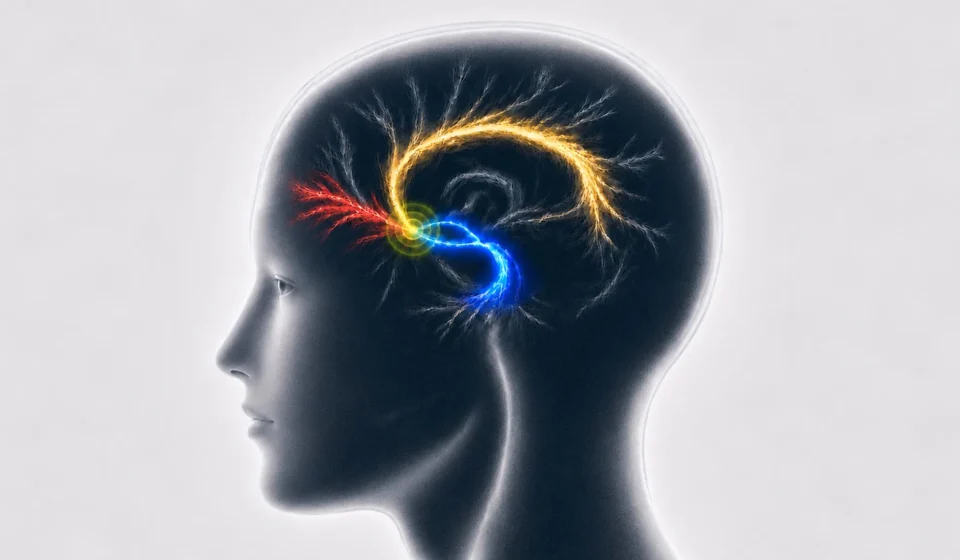

Mount Sinai scientists have identified three important brain connections associated with long-term improvement in patients receiving deep brain stimulation (DBS) for severe depression that has not responded to conventional treatments. This discovery could help researchers make this experimental therapy more precise and effective.
Published on October 1 in the American Journal of PsychiatryThe research examined the largest group of patients collected to date in several independent cohorts who had received subcallosal and cingulate deep brain stimulation (SCC DBS) for treatment-resistant depression.
Researchers found that lasting improvements were consistently associated with electrical stimulation reaching three specific white matter pathways: the cingulum fasciculus, forceps minor, and medial uncinate fasciculus/ventral amygdalofugal pathways.
These findings strengthen the case for using detailed maps of brain connections to determine exactly where electrodes should be implanted, rather than choosing their positions based primarily on anatomical landmarks. Known as connectome-based targeting, this strategy has already helped shape the ongoing Abbott TRANSCEND clinical trial, a randomized, controlled study that uses individualized brain connectivity maps to guide SCC DBS treatment.
“This study highlights the importance of individualized surgical targeting to achieve optimal results with deep brain stimulation for depression,” said Helen Mayberg, MD, professor of neurotherapeutics at Mount Sinai and founding director of the Nash Family Center for Advanced Circuit Therapeutics at the Icahn School of Medicine at Mount Sinai. “In any randomized controlled trial of a neuromodulation treatment, precise placement of probes and confirmation that the intended brain target has been engaged are essential first steps. We still have much to learn about which patients are most likely to benefit from stimulation of that particular target, but developing imaging-based signatures that can match patients to their optimal treatment remains a central goal of our research.”
How Deep Brain Stimulation Targets Severe Depression
For people with treatment-resistant depression, standard therapies have failed to provide adequate relief. Researchers are studying deep brain stimulation as a possible treatment for people living with severe and persistent symptoms.
The procedure involves surgically placing electrodes inside the brain to transmit controlled electrical signals to circuits involved in depression. However, correct positioning of the electrodes remains one of the biggest challenges.
Electrical stimulation does not simply affect the brain tissue closest to an implanted electrode. It can also influence larger networks via white matter pathways that connect different regions of the brain. As a result, two patients with electrodes implanted in nearly identical locations can experience very different results depending on which connections are actually stimulated.
Previous research from Mount Sinai and Emory University has established the importance of these networks. In studies published between 2014 and 2023 in Biological Psychiatry, Molecular PsychiatryAnd NatureThe teams identified white matter pathways associated with successful treatment of CTS DBS and developed a method for planning electrode placement using brain connectivity maps.
The latest investigation sought to determine whether these links were also important in patients treated at other research centers. The scientists also wanted to understand whether differences in the pathways reached by the stimulation could help explain why patients were not benefiting.
Three brain connections linked to lasting improvement
To investigate, researchers reviewed information from several clinical studies, including the BROADEN trial and a cohort of patients from the University of Toronto, where SCC DBS was initially developed.
They used computer models of the electric fields generated by the implanted electrodes as well as maps of brain connectivity. This allowed them to estimate which pathways received stimulation and compare these patterns between different groups of patients.
Results showed a consistent relationship between sustained improvement and stimulation of the cingulum fasciculus, forceps minor, and medial uncinate fasciculus/ventral amygdalofugal pathways.
One discovery was particularly remarkable. Across study sites, patients who had not responded to treatment after two years showed a lack of stimulation engagement with the left cingulum bundle.
The researchers did not test whether moving the electrodes to reach this pathway would improve these patients’ symptoms. Nevertheless, this model offers a possible explanation for why seemingly similar electrode placements can produce different results. An electrode may be positioned in the correct general region but still fails to activate all of the connections associated with lasting improvement.
“This study addresses an important question in DBS: not only which area of the brain to stimulate, but what connections within that area should be engaged,” said Brian Kopell, MD, director of the Mount Sinai Neuromodulation Center. “For a network disorder such as depression, millimeters can determine whether stimulation reaches the pathways we intend to modulate. Identifying and reproducibly engaging these pathways gives us a more precise surgical target and a framework for understanding why otherwise similar electrode placements may produce different clinical outcomes.”
Towards more personalized treatments for depression
Although it seems important to achieve all three pathways, the researchers emphasize that electrode placement alone is unlikely to determine whether a patient improves.
The investigation focused on identifying which brain connections should be stimulated. Further studies are needed to determine which people are most likely to benefit from SCC DBS and how electrical stimulation should be adjusted as treatment continues.
The brain imaging data also had limitations. Individual diffusion MRI scans, which can provide information about a person’s white matter connections, were not available for all participants. Therefore, much of the analysis used generalized maps of brain connectivity rather than maps created specifically for each patient.
For the Emory patient group, the researchers were able to compare results obtained from generalized connectivity maps with those based on individual diffusion imaging. Both approaches produced consistent results, further supporting the importance of the identified pathways. However, further research is needed to establish the value of patient-specific imaging.
Future investigations will explore whether additional brain imaging measures, including white matter integrity and functional connectivity, can help identify appropriate patients, improve electrode placement, and guide treatment parameters.
“Our results show that precisely engaging these white matter pathways is a critical first step toward a durable response,” said Ki Sueng Choi, PhD, associate professor, imaging leader at the Center for Advanced Circuit Therapeutics at Mount Sinai and corresponding author of the study. “The next step is to characterize abnormal functional and structural states of the brain along these pathways to create more detailed models to define patient-specific stimulation parameters, including amplitude, frequency and pulse width, for precision medicine.”
By combining increasingly detailed brain maps with personalized stimulation settings, scientists hope to better understand why some people experience lasting relief while others do not. The findings represent another step toward developing more targeted treatments for severe depression, although additional clinical research is needed to determine the extent to which these approaches can improve outcomes.
Research funding and disclosures
The research was supported by the National Institutes of Health BRAIN Initiative through grant UH3NS103550, the Hope for Depression Research Foundation, and the DANA Foundation.
Abbott’s Neuromodulation business provided data for the BROADEN clinical trial but was not involved in the design or analysis of the current study.
Conflict of Interest Disclosures: Dr. Brian Kopell is a paid consultant to Abbott Laboratories.
Dr. Helen Mayberg is co-inventor of a method that uses deep brain stimulation (DBS) in a particular brain region (the subcallosal cingulate area) to treat treatment-resistant depression. The method was licensed to Abbott Laboratories. Dr. Mayberg has received royalties from Functional Neuroscience related to this technology and is eligible to receive additional payments in the future. She is also a paid consultant to Abbott Laboratories on their clinical trials involving DBS for depression.
Dr. Ki Sueng Choi and Dr. Martijn Figee are also paid consultants to Abbott Laboratories.
Dr. Mayberg, Dr. Kopell and Dr. Choi are named co-inventors of a patent application covering a technique for identifying optimal electrode placement in deep brain stimulation for depression. The patent application was filed through Mount Sinai and the technology remains unlicensed. However, this approach was used in the TRANSCEND clinical trial.
Gn Health