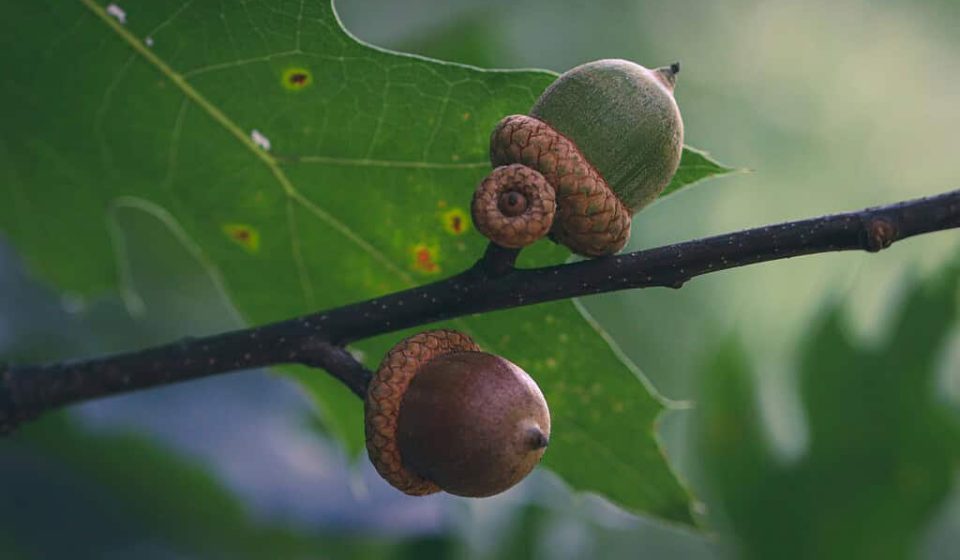

The next time you drive through an oak forest in autumn, look down. Those acorns scattered on the ground might tell you something about the future. Specifically, whether or not ticks will have a good year in two summers.
This seems like an unlikely connection. But after more than 35 years of tracking wildlife, researchers in New York have discovered that acorn production can help predict the risk of exposure to Lyme disease nearly two years in advance. The explanation involves a chain reaction connecting oak trees, hungry mice and blood-sucking ticks.
From acorns to ticks
Every few years, oak trees produce huge quantities of acorns in an event known as masting. For forest animals, it’s an all-you-can-eat buffet. For white-footed mice, in particular, it can mean the difference between a harsh winter and a population boom.
With more food available, more mice survive and reproduce. The following summer, the forest can be full of them.
Meanwhile, ticks are looming on the eve of this event.
Blacklegged ticks, the primary carriers of Lyme disease in the northeastern United States, have a complicated life cycle. They hatch as tiny larvae, usually free of the bacteria. Borrelia burgdorferiwhich causes Lyme disease. To grow, they need a blood meal.
White-footed mice are excellent hosts. Not only do they allow large numbers of tick larvae to successfully feed, but they are also remarkably effective at transmitting Lyme bacteria to those ticks.
After feeding, the larvae abandon their hosts and eventually transform into nymphs. These tiny, immature ticks emerge the following year, ready to receive another blood meal. Unfortunately, this meal may have come from a human.
The result is a delayed chain reaction.
Surprisingly, this is not a new observation
The connection is not entirely new. Scientists have demonstrated aspects of this in research published in Science in 1998 and a follow-up study in 2001. But decades of additional observations have now strengthened the evidence and revealed how this relationship fits into a much more complex ecological system.
In the new analysis, published in Proceedings of the National Academy of SciencesThe researchers examined data collected since 1991 at the Cary Institute of Ecosystem Studies in Dutchess County, New York.
They found that years when mice were abundant were followed by about 40 percent more nymphal ticks, according to their best-supported statistical model. Nymphal ticks are the eight-legged immature developmental stage responsible for the vast majority of cases of Lyme disease. Acorn production, in turn, predicted mouse abundance the previous year.
In other words, researchers could see a potential tick boom long before the ticks themselves appear.

The situation for deer is more complicated
For decades, white-tailed deer have been closely associated with Lyme disease. There’s good reason for this: Adult blacklegged ticks frequently feed and mate on deer, and a single engorged female can lay thousands of eggs.
No more deer, no more ticks; simple thought. But long-term data tells a different story.
Although deer abundance fluctuated more than six times during the study period, the researchers found no statistically significant relationship between deer numbers and nymphal tick abundance two years later.
Deer still play an important role in the tick life cycle. They were simply not useful indicators of year-to-year changes in nymph numbers at these sites.
Mice were a much better predictor. But even with mice, the relationship was complicated.
Mice and ticks
Since white-footed mice are so effective at transmitting Lyme bacteria, scientists initially assumed that having more mice would also increase the rate of Lyme bacteria transmission. percentage of ticks carrying the infection.
But that wasn’t the case.
Over the long term, approximately 15 to 30% of nymphal ticks at the study sites carried Lyme bacteria, with the prevalence of infection remaining relatively stable despite fluctuations in mouse abundance.
Researchers suspect the explanation lies in the rest of the forest. Ticks also feed on squirrels, chipmunks, birds and other animals, many of which are much less effective at transmitting the bacteria.
What matters is not just how many mice live in a forest, but also how tick blood meals are distributed throughout the animal community.
And what matters most when it comes to predicting Lyme disease risk is apparently acorns.
Can we really predict Lyme disease?
The possibility of using acorns as an early warning system is particularly interesting because Lyme disease is a significant public health problem.
The U.S. Centers for Disease Control and Prevention estimates that approximately 476,000 people are diagnosed and treated for Lyme disease each year in the United States, although this estimate based on insurance claims may include some people without confirmed infections.
The illness can cause fever, fatigue and a characteristic rash. Without timely antibiotic treatment, it can sometimes affect the joints, heart and nervous system.
Knowing when tick populations are likely to increase could help public health officials prepare warnings and direct prevention efforts.
Counting acorns alone won’t help us predict Lyme disease outbreaks. But combined with information about mouse populations, tick abundance and the ecosystem as a whole, they could offer an unusually early warning of when risk might increase. The researchers’ findings suggest that predicting disease threats requires looking beyond the animals that carry them.
After all, a tick bite can happen in an instant. But the chain of events that makes it more likely may begin years earlier, with an oak tree dropping its seeds on the forest floor.


Gn Health