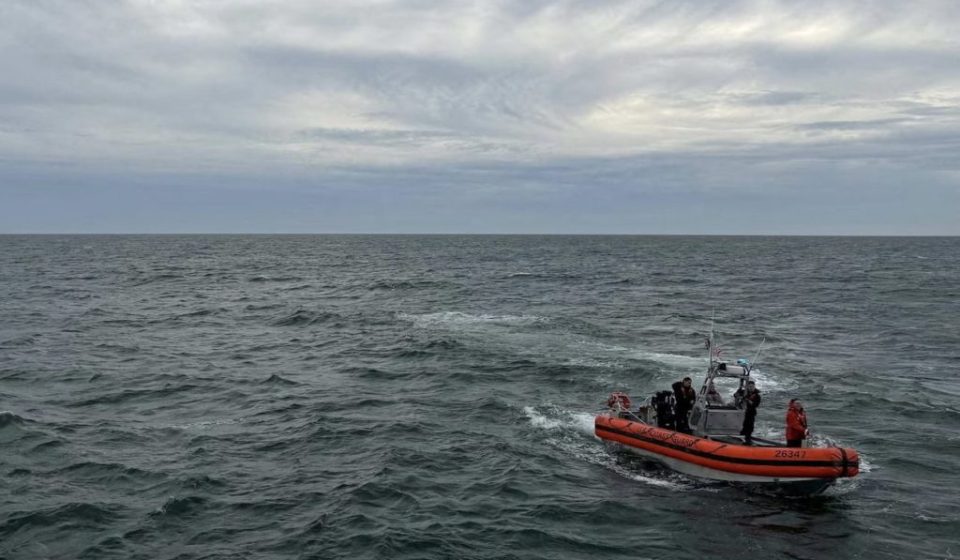
Search continues for missing Bermuda to Boston medical flight as crews plan to scour the ocean floor

The search continued off the coast of Massachusetts on Sunday for an air ambulance carrying six people missing on a flight from Bermuda to Boston as authorities planned to search the seabed, the US Coast Guard said.
The Federal Aviation Administration contacted the Coast Guard at 2 a.m. Saturday to inform it that it had lost contact with the Gulfstream G100 carrying four Canadians and two Bermuda nationals over the Atlantic Ocean. Later Saturday, searchers found a “debris field” off the coast of Nantucket, Coast Guard Northeast District Rear Adm. Matt Lake said at a news conference Sunday.
READ MORE: Air traffic control calamity disrupts hundreds of US flights, putting spotlight on aging system
Coast Guard crews, the New York National Guard Air Rescue Wing and Massachusetts authorities have since searched an area covering 2,840 square miles (7,356 square kilometers) using fixed-wing aircraft, helicopters, boats and cutters.
“This is a large and challenging research area,” Lake said.
The water depth around the debris field was 80 to 90 feet (approximately 24 to 27 meters). The Coast Guard was deploying sonar to search the seabed, he said.
The Coast Guard has informed the next of kin of those on board the Canadian-registered air ambulance plane of the search progress, Lake said.
Weather was not a factor in the search efforts, said Coast Guard Capt. John McTamney, response chief for the Northeast District.
“We will continue to search and saturate the area until we are confident that if there were any survivors remaining on the surface of the water, we would have found them,” McTamney said.
The plane had four crew members and two passengers on board when it left Bermuda’s LF Wade International Airport for the overnight flight to Massachusetts, according to a statement from Bermuda airport operator Skyport.
The sound of air traffic indicates that the plane may have “arrived blind” as a storm loomed shortly before its disappearance.
The pilot reported electrical problems and declared an emergency as the plane approached the coast, according to air traffic control audio released by LiveATC.net. “Roger, you said you came blind. Is that what you said?” a controller can be heard asking the pilot.
That leads Mary Schiavo, a former Department of Transportation inspector general, to believe the plane may have lost its navigation instruments just as a storm crossed its path on radar. The plane also descended sharply from its cruising altitude of about 24,000 feet to about 10,000 feet, according to preliminary data from flight tracking site FlightRadar24.
“Something bad happened with this big crash, and they flew into this big storm. It’s a terrible place to be to lose your instruments and fly blind,” said Schiavo, an aviation attorney. “It’s very easy to get disoriented and not know if you’re turning, going up, going down, etc.”
Transport Canada was closely monitoring and working with authorities on search and rescue efforts, the country’s Transport Minister Steven MacKinnon said on the social platform X.
AP Transportation Writer Josh Funk and Associated Press reporter Laura Turbay in Little Rock, Arkansas, a corps member for the Associated Press/Report for America Statehouse News Initiative, contributed to this report. Report for America is a nonprofit national service program that places journalists in local newsrooms to report on under-reported issues.
A free press is the cornerstone of a healthy democracy.
Support trusted journalism and civil dialogue.
Gn headline