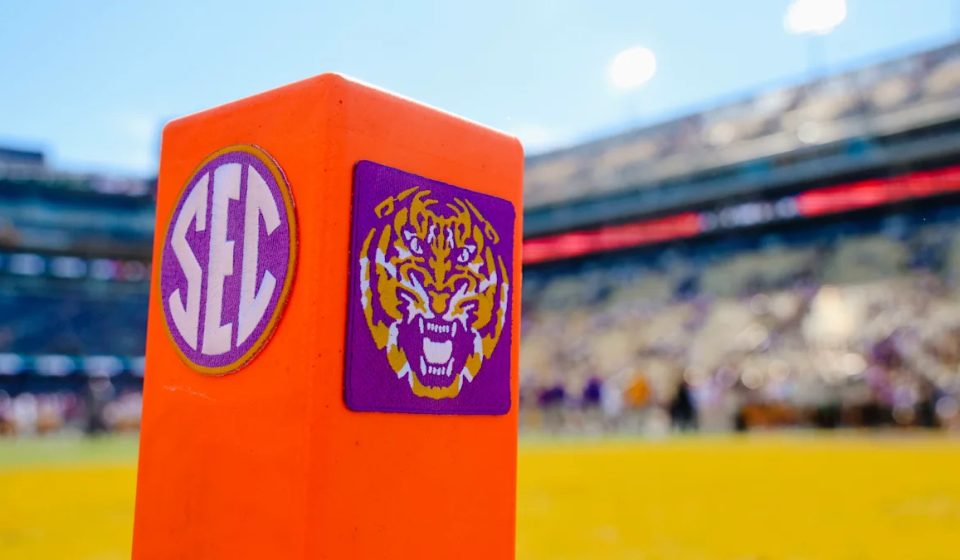
SEC mulls dismissal of LSU as member school after latest incident involving RJ Luis – ‘Get your popcorn ready’

Last week, LSU did something that college administrators and coaches told the SEC they wouldn’t do.
At a game in Baton Rouge, men’s basketball coach Will Wade played against RJ Luis, the basketball player who signed a professional contract and even appeared in some NBA preseason games before an injunction allowed him to return to college.
Advertisement
A day after that event, LSU President Wade Rousse announced what appeared to be an end to the spicy melodrama between the university and his own conference. In a statement Thursday, Rousse revealed that LSU would no longer play Luis. This statement follows a conversation Rousse had with SEC Commissioner Greg Sankey.
That’s it, right? Was this months-long public legal battle between a school and its own league over?
This is not the case.
On Monday, in another landmark lawsuit against LSU in federal court, the SEC made clear it’s not over. The league intends to hold a special meeting of presidents on Dec. 3 to consider expelling LSU from the conference. These are actually direct comments from Sankey himself, whose four-page statement was part of Monday’s court filing.
Advertisement
Court documents paint a confusing picture of the brewing battle between LSU and the SEC — a contentious fight more than three months old that has even involved Louisiana’s governor and attorneys general.
But are the threats of eviction real? Is the SEC really going to kick one of the oldest members and one of the biggest brands out of the conference?
If you talk to conference attendees, the answer is yes. In fact, those in the SEC – and even some at LSU – believe the league presidents have the necessary 11 votes (out of 16) to revoke the university.
But there are likely solutions to the quagmire the Tigers find themselves in. (Let’s be clear, they end up here primarily because of their own risky decisions, many of which were made despite the advice of some prominent members of LSU.)
Sankey’s own statement offers a potential path for LSU to stay in the conference (maybe). In line #30 of the Commissioner’s Statement, he writes: “As of the time of filing this statement, Mr. Luis has not dismissed his lawsuit against the SEC. »
Advertisement
The lawsuits against Luis and Jack Pyburn (the football version) against the SEC have not been withdrawn. Is the SEC’s potential expulsion vote a way to encourage – albeit strongly – LSU to convince lawyers for Luis and the football players to dismiss or withdraw their cases?
Maybe.
The SEC informed LSU of this decision: you have 10 days.
“In consultation with and at the direction of the SEC Chairman and based on informal comments from other Conference CEOs, I have given formal notice of a special meeting of the Conference, to be held on December 3, 2026, to consider termination of LU’s membership in the SEC,” Sankey wrote in the new court documents.
Advertisement
One person in Louisiana on Monday thought there was another way to rectify this situation: LSU self-imposes some sort of punishment or agrees to sanctions from the SEC, such as suspension and/or probation of Will Wade for multiple games or forfeiture of games.
It’s unclear what the SEC chairs will agree to to resolve the issue.
“Get your popcorn ready,” said one person involved in the mess. “Maybe you’ll get yourself an old-fashioned one too.”
There are many dynamics at play here on both sides.
The SEC claims that LSU and its coaches, Wade and Lane Kiffin, orchestrated and supported lawsuits by players who signed professional contracts (there is evidence of this) in an effort to have them play despite violating league rules. Although LSU never enrolled football players Dae’Quan Wright and Zxavian Harris, the school enrolled and then played Luis after a Louisiana judge granted him an injunction to play and protected him from SEC enforcement of its rules.
Advertisement
The university claims it had no choice but to play Luis or risk being held in contempt by the court itself for violating an injunction. Many SEC members believe the school misinterpreted the injunction and only used it to put Luis down — especially given what happened a day later.
Last Thursday, after that conversation with Sankey which took place just before a previously scheduled presidents’ meeting, Rousse released her statement announcing that Luis would no longer play for the Tigres.
Such a decision did not end this debacle for several reasons.
On the one hand, as previously mentioned, the SEC likely wants LSU to accept, at the very least, some sort of penalty for its actions — playing against Luis and having its coaches intentionally support lawsuits for rule violations.
Advertisement
In news never made public, the school and league were close to agreeing last month to a truce in which the SEC would dismiss his lawsuit and LSU would, at the very least, publicly acknowledge its wrongdoing and perhaps even agree to sanctions. They could not reach a compromise.
But perhaps the biggest reason is a little thing called conference autonomy. Remember these words because you’ll hear them a lot over the next few months, including in the SEC’s own statement regarding the new court filing released Monday. The lawsuit against LSU “aims to protect the conference’s ability to govern itself and enforce the rules and policies that member universities themselves have voluntarily adopted,” the statement said.
Conferences, like the SEC, attempt to establish or reaffirm their own rules and apply them to their own members under league-wide governance models, in place of the NCAA’s rules, which have mostly been hamstrung by court rulings (judges have deemed the NCAA’s amateurism rules to be in violation of antitrust law). In theory, conference officials believe they can avoid legal challenges by imposing smaller-scale regulations with league-wide rules.
Advertisement
We’ll see. Some disagree.
But the fact is, many LSU students believe the university is being unfairly disciplined by mom and dad when other kids have committed similar acts without punishment in the past, namely former professional player Charles Bediako’s play at Alabama in February.
“Why are we taken as an example?” asked a Baton Rouge-based stakeholder.
The answer is simple: timing.
Conferences began mobilizing this fall to establish league rules after House rule failures and with a federal bill that still hasn’t passed Congress.
But one person asked, “How far is the SEC willing to go to prove it can govern itself?” »
Advertisement
The presidents could respond to it next Thursday.
In the meantime, have your popcorn – and the old fashioned way – by your side.
“There are people who think this is a bluff,” said another person involved in the legal battle. “They set a specific date. We don’t set a meeting if it’s a bluff.”
Gn sports