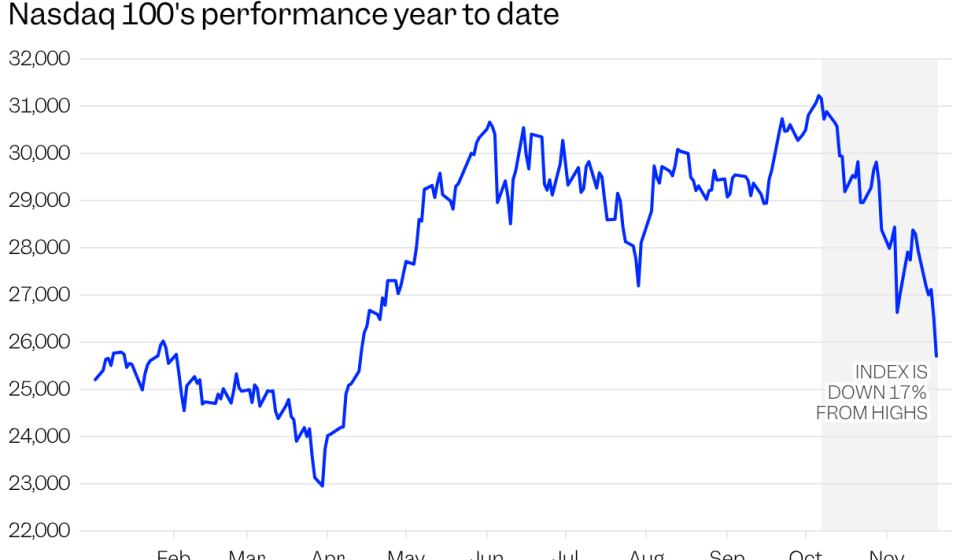

Wall Street is staring at a sea of red in tech and AI names since the market hit all-time highs just a month ago.
A brutal sell-off in tech stocks that lasted several weeks sent the Nasdaq Composite into negative territory for the year on Friday, while dragging the S&P 500 and Dow Jones into a correction.
Today, more and more Wall Street forecasters are asking investors a tough question: Is the AI business over?
Concerns about the end of the artificial intelligence-fueled bull market have grown amid the bloodbath in the technology sector. The selling was driven by panic over slowing AI investments, mid-term blunami and the impact on data centers, as well as the Nvidia crisis which sent the stock down 47% since early October.
More recently, Anthropic’s IPO came and went without having a positive impact on the market as a whole. The record public offering was supposed to give the AI sector a much-needed boost, and the mixed market reaction is the latest evidence that the AI business is in trouble.
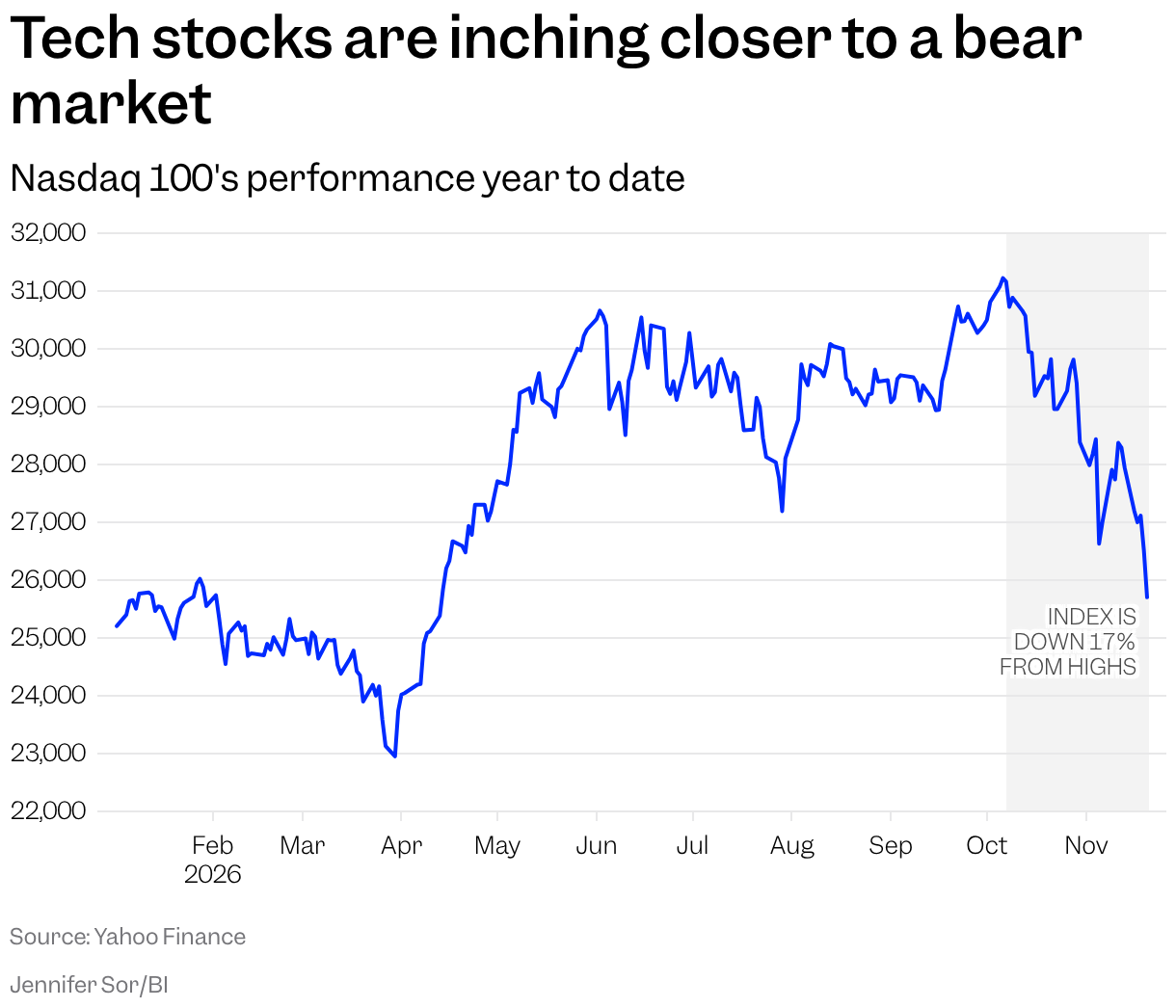
The Nasdaq 100 is moving closer to an official bear market. The tech-heavy index is down 17% from its all-time high earlier this year, but many parts of the tech sector are already in bearish territory.
More painful losses are being felt in the chip, memory, data center and neocloud sectors.
Wells Fargo is signaling the risk of a broader reset of valuations in the AI space, the bank wrote this week, triggered by factors including higher rates, high oil prices, signs of economic weakness and tighter regulation of AI, Sameer Samana, the bank’s head of global equities and real assets, told Business Insider.
Samana said the market reaction to Anthropic’s mega-IPO this week reinforced the bank’s view that the AI sector could be in the midst of a reset. He declined to give an estimate of the extent of the possible fall in stock prices, but offered a hypothesis in which profit growth would collapse by 33%, leading to a decline in valuations.
“The IPO sucks a lot of liquidity from other parts of the market,” he said, adding that the bank favors large-cap communications services, industrials and materials stocks to avoid becoming “overly dependent on the AI story.”
“We expect volatility to remain elevated as markets re-evaluate AI spending, regulation, industry leadership and the conversion of investments to free cash flow,” the note added.
With Anthropic’s IPO looming, investors are once again turning their attention to AI investments, and many are wondering whether spending will continue to hold up and justify mega-valuations in the tech space.
A major fear is that data center spending will slow over the next year as lawmakers crack down on new construction, limiting the sector’s growth.
Investment research firm TS Lombard said it had changed its position on global stocks to “underweight”, reducing AI exposure areas in the United States and Taiwan. The firm added that it was “skeptical” that the market could completely avoid an AI crash, and in a separate note it laid out a scenario in which the market experiences a “definitive change in mood” by the end of 2027, leading to a 40% crash in AI-related stocks by early 2028 as tech companies reduce their investment forecasts.
“The question was whether AI could generate massive, unprecedented revenues that could justify these multibillion-dollar investments, especially when the underlying technology was now available for free and most ordinary people just weren’t very concerned. By early 2028, the answer to that question was a resounding “no,” the strategists wrote of their hypothetical scenario.
Capital Economics, a research firm that has long warned of an AI bubble, highlighting the risks of revenue and investment in AI. The firm predicted the S&P 500 would fall 9% through the end of next year in a note following Anthropic’s IPO, although the index could post even bigger losses in the meantime.
“The revenue barrier to justify the scale of investment in AI seems very demanding. And a combination of other risks, even in minor form, seems plausible: for example, somewhat stricter regulation of the development and application of AI, as well as a tightening of AI-related funding,” the researchers wrote.
“An AI stock market collapse in 2027 has long been our central prediction and appears to be a growing concern for investors,” the company added.
Citi said it reduced its risk exposure to U.S. stocks last month and, in a note this week, advised investors to stay on guard. The bank highlighted fallout risks related to Nvidia, given that the chip giant supports a wide range of data center projects, neocloud providers and AI companies.
Jensen Huang’s departure is also seen by some investors as a near-existential risk, given that Huang has served as an unofficial model of the AI business.
“AI risks have increased,” the analysts write, adding that stock rotation has recently resembled the “extreme” moves that led to the bursting of the dot-com bubble.
Others dispute the extent of technology’s decline from record levels.
Prominent AI researcher Gary Marcus highlighted losses across the tech sector in his newsletter, Marcus on AI, on Friday. The Global X Artificial Intelligence & Technology ETF, for example, is down 24% from its summer high.
“In the months (or even days) to come, Nvidia and Neoclouds will be hit hard,” Marcus wrote in a note on Substack. “It appears that the death spiral that this newsletter has long been warning about has begun.”
Gn headline