
Semiconductor stocks saw a sharp sell-off on Friday, October 30, after IntelForecasts fell well short of expectations due to the decline in the personal computer (PC) market.
THE PHLX Semiconductor Sector the index fell 7% in a single session. Actions of Nvidia (NVDA -0.50%) were down more than 4% on October 30, while other popular semiconductor stocks, such as Broadcom (AVGO +0.43%) And Micron technology (UM -0.71%)has also declined considerably.
However, I think the sell-off in this sector is overdone. Indeed, chips play a central role in various applications, including artificial intelligence (AI), smartphones, computers, vehicles and factories. Bank of America estimates that U.S. semiconductor industry revenues alone could reach $3.2 trillion in 2030, up from an estimated $1.7 trillion this year.
As such, now is a good time to buy some of the biggest names in this sector after the recent pullback.

Image source: Getty Images.
The AI boom will provide solid growth for these semiconductor companies
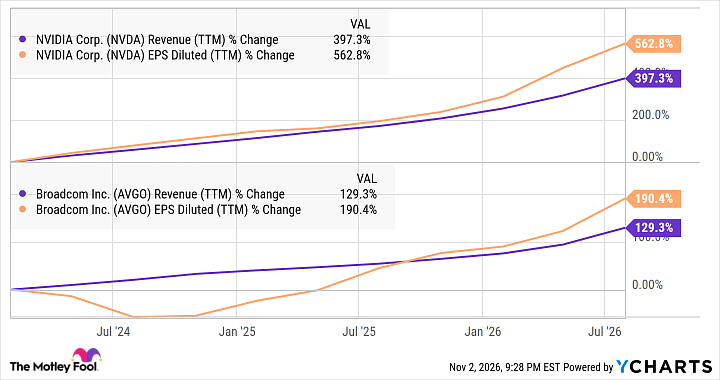
Nvidia and Broadcom are among two major semiconductor companies capitalizing on demand for AI-powered chips. Both companies have seen solid growth lately, and the good news is that they expect to maintain their momentum going forward.
NVDA Earnings Data (TTM) by YCharts
Nvidia management, for example, indicated during the August earnings conference call that it expects revenue to grow 70% in fiscal 2028. Nvidia CFO Colette Kress noted that “this is a supply-constrained outlook,” suggesting the company could grow faster if it could meet more demand. Nvidia’s forecast is quite impressive, considering its revenue is expected to jump 90% in fiscal 2027 (ending January next year) to nearly $412 billion.
NVDA Nvidia
$205.66-$1.03 (-0.50%)
NASDAQ · At 9:48 a.m. ET on 11/04/26
Better yet, the company’s earnings per share (EPS) are expected to grow 95% in fiscal 2027, followed by a 71% increase in fiscal 2028. Meanwhile, Broadcom expects its AI revenue to double over the next two fiscal years. Incredible demand for Broadcom’s custom AI processors and networking chips will push its AI semiconductor revenue to $58 billion in the recently ended fiscal 2026, a 186% increase from the previous year.
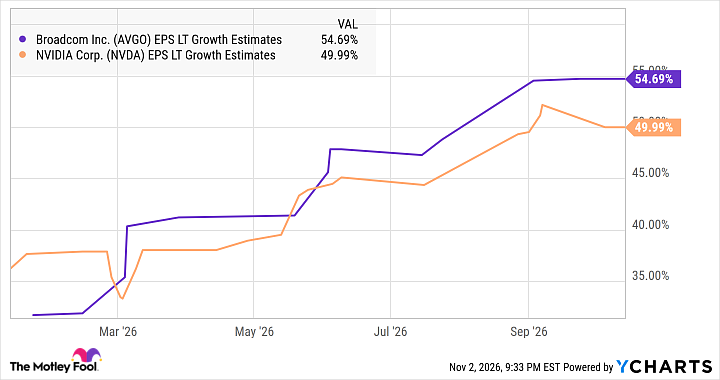
The company projects $230 billion in AI semiconductor revenue in fiscal 2028, nearly 4 times the AI revenue it is on track to generate this year. So it’s easy to see why analysts expect Nvidia and Broadcom to see healthy EPS growth over the long term.
AVGO EPS LT Growth Estimates Data by YCharts
Additionally, both stocks boast attractive valuations following their recent declines, especially considering their growth potential. Nvidia has a price-to-earnings-to-growth (PEG) ratio of just 0.27, while Broadcom’s PEG ratio is 0.99, according to Morningstar. The PEG ratio is a forward-looking valuation metric that takes into account a company’s projected annual earnings growth over the next five years.
A reading below 1 suggests the stock is undervalued relative to its growth potential. So, investors get great deals on these AI stocks, which could make them richer in the future. Nvidia’s 12-month median price target of $320 implies a 58% jump, while Broadcom’s $530 target suggests gains of 64%. As such, buying these top chip stocks right now could prove profitable.
The memory market is poised to get bigger, making Micron an obvious buy
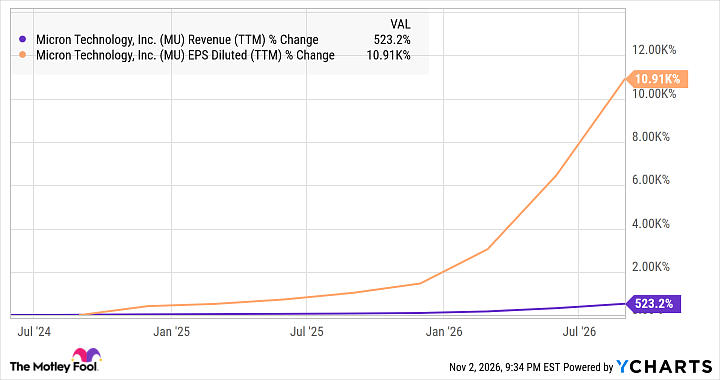
Micron Technology has seen exponential growth in revenue and profits due to the tremendous demand for memory chips and the accompanying supply shortage.
MU Earnings Data (TTM) by YCharts
The good news is that the favorable memory market dynamics fueling Micron’s growth are sustainable. Micron’s peer SK Hynix recently noted that the memory shortage will not disappear until 2030, due to high demand from AI data centers and emerging AI applications such as humanoids. As a result, SK Hynix estimates that memory demand will continue to outstrip supply until the end of the decade.
This is great news for investors in Micron stock, especially since it trades at an attractive 12 times earnings. Micron’s 24% share of the dynamic random access memory (DRAM) market and 15% share of the NAND flash storage market puts it in an ideal position to maintain the healthy growth it has experienced over the past two years.
Unsurprisingly, Micron has a 12-month median price target of $1,575, implying an 89% upside from current levels. The stock could easily exceed analyst targets in the coming year as it trades at an extremely attractive valuation, although it is expected to deliver long-term EPS growth of 55%, according to YCharts.
As such, savvy investors may consider using Micron’s latest pullback to buy top growth stocks at an attractive valuation, as it could make them richer in the long run amid the memory market’s secular growth.
Gn bussni