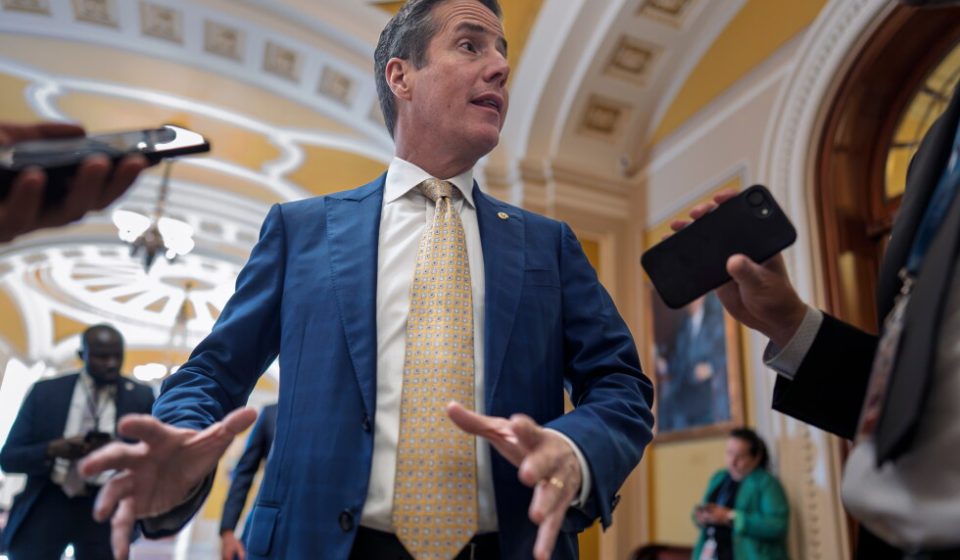

WASHINGTON (AP) — Legislation to permanently ban the sale of Chinese vehicles in the United States stalled Wednesday as senators struggled to reach a deal, all but guaranteeing the bill will have to wait until after the November election.
The bipartisan bill, sponsored by Republican Sen. Bernie Moreno of Ohio and Democratic Sen. Elissa Slotkin of Michigan, aims to prevent China’s auto industry from gaining a foothold in the U.S. market. It would ban the import, manufacture and sale of internet-connected vehicles, software and hardware linked to China or other foreign adversaries, including Russia and North Korea.
Chinese automakers are already effectively banned to sell or build vehicles in the United States under a policy put in place by the Biden administration, but senators hope to close the door more permanently.
The summit between the Chinese president Xi Jinping and President Donald Trump in Washington last week, who focused in part on trade between the world’s two largest economies, gave new impetus to the legislation. Slotkin said almost all senators were prepared to support it, and that they had initially planned to seek its passage last week without a formal roll-call vote.
Senators delayed further negotiations with the lone holdout, Republican Sen. Rand Paul of Kentucky, who argued the legislation could unfairly sweep away Mercedes-Benz. The bill would ban Chinese entities from vehicles manufactured by companies with more than 15% ownership. Mercedes-Benz has nearly 20% passive Chinese ownership.
Supporters say they will try again after the election. But the delay is a setback for bipartisan legislation that has enjoyed support from automakers and unions, as Washington grapples with the growing global reach of China’s auto industry and concerns about potential surveillance technology.
“It’s literally a spy machine on wheels,” Slotkin said of the Chinese vehicles. “All this data and all this information goes back to Beijing.”
Lawmakers see threat from Chinese electric vehicles
Lawmakers and analysts have warned of dire consequences if Chinese electric vehicles become available in the United States.
“I’m concerned about what may happen to the U.S. auto industry with Chinese electric vehicles,” Republican Sen. Steve Daines said in an interview with The Associated Press before the Trump-Xi summit. “They are remarkable, high quality at a much lower cost. But it’s not fair if you have a product that is significantly subsidized by a government to be able to enter our market.”
Chinese automakers have expanded rapidly overseas, competing aggressively on price and technology and putting pressure on established makers in Europe and other markets. In the first eight months of this year, China’s exports of new energy vehicles more than doubled from the previous year, shipping more than 3.4 million vehicles, according to the China Automobile Manufacturers Association.
Chinese automakers provided 60% of global electric car sales in 2025, while European and North American automakers were each responsible for about 15% of global sales, according to the IEA, or International Energy Agency.
Their emergence has raised concerns in Detroit because allowing them to enter the United States could expose domestic automakers to a new source of lower-cost competition.
However, Trump has at times taken a more welcoming approach toward Chinese investment in the U.S. auto industry. Speaking at the Detroit Economic Club in January, he said he was open to Chinese automakers building factories in the United States as long as they employed American workers.
“If they want to come build the factory and hire you and hire your friends and your neighbors, that’s great. I love it,” Trump said. “Let China in.”
That stance put Trump at odds with an unusual coalition of lawmakers, automakers and unions that have pushed to keep Chinese vehicles out of the U.S. market.
In April 2026, Commerce Secretary Howard Lutnick answered “no” when asked whether Chinese electric vehicle manufacturers such as BYD would come and establish joint ventures in the United States.
But in early September, before welcoming China’s Xi, Trump again said he would not oppose Chinese automakers building cars in the United States.
The White House did not respond to an AP inquiry about its position on the bill.
What the bill would do
Slotkin and Moreno structured their legislation around two threats: protecting the U.S. auto industry from heavily subsidized Chinese competitors and preventing technology built into connected vehicles from collecting sensitive data on Americans.
In July, Slotkin called Chinese cars “surveillance programs on wheels,” arguing that they could collect information on American drivers and sensitive sites and transmit it to Beijing. Moreno said China’s auto industry “was built to destroy American manufacturing, hollow out the middle class and undermine our national security.”
The bill would prohibit the importation, manufacture, sale, resale, or introduction into interstate commerce of connected vehicles and related software and hardware associated with China, Russia, Iran, or North Korea. This would effectively enshrine and expand restrictions that began under the Biden administration, making it harder for a future administration to roll back them.
But some worry that the 15% stake cap could harm companies with strong U.S. roots.
“We are not going to let the President of the United States sign a bill – nor would he – banning the entry of Mercedes-Benz into the United States of America,” Moreno said, also mentioning companies like Volvo. “We have to find a way to deal with all of this.”
James Lewis, a distinguished fellow in the technology policy program at the Center for European Policy Analysis, said the bill could return after the midterm elections, given the threat Chinese automakers pose to U.S. businesses.
“China can make enough cars in a single year to meet the entire world’s demand. You don’t need other countries to make cars with China in the picture,” Lewis said. “It’s existential for automakers.”
“The car companies care a lot. They are very influential,” he said. “They are deeply concerned about this situation.”
Gn bussni