
WASHINGTON (AP) — Senators from both parties said Wednesday they have reached agreement on legislation to speed up permitting reviews for new energy and infrastructure projects that now face years-long delays as lawmakers seek to meet growing demand for electricity and other forms of energy.
The bill, its supporters say, would reduce the arduous time required to launch large energy projects at a time when demand is increasing due to the proliferation of energy projects. data centers for artificial intelligence. The bill would ensure that AI data centers are forced to pay for their increased electricity consumption and mark a significant change in the a historic environmental law which critics say slows down the process of building energy projects.
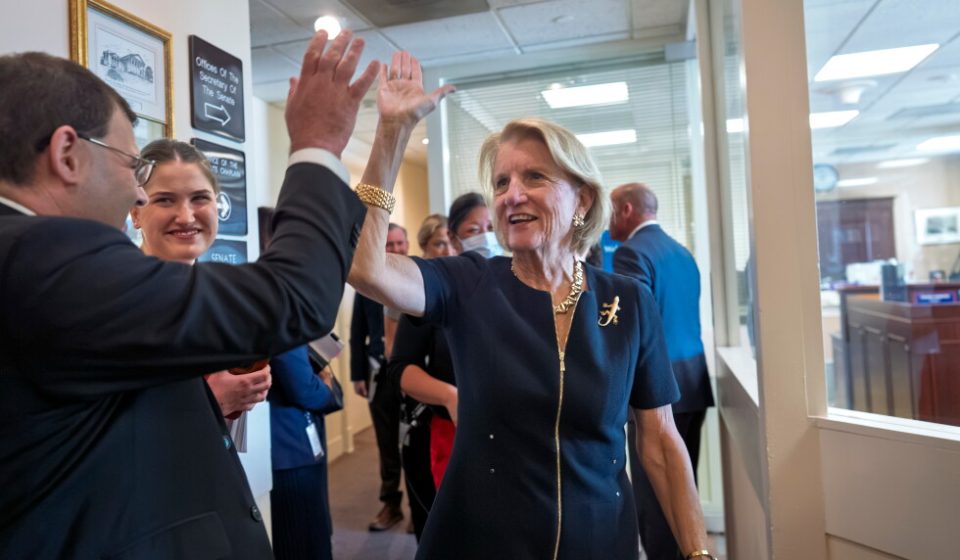
Republican Sen. Shelley Moore Capito of West Virginia, chairwoman of the Environment and Public Works Committee, called the bill “a major step toward making it faster, more efficient and easier to build infrastructure projects” of all types, while maintaining important environmental protections.
The vote on the bill will not take place until after the midterms
“The American people sent us here to do great things. This is a great thing. It’s monumental and it’s a legacy,” Capito said at a news conference at the Capitol where she was joined by Republican Sen. Mike Lee of Utah and Democratic Sens. Martin Heinrich of New Mexico and Sheldon Whitehouse of Rhode Island. The four senators lead the chamber’s energy and environment panels.
Heinrich said the bill “will mean more energy on the grid, more good-paying jobs and lower electricity costs for families and businesses. And as data centers drive demand for more energy, it will ensure they pay their fair share of the grid upgrades they need – and won’t leave that bill on American families.”
The vote on the bill won’t take place until after the midterm elections, reflecting the fraught political reality ahead of an election that could shift partisan control of both chambers. But the bill represents a rare example of bipartisanship on the nation’s energy policy, with lawmakers from both parties agreeing on the need to build new energy projects of all types.
Lee, who chairs the Energy Committee, expressed confidence the bill will be approved in a lame duck session in November, noting its bipartisan support and encouragement from business and environmental groups.
Whitehouse, the top Democrat on the environmental panel, was also optimistic but said Democrats were still seeking clarification on how the bill would prevent President Donald Trump’s administration from blocking wind and solar projects.
He and Heinrich, the top energy Democrat, denounced what they call “Trump’s reckless and vindictive attack on wind energy,” which includes repeated actions to block large-scale wind projects under construction off the East Coast. The administration suspended five offshore wind projects in December, citing unspecified national security concerns.
The projects then moved forward after the intervention of federal judges. A the federal judge also invalidated Trump’s decree blocking wind energy projects at the start of his second term.
Brad Campbell, president of the Conservation Law Foundation, an environmental advocacy group, criticized the deal, saying it “seems to adopt a wish list from the fossil fuel industry.” He said the bill could reduce protections for drinking water and endangered species, limit judicial review and restrict the power of the Environmental Protection Agency and states to review the impacts of energy projects.
Drew Maloney, president and CEO of the Edison Electric Institute, which represents for-profit utilities, said he was encouraged by the provisions to streamline environmental permitting and “create certainty for projects.” The group is reviewing transmission arrangements to see how they affect efforts to provide electricity to its 250 million customers, it said.
In a statement, the White House said the bill would “implement transformative policies aimed at lowering energy and housing costs for Americans, spurring new construction and investment in American infrastructure, and creating American jobs.”
Trump’s opposition played a role in delaying a deal
Trump’s opposition to wind power has been a consistent stumbling block to a deal on permitting reform, which Democrats say can only move forward if the administration agrees to allow previously approved projects to move forward.
Trump recently proposed easing his administration’s blocks on renewable energy projects, in part to entice Democrats to accept a permitting deal. But it was unclear how long the offer would last and whether it would change once the election results are known.
Whitehouse called the administration’s proposal reasonable, but said the overall problem remains “unresolved.”
Manish Bapna, president and CEO of the Natural Resources Defense Council, said his group was studying the details of the bill, but said, “Ensuring the deal ends the Trump administration’s war on clean energy — the cheapest, fastest sources of energy — will be a necessary part of any deal.” »
Capito was convinced that such obstacles could be overcome.
Both sides recognize that for too long, “America has had a permitting system filled with delays, expense, red tape and uncertainty,” she said. “Too long, too expensive. And we’ve seen projects that should be completed faster (take) decades.”
The Senate bill would limit legal challenges under the National Environmental Policy Act, a cornerstone environmental law that requires federal agencies to review the possible environmental impacts of a project before it is approved. The law is increasingly accused of blocking projects of all types.
Challenges under the National Historic Preservation Act would also be limited. The law protects Native American cultural treasures and other important items.
The bill would make it easier to choose the location of interstate transmission lines and strengthen the Federal Energy Regulatory Commission’s authority to review large projects concurrently with state reviews, helping necessary projects move through the overall permitting process more quickly.
The bill would also require data centers to pay all associated transmission costs, preventing costs from being passed on to families or businesses.
___
Associated Press writer Jennifer McDermott contributed from Providence, R.I.
Gn usa