
Psychopathy is not listed in the Diagnostic and Statistical Manual of Mental Disorders, and it is not an official diagnosis that a psychiatrist or psychologist will give.
But the term is still widely used, particularly in criminology, to describe a problematic set of personality traits.
The triarchic model states that psychopathic personalities have three key characteristics: boldness, disinhibition, and malice.
A new study by clinical psychology researchers Ky Bray and Laura Drislane, both of the University of Mississippi, shows that these traits can show up in people’s writings, in ways that don’t always fit our “psychopath” stereotype.
Their results are published in the journal Personality and individual differences.
“People tend to think of psychopathy as just one thing, but it’s actually multidimensional,” Bray says.
Everyone exhibits these traits to some extent. It’s when they appear together, at high levels across the board, that things can get dark.
“That’s part of why we’re moving away from the term ‘psychopath,’ because we don’t think of psychopathy as a category,” Drislane says.
“But psychopathic dimensions can predict important outcomes, like criminality, recidivism, or domestic violence.
“What our research, including this paper, suggests is that it’s important to look beyond that label and look at the different components or dimensions of psychopathy, because each of these dimensions actually has a unique set of outcomes or things that it can predict.”
Bray and Drislane recruited 307 undergraduate students and 144 former inmates from the community, who each completed a questionnaire (the Triarchic Psychopathy Measure, aka TriPM) designed to assess levels of the three psychopathic personality traits.
They were also asked to write about their lives, describing a high point, a low point and a turning point.
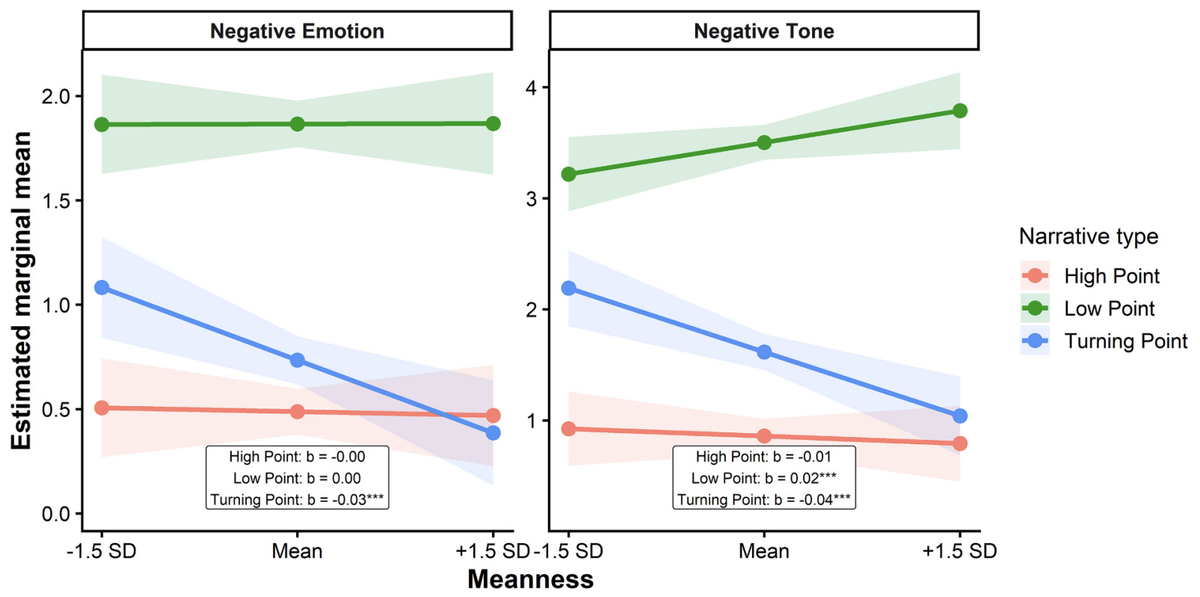
The goal of this study, Bray emphasizes, is not to use writing to diagnose psychopathy (which, again, is not a formal diagnosis anyway), but to demonstrate how psychopathic traits can show up in everyday behaviors, including language.
For example, people who scored high on the “boldness” spectrum in the TriPM tended to use fewer anxiety-related words (e.g., “worry,” “fear,” “fearful,” or “nervous”) in their overall writing.
A person scoring high on “badness” was less likely to use words associated with negative emotions — “bad,” “hate,” “hurt” or “tired,” for example — when writing about the major turning point in their life.
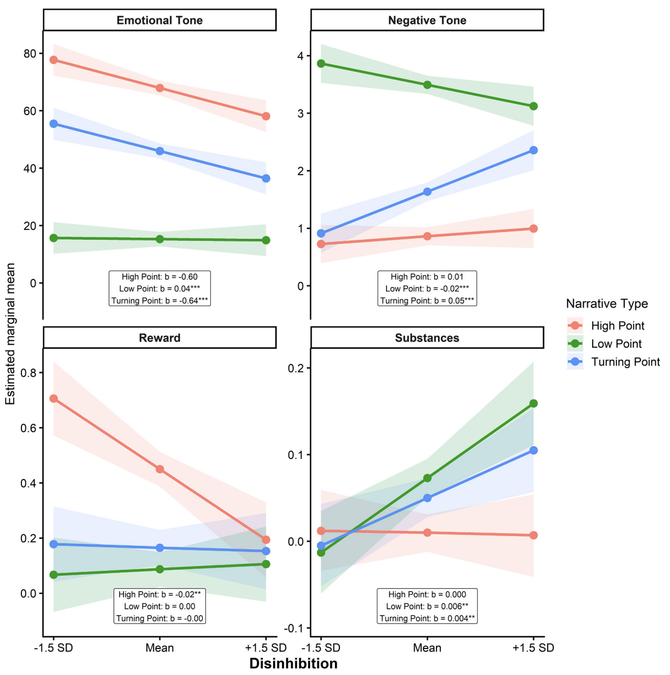
Of the three personality traits, disinhibition had the greatest effect on language. People who scored high on disinhibition tended to make significantly less reference to positive outcomes across all three writing prompts.
They used more negative language than their peers when describing strengths and turning points, but not when writing about weaknesses.
They also tended to refer more to substance use (words like “beer,” “wine,” “drunk,” and “cigar”) when talking about low points and turning points, but not high points.
“Viewing (psychopathy) from a multidimensional perspective allows us to observe how these traits can manifest in non-forensic populations, in people who have not committed a crime,” says Bray.
“This allows us to see how these traits affect students, professionals or interpersonal relationships.”
The findings suggest that the language used by people with psychopathic traits does not necessarily lack emotion or personal meaning, unlike the stereotype of a cold, callous criminal.
But it doesn’t always match what other people would consider appropriate for the context.
“If we want to be able to treat or, ideally, prevent the development of psychopathy, we need to understand the mechanisms at play,” says Drislane.
“It comes down to understanding the unique contributors to these three dimensions.”
The research was published in Personality and individual differences.
This article was fact-checked by Rachel Garner and edited by Rebecca Dyer. Although we are proud of our process, we are only human. If you spot an error, please let us know.
Gn Health