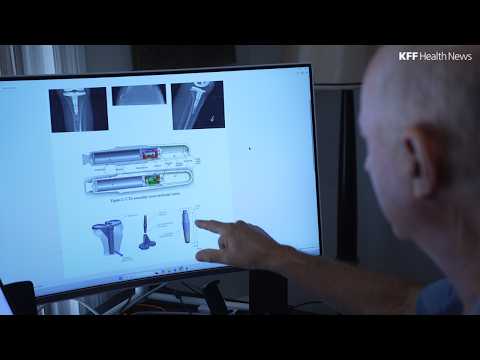
Steve Russak woke up after knee replacement surgery last year to a text message. It came from the company that made his new knee. Over the next few days, Zimmer Biomet sent four text messages. Russak did not understand their requests for him to use an app.
Eventually, a company representative called and offered help installing some accessories, Russak told KFF Health News. “I said, ‘What? I don’t know what you’re talking about.'”
It turned out that Russak had not received any bone and cartilage replacement. The 70-year-old Santa Rosa Valley man had a “smart knee” installed — an artificial joint called Persona IQ with a lithium-ion battery, sensors and transmitter that, if he allowed it, would send data about his gait and range of motion to his clinicians and Zimmer Biomet.
Russak is suing the doctor, Zimmer Biomet and Canary Medical, a health technology company that helped develop the device. In his trialRussak claims the knee was an “unauthorized implantation” and that, according to Zimmer’s “patient materials,” he should have been given the option to opt out of data collection or decline the knee altogether, but that was not the case.
Russak does not want to configure the device to collect and transmit data for several reasons, including his privacy. Now that it’s in his body, he said it poses potential disruptions. For example, Russak said he was recently unable to get an MRI due to compatibility issues.

Neither the doctor nor the doctor’s lawyer responded to requests for comment.
The case is ongoing, with the next hearing scheduled for December. Russak said he dropped the allegations of fraud and breach of fiduciary duties initially filed against the doctor, but continued to sue on other grounds, including lack of informed consent. The doctor has not yet responded to the complaint filed in court.
Both Zimmer And Canary filed initial responses denying “each and every allegation” in Russak’s complaint. They offered various defenses, including claiming that any damage was the fault of another party or, as Zimmer’s response puts it, that it was caused by actions or reactions “not reasonably foreseeable.”
Canary did not respond to requests for comment. Zimmer spokesman Troy Kirkpatrick declined to comment on the lawsuits against the company, but said that “nearly 90 percent” of surveyed patients who received Zimmer joint replacements say they would choose an orthopedic device with remote monitoring capabilities again in the future.
“Transmission of postoperative recovery data requires patient authorization at the time the patient creates an account and is designed to support patient-surgeon relationships and postoperative care,” Kirkpatrick said in an emailed statement. He added that Zimmer takes privacy and regulatory compliance “very seriously.”
The smart knee is part of an emerging trend in American medicine. While Zimmer presented his device as “the first and only in the world” Smart knee approved by the FDA in 2021, there are now a range of Internet-connected devices – from implants to external products such as blood pressure monitors – that transmit data on patients’ conditions to doctors or other health professionals. For advocates, the products offer the possibility of better care: They can provide measurements showing whether a patient’s blood sugar is getting out of control, for example.
However, increased surveillance has potential downsides, including threats to privacy, and some doctors and researchers caution that there is little evidence that smart devices improve health outcomes.
There’s “a lot of enthusiasm for remote monitoring technologies. There’s huge potential,” said Sanket Dhruva, a cardiologist and digital health researcher at UC San Francisco. But more rigorous data is needed, he said. “We’re getting all this data: Is this helping our patients recover better? That’s what we really care about.”
Still, these devices typically mean more money for doctors, who can charge to review the information they collect.
Monitor every step
Medicare and private insurers reimburse clinical professionals for reviewing smart device data. In 2024, almost 1 million Medicare beneficiaries received this service, known as “remote patient monitoring,” according to the Department of Health and Human Services’ Office of Inspector General. Medicare, the federal program covering older and some disabled Americans, paid medical providers $536 million for remote monitoring, more than double what it paid three years earlier. A review of the Peterson-KFF Health System Tracker found about 300,000 adults with employer-sponsored insurance received at least one request for remote monitoring in 2023.
Medicare proposed withdrawing some reimbursements after department decision the inspector general has been notified remote monitoring poses fraud risks: approximately 43% of patients in 2024 did not receive the full range of services defined by the program, which includes patient education on the device and data monitoring to detect changes in their health status. The watchdog also warned that companies sometimes cold call patients to offer and enroll them in devices they may not need.
Internet-connected devices can also pose privacy risks or expose patients to unintended consequences. In 2018, ProPublica reported that insurers were monitoring the performance of continuous positive airway pressure (CPAP) machines and, finding that some patients were not using them, were denying coverage for replacement supplies such as masks.
In Zimmer’s case, Centers for Medicare & Medicaid Services spokesperson Christopher Krepich emailed KFF Health News stating that “payment by CMS does not mean the agency endorses a manufacturer’s marketing claims or guarantees that a technology improves outcomes for individual patients.” » He said the agency regularly evaluates its reimbursement policies.
Russak’s Medicare account shows the program paid for his surgery and knee implant, but he received no claims related to remote monitoring of the device, which he did not configure to transmit data.
The Smart Knee is one of the flagship orthopedic products from Indiana-based Zimmer Biomet, which also makes unconnected knee joints. The company – which hired professional strongman, actor and former California governor Arnold Schwarzenegger to introduce its products as its “movement director” – sold some $3.3 billion worth of knee joints last year.
On the California coast in Contra Costa County, Jodi Murphy filed a lawsuit against Zimmer Biomet, Canary Medical and her doctor after she received a Persona IQ knee implant and was registered to use Zimmer’s app. THE the lawsuit alleges the doctor and companies were at fault because they acted “without disclosing this device or obtaining plaintiff’s specific informed consent for its use.”
The doctor and his practice denied all allegations. Zimmer’s lawyers I said the company “does not practice medicine and, under the law, has no obligation to obtain consent for treatment provided by its physician.” A hearing is scheduled for February.
The doctor did not respond to requests for comment. Murphy and his attorney declined to comment.
Russak’s lawsuit alleges that his doctor told him that he “did not disclose the electronic nature, wireless transmission functions, or data collection capabilities of the Persona IQ to prior patients in whom he had implanted the same device.” He goes on to cite this exchange as proof that the companies “failed to properly educate” the doctor.
“I don’t believe Zimmer or Canary trains the doctors, and that’s a problem,” Russak told KFF Health News.
Zimmer’s website says the implant allows care teams to “monitor and personalize” a patient’s experience and improve the efficiency of a practice. Many patients prefer the remote option, the company’s literature states. Further down the webpage, the company says the implant is “not intended to support clinical decision-making” and has “not been shown to provide any clinical benefit.” The company also mentions THE potential financial rewards for surgeons who implant the device – including ongoing payments for remote monitoring.
“Nice to have” versus “necessary to have”
Kevin Bozic, orthopedic surgeon and chair of surgery and perioperative care at the University of Texas, examined research on the Zimmer Smart Knee provided by company spokesperson Kirkpatrick at the request of KFF Health News. “None of them compare Persona IQ to a more conventional (knee) implant,” he wrote in an email.
Bozic said orthopedic surgeons he knows are “ambivalent” about Zimmer’s smart knee devices and many don’t use them. The implant is “the most generic part of the operation and does not really have a major impact on the result”.
In theory, he said, the data collected by the device on the number of steps the patient takes and the range of motion of the joint allows for better care. If a patient becomes more sedentary, that could be a useful signal for clinicians, he said.
But, in practice, “it’s a nice option to have, certainly not a necessity,” Bozic said, “certainly not something I would want to add a significant cost to the procedure.”
Surgeons already monitor patients and ask to be informed if their health conditions change, he said. “It’s overkill to have it on the knee.”
Smart-Knee makers have also taken advantage of another Medicare benefit – a “new technology supplement” – which temporarily subsidizes the adoption of new, otherwise money-wasting devices, thereby encouraging innovation. (The additional payment for Persona IQ expired in fall 2024.)
The payment program has undergone several adjustments in recent years. As of late 2020, there was no longer a need for new technologies to significantly improve old devices or pills, until…
Gn Health