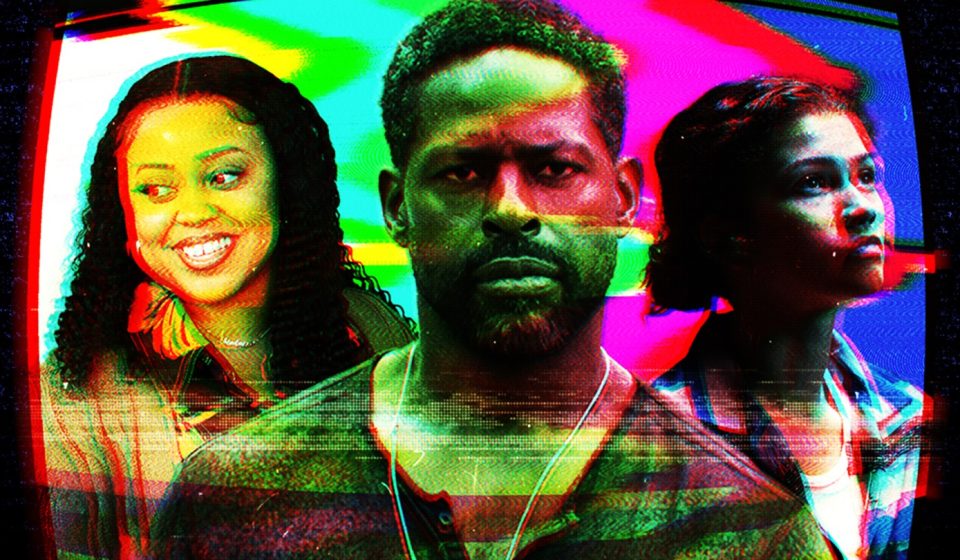

When #Emmyssowhite started trending after white actors swept the lead and supporting acting categories at the Sept. 14 ceremony, it exposed a deeper reality than the demand for equal recognition: Actors of color can’t win accolades for roles that don’t exist.
“The Emmys ultimately reflect the work that makes it to our screens, and this year’s results are another reminder that progress is not linear,” Cris Abrego, president of the Television Academy, said in a statement to The Hollywood Reporter. “We’ve seen significant gains in representation across our industry, but we’ve also seen real regression, and we can’t take progress for granted. »
UCLA documented this decline in its Hollywood Diversity Report, released in June, which noted that, for the first time in three years, the proportion of leading actors of color on streaming had fallen below its proportion in the U.S. population, falling from a high of 51 percent in 2024 to 36 percent in 2025. Streaming films starring a majority of people of color fell from 41 percent to 25.8 percent. hundred.
“It’s always two steps forward, one step back, but this time it’s like two steps back,” says Gloria Calderón Kellett, creator of the Prime Video series. With Love. “It feels like I’m taking four steps back, if I’m honest.”
When Black Lives Matter protests erupted across America in 2020, Hollywood positioned itself as an ally, and for a short time, it appeared that the industry had done more than just pay lip service to its commitment to representing marginalized communities.
Netflix tweeted: “To be silent is to be complicit. Black lives matter. We have a platform and we have a duty to our Black members, employees, creators and talent to speak out.” Bob Iger wrote in a letter to Disney employees posted on the Walt Disney Company website: “While we don’t have all the answers, we are committed to using our compassion, creative ideas and collective sense of humanity to ensure that we foster a culture that recognizes the feelings and pain of our people. We also realize that now more than ever, it is time for all of us to further strengthen our commitment to diversity and inclusion everywhere.”
The Academy of Motion Picture Arts and Sciences took what, arguably, seemed like the most significant step, instituting diversity and inclusion requirements for Best Picture nominees — we’ll talk more about that next winter when we inevitably find ourselves in another #Oscarssowhite race, given the limited number of frontrunners of color in early nominee predictions.
UCLA’s 2022 Hollywood Diversity Report showed that the share of digital scripted series created by people of color increased from 14.7% in the 2019-20 season to 25.6% in 2020-21 – the largest annual gain seen in the report’s nine-year history. Yet as the 2023 writers’ and actors’ strikes brought a halt to an industry still reeling from the financial losses of the pandemic, a familiar trend has emerged. UCLA’s Streaming Television in 2023 report found that of the 228 scripted shows analyzed, only 25 (11%) had a BIPOC creator. A year later, this share rose nominally to 12.2 percent.
“It’s often the case that diversity, in terms of race or ethnicity, is seen as something optional or non-essential when the research we’ve done has shown that it should be incorporated into every decision that’s made, because audiences are becoming more racially and ethnically diverse, and so they’re also very interested in seeing that reflected on screen,” says Ana-Christina Ramón, director of the Entertainment and Media Research Initiative at UCLA and co-author of Hollywood Diversity. reports.
It is thanks to this perspective that the Emmys went from a year without a winner of color in 2021 to a historic number in 2023 (five out of 12, equaling the record set 32 years earlier) and went back to zero in 2026, explains Ben Watkins, creator of Prime Video. Cross and the upcoming Muhammad Ali drama The biggest. “It’s important for us to recognize and say out loud that this is not an anomaly, but a trend…it’s a reflection of a fundamental problem.”
According to UCLA’s Ramón, this problem is twofold. “It’s part of a systemic bias that I think exists,” she says, comparing the decline in racial parity to the underrepresentation of women among the total actors, writers and directors of streaming films seen on streaming over the past year, despite women making up the largest demographic of viewers. “There’s this general problem of relying on an old mindset and going back to a culture where there’s just a boys’ club,” she says. (UCLA’s 2020 report found that 92% of presidents or CEOs at 11 major studios were white; 68% were men.) “A lot of people think, ‘oh, that’s probably long gone because of the progress that’s been made,’ but there are stories about this resurgence of being able to be openly misogynistic, openly racist, from what I’ve heard from people behind the scenes.
On the day he was sworn in for his second term as president, January 20, 2025, Donald Trump issued an executive order terminating all diversity, equity, inclusion, and accessibility offices and programs within federal agencies. Shortly into Trump’s term, Disney, in its filing with regulators, removed all references to its Reimagine Tomorrow initiative, launched in 2021 to amplify underrepresented voices; Amazon Studios has eliminated policies aimed at increasing the diversity of its TV shows and movies; Paramount abolished hiring targets based on race, ethnicity and gender and Warner Bros. Discovery has announced that it is dropping the “D” and “E” in its recruiting efforts and now focuses solely on inclusion.
“Looking back at DEI revealed how successful the effort had always been, as if our opportunity to create was the result of a box being checked,” says Deli Boys creator Abdullah Saeed.
More perplexing is the industry’s pushback, despite evidence that diversity is in its economic interest. The Latino Donor Collaborative’s Latinos in Media 2024 report finds that the industry could generate an additional $12 billion to $18 billion annually if it can achieve adequate Latino representation in television and film.
A study released in January by USC’s Norman Lear Center’s Latino representation initiative, ¡Pa’lante!, found that Latinos made up just 6% of credited characters in major series broadcast for the 2024-2025 television season, despite making up 20% of the U.S. population. UCLA’s 2026 Hollywood Diversity Report also found that streaming movies with casts of 21 to 30 percent BIPOC had the second highest median rating among all household and viewer groups and that in 2025, six of the top 10 streaming movies and ten of the top 20 streaming movies by total household ratings featured casts that were more than 30 percent BIPOC.
We should also not ignore that HBO The Pittwith its uniquely multi-ethnic cast, topped all Emmy nominations this year, with 25, and won best drama for the second year in a row, and Abbott Elementary School, the most diverse network Emmy nominee, remains one of ABC’s most-watched comedies as it approaches its 100th episode in its sixth season this fall.
“I feel a fear that I had not felt before,” admits With Love creator Calderón Kellet. “I got to Hollywood and UPN had started and there were more shows that were focused on stories about people of color, comedies and dramas, and it was like a hopeful time. And then certainly when I got One day at a timefor a minute there, it was incredible. There was Gentified And Vidaand we were really seeing this onslaught of all these Latina-led shows, which was so exciting. And then the graveyard of these shows slowly started to fill up.
After some research, Calderón Kellett found a common denominator. “Our budgets weren’t the same,” she says, qualifying the latest data from UCLA that found less than a fifth of streaming films made by BIPOC filmmakers had a budget of more than $50 million, compared to just over a quarter of those made by white men. “It’s like, oh, there are opportunities and it’s great, but we always start the marathon five miles behind. It’s very difficult to win the race when you start at such a disadvantage.”
When Saeed began shopping his Hulu crime drama centering on two Pakistani American brothers (Asif Ali and Saagar Shaikh), he said, “Deli Boys was passed on by everyone except Onyx Collective,” Disney’s content brand for creators of color and underrepresented voices launching in 2021. “While I’m very grateful to have a platform specifically for us, I wish we didn’t live in a world where we needed this separate water cooler and just had access to actual spaces,” he says.
The series, which premiered in March 2025, aired for two seasons and received 28 Emmy nominations in 22 categories this year – although it ultimately landed no nominations – before being canceled in August.
“What’s the saddest thing about Deli Boys“The cancellation is that it eliminates Brown creative at-bats at every position, and the decision to end it was not made by the Brown people,” says Saeed, who notes that he was told that viewership was the basis for the decision, although he also noticed a change in attitude toward his message.
Calderón Kellett also felt this change. “It’s the same problems that existed here in the ’90s; the difference is that I didn’t feel the fear factor of this moment where, suddenly, by being Latina, my identity is political.”
The merger of Paramount Warner Bros. recalls another reality of the 90s, considered the golden age of black television before CBS and Warner Bros. Entertainment merged UPN and The WB to form The CW, dropping many…
Gn entert