KABUL, Afghanistan (AP) — In the shadows of the busy streets of the Afghan capital lies a hidden world: the world of women, quietly defying the draconian bans imposed when the Taliban took power following the withdrawal of US-led troops in August 2021.
For women, schooling beyond primary is prohibited, except for Islamic religious education and language classes. Parks and gyms are prohibited, beauty salons are prohibited, and a strict head-to-toe dress code applies. Although women can obtain certain business licenses, they do not have access to most jobs.
“Being a woman in Afghanistan is a crime,” said a former footballer whose dreams were shattered by a sports ban.
Rules are enforced by the widely feared morality police of the Ministry for the Promotion of Virtue and the Prevention of Vice. They patrol the streets in white coats similar to those of a doctor and can hold women who break the rules. Some were beaten.
The ministry is “fully committed” to ensuring the rights of all under Islamic sharia law, spokesman Mohammad Aslam Badriwal told The Associated Press in response to questions about restrictions on women.
“Our sisters can also manage their social and business affairs, provided that they strictly adhere to the principles of Islamic Sharia and the laws currently in force,” he said, adding that the ministry’s priority is “to ensure that our sisters are completely safe within society and can enjoy all the rights granted to them by Sharia.”
Some women have found a way to defy the bans, despite the risks.
Here’s a glimpse into the hidden lives of three of these women in Kabul, all speaking on condition of anonymity for fear of arrest.
She opened a salon not once, but twice
For years, this 40-year-old woman worked in one of Kabul’s beauty salons. When the authorities banned them, she felt her life contract.
“You just feel a sense of hopelessness; you become completely discouraged,” she said. “Right now in Afghanistan there is nothing that can bring joy or comfort. There is no travel, no parks, no schools, there is absolutely nothing.”
Work was all he had left.
“But now they don’t even allow that,” she said. “It’s as if, for Afghan women, working has become a crime.”
Despite the salon being banned, she decided to open her own. Demand was high, especially for weddings, where women must sport elaborate hairstyles and makeup.
She rented an apartment and bought equipment. Soon she had around thirty customers. With her husband among millions of Afghan men unable to find workit was a lifesaver.
But the authorities discovered his secret living room. Their raid took away all the equipment, almost all the furniture.
“I felt completely hopeless,” she said. “If my job, the only thing that gave me meaning, is taken away, what am I left with? How am I supposed to feed my children? How am I supposed to cover household expenses? I reached a point of total despair and thought, ‘I’m just going to leave.'”
But customers kept calling and she had bills to pay. Finally, she decided to try again. She rented another apartment and reopened. She now has seven employees – young women who support their own families.
On a recent October day, the salon was filled with women getting their wedding makeovers. They lay on cushions on the floor while beauticians powdered their cheeks.
The atmosphere was light, but with an undercurrent of fear.
“Every time there is a knock on the door,” the salon owner said, “I fear the Taliban are on the other side.”
Football was his life and it still is his passion
As a teenager, all her ambitions were linked to football. And it seemed like her dream was coming true: she was selected for the national team. But two years later, the ban on women’s sport crushed them.
Plunged into depression, she spent barely six months leaving her room.
Her family was worried and they knew they had to find a way out. Eventually, she started playing again – not on fields, but in the confines of her home.
She also took up boxing, turning a pile of old car tires into a rudimentary punching bag. It helped her manage her emotions, she said.
His true love remains football. Unable to play properly herself, she decided to pass on her knowledge and skills to a new generation. She leads a small group of young boys into the small walled courtyard of her house.
“I saw in them the same dreams and the same passion that I had during my own childhood,” she said, with tears in her eyes. “It makes me feel really good to train with them. Sometimes I see myself in them.”
Between boxing and coaching, she manages to get through the days. But his vision of the future is bleak. She wants to leave and find refuge in another country.
“I don’t see any hope for me in Afghanistan,” she said.
“No door is open to us.”
At this school, regular lessons are anything but
Students stagger arrivals to avoid arousing suspicion. The door opens just enough to let them in.
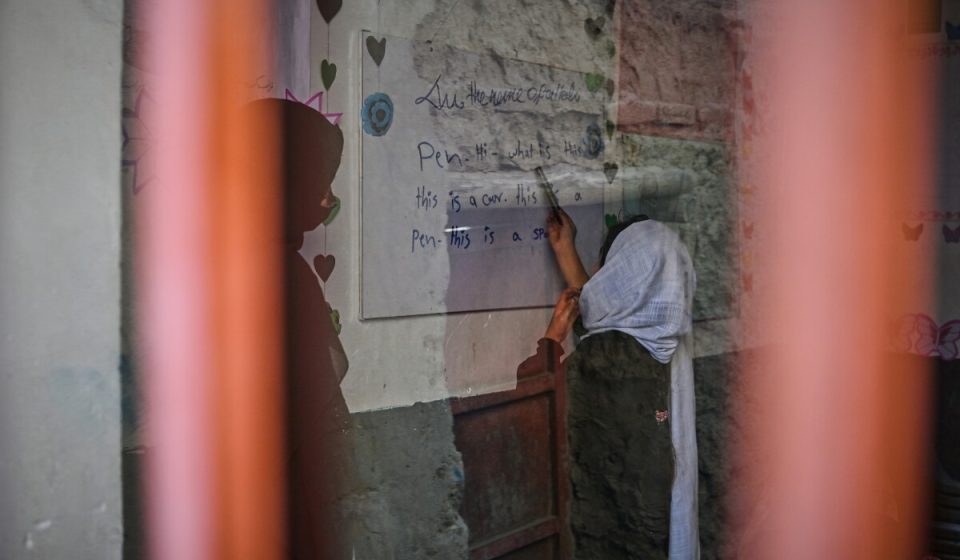
Inside, the subjects are ordinary: history, sciences, geography, mathematics, languages, Koranic studies. But this is no ordinary school. Installed in a private house, its students are boys but also girls up to 20 years old. Including teenage girls, classes must take place in secret.
The teachers here – a 20-year-old helped by her teenage sister – are not professionally trained. They do their best to pass on what they learned before being excluded from school.
“The current situation in Afghanistan is far from ideal. I was suffering from increasing depression, so I decided to organize this course,” said the 20-year-old.
She started more than a year ago, she said, hoping to help girls “by giving them a sense of hope and allowing them to continue their education.” Today it has around thirty students.
One room in the house was transformed into a classroom, with students sitting on the floor at low plastic tables. Brightly colored drawings decorate the walls.
Restrictions on education are the ban most hated by the Taliban. Authorities have repeatedly said they are working on a solution.
“As for the part (of education) that still has gaps, we are working to resolve it comprehensively,” government spokesman Zabihullah Mujahid said in August. But there have been no signs of progress.
The teenage teaching assistant said many girls fell behind and “we wanted to create an environment where girls can study and strive to achieve their goals.”
But with every class they organize, they risk being arrested.
“We are very afraid of the Taliban,” she said. “We fear that one day they will come after us, accuse us of violating their rules, arrest us and take us away. We are absolutely terrified of that possibility.”
Gn world