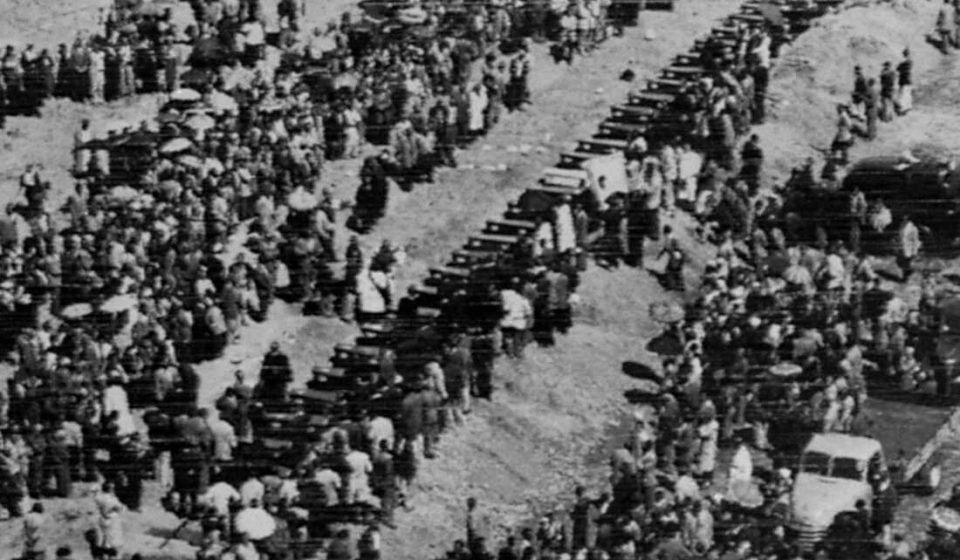


A mass funeral is held in Sharpeville, South Africa, on March 30, 1960, for 69 people killed by police during an anti-apartheid demonstration. More than six decades later, the victims’ families are renewing their fight for justice.
P.A.
hide caption
P.A.
SHARPEVILLE, South Africa – Paulina Mathinye points anxiously at the rows of trash-strewn, weed-filled graves in the cemetery where her father is buried.
“Look where they sleep,” she said of the dozens of black protesters buried here, all of whom were killed when police opened fire on March 21, 1960, in what became one of the bloodiest days in apartheid history.
“Why are they dirty? It’s a shame,” said the 71-year-old grandmother, wearing a floral dress and an elegant sun hat.
The cemetery, like many other things in this visibly poor township, located about an hour’s drive from Johannesburg, is abandoned. But Mathinye notes that for at least one day a year, when South Africa’s political elite descend to commemorate the massacre, the cemetery is spotless. This anniversary is a public holiday known as Human Rights Day.
“I’m still angry. My anger comes out because it was the day my father was shot,” says Mathinye, who was only five years old at the time.
She says her father’s role in what became a turning point in the fight against apartheid has not been adequately recognized by the current democratic government.
And she says she wants justice – even if it’s delayed.

Paulina Mathinye stands near her father’s grave at a cemetery in Sharpeville, South Africa, September 23, 2026.
Kate Bartlett/NPR
hide caption
Kate Bartlett/NPR
That’s why she signed up to participate in a potential class-action lawsuit 66 years later, alongside Sharpeville survivors and the families of Sharpeville victims.
At least 69 people were shot dead by police that day. They were protesting the country’s pass laws, which restricted the movement of black people and where they could live and work.
Although it is unclear whether the perpetrators are still alive, those involved in the case hope it can lead to reparations.
But first, the group’s lawyers must challenge an apartheid-era law that continues to block their efforts to seek redress. The law remains in force decades after the end of apartheid and the coming to power of a black majority government.
In September, they filed an application in the Gauteng High Court challenging the continuation of the Compensation Act 61 of 1961. If the court finds the law unconstitutional and also certifies a class action for survivors and dependents of those killed, then individual damages claims could follow.
Mathinye says the repercussions of that day in 1960 affected his entire life.
Without his father, main breadwinner, she was unable to complete her studies. This, in turn, affected the lives of his children and grandchildren.
“So we struggled a lot. And we’re still struggling today, because nothing happened,” she told NPR.
If the case moves forward and is successful, Mathinye says she will use the money from the repairs to fix up her modest home and pay for her four grandchildren’s education.
Part of a larger trend
The Sharpeville case is just one example of a new wave of legal efforts aimed at seeking truth, accountability and reparations for crimes committed during apartheid before it is too late.
“It is crucial that these issues of deep injustice are addressed properly and that South Africa addresses them and does not sweep them under the rug,” says Daniel Leader, an international human rights lawyer who is advising the South African legal team representing the Sharpeville survivors and their families.
Other cases include a court ruling last year that South Africa’s first Nobel Peace Prize winner, Chief Albert Luthuli, was beaten to death by apartheid police in 1967.
Luthuli, the former leader of the African National Congress – Nelson Mandela’s party – had already been declared dead after being hit by a train. The new ruling overturned the findings of an earlier investigation.
The investigation into the 1985 murders of four anti-apartheid activists known as the “Cradock Four” has also been reopened. The activists were kidnapped and killed by apartheid security forces near Cradock, a town in the Eastern Cape. Even though the officers involved are all dead, the victims’ families hope the investigation will establish who ordered the killings.
And the investigation into the torture and death of Steve Biko, the iconic Black Consciousness leader who died in police custody in 1977, has also been referred to the courts.
“It is very clear that the murder of Steve Biko was exactly that, murder,” Nkosinathi, Biko’s son, told media in September when the investigation reopened. “We hope that this investigation will ultimately lead to this very certain and unambiguous conclusion.”

The family of South African Black Consciousness leader Steve Biko awaits the start of an inquest into his death in prison in Pretoria on November 14, 1977. From left: his older brother Kaya Biko; his widow Nontsikelelo Biko; his sister Nobanile Mvovo; and his mother, Alice Biko.
Anonymous/CAPE ARGUS/AP
hide caption
Anonymous/CAPE ARGUS/AP
During the initial investigation in 1977, members of the security branch said Biko had fallen and hit his head during a “fight with the security police”.
The Truth and Reconciliation Commission (TRC), a court-like restorative justice body established in the 1990s to uncover the truth about human rights violations during apartheid, has re-examined Biko’s case.
He denied amnesty to the security agents who testified, saying they had not told the truth. This essentially paved the way for possible lawsuits, but they never happened.
In fact, hundreds of recommendations for prosecution made by the TRC were delayed or never implemented. Last year, President Cyril Ramaphosa launched a formal investigation into whether the recommendations had been deliberately abandoned.
The investigation is looking into whether there was a secret agreement between the former leaders of the apartheid regime and the country’s new black leaders not to prosecute in the interest of reconciliation. Its conclusions are expected in December.
Back at Sharpeville Cemetery, Paulina Mathinye and three other descendants of those killed in the massacre stop at a memorial plaque before leaving the cemetery.
Vincent Thamae, of the NGO Voices of Sharpeville which works with survivors and descendants, asks that they take leave of the dead.
“We ask those who sleep here to be with us as we seek to bring them justice,” he said.
Gn world