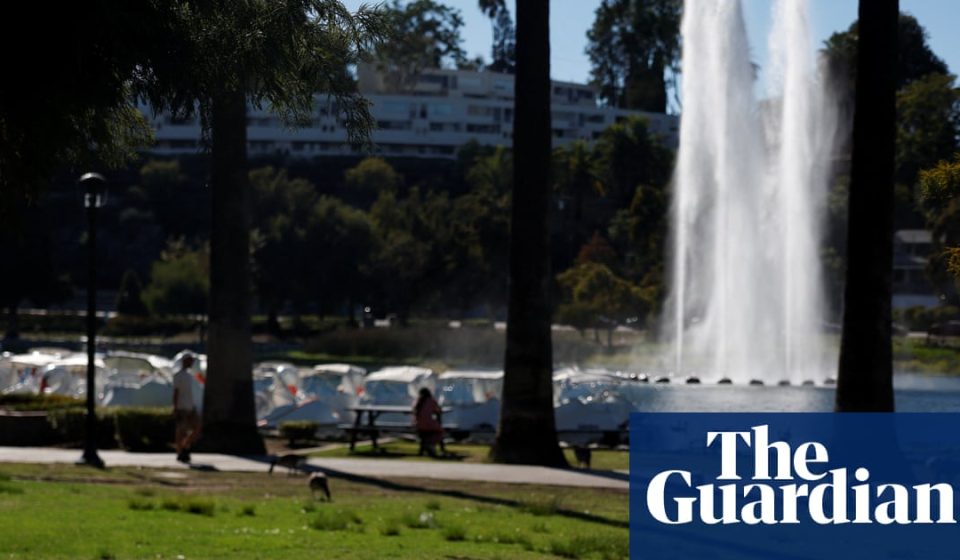
Southern California sweltering as late-season heatwave smothers region | California

Southern California faced scorching heat waves this summer that left residents wondering what happened to their famous Mediterranean climate.
Today, autumn also brings its share of heatwaves.
Friday kicked off a new round of long-term heatwave advisories from the National Weather Service (NWS), which expects unusually high temperatures to persist for at least a week. Temperatures are expected to hover around 100F in downtown Los Angeles and reach triple digits further inland, increasing the risk of heat-related illnesses and wildfires.
“We expect temperatures to be 15 to 20 degrees above normal, which is pretty significant,” said Richard Bann, a meteorologist with the NWS Weather Prediction Center. “Stay cool. Stay hydrated. Limit sun exposure.”
October heat waves are not uncommon in Southern California. They are caused by ridges of high atmospheric pressure that park over the region. This year, they are also influenced by an ongoing marine heatwave which, in turn, is causing a strong El Niño – a year when surface water temperatures in the Pacific Ocean are above average.
But experts say the severity and duration of this year’s fall heatwave are extreme and likely to become more frequent in the future as the climate crisis causes global temperatures to rise.
“Extremely hot temperatures on Friday are rare,” said V Kelly Turner, professor of geography and urban planning at UCLA. “Nearly 7F warmer than the hottest October 2 on record and about 30 degrees warmer than historical averages around 75F.”
If there’s a silver lining for Southern California, it’s that current forecasts don’t call for strong winds that would threaten to fuel and spread wildfires — although increased heat and low soil moisture make them even more likely.
It’s difficult for scientists to point to a specific event and describe it as an effect of climate change, said David Neelin, an atmospheric physicist who studies climate change at UCLA.
But research shows that with every half degree of global warming, heat waves become both more likely and longer lasting.
“Overall, it’s hard to escape the fact that a warmer climate adds to the strength of heat waves,” Neelin said. “This increases the likelihood of heat waves and the likelihood of having longer duration heat waves.”
This week’s heatwave will coincide with important outdoor events in the region, including Game 1 of the National League Division Series between the LA Dodgers and Atlanta Braves on Saturday, noted Edith de Guzman, a researcher who studies climate change and heat adaptation at UCLA. She urged political governments to invest now in heat adaptation to make the region more livable in the future. Providing more shade is the “most effective way to keep people safe,” she wrote in a text message.
“Climate change is making heatwaves of longer duration possible, while simultaneously increasing their frequency and intensity,” De Guzman wrote. “So we should prepare for more things like this in the future.” »
Gn headline