

Visual Group China | Getty Images
Elon Musk said Tesla shareholders on Wednesday that, regarding a possible merger with EspaceXhe had already “said everything that needed to be said.” Tesla’s head of investor relations told analysts before opening the call to their questions that executives would “not address” the issue.
The day before, Musk had already assured that a tie-up between his trillion-dollar companies would be a dominant topic of conversation on Wall Street in the near future, after endorsing a possible merger during SpaceX’s third-quarter earnings conference call.
“Do I think it would be a good idea? Yes,” Musk said Tuesday, revealing that the two companies had formed special committees to explore a transaction.
While Musk said he was “tap dancing through a minefield” in publicly commenting on the issue, analysts, investors and fans have long been seduced by “Muskonomy” and the prospect of a conglomerate that would combine the development of electric vehicles and humanoid robots with reusable rockets, satellite communications and artificial intelligence.
Talk of mergers overshadowed Tesla’s earnings report, which showed a decline in auto revenue and an even steeper decline in the company’s energy business. Musk is selling Wall Street a future for his electric vehicle maker that relies more on robo-taxis and humanoid robots than auto sales. But the company’s self-driving technology is still in development, its Robotaxi service is very early, and its Optimus robots aren’t ready for high-volume production.
SpaceX CEO Elon Musk attends a news conference hosted by President Donald Trump with AI executives following a meeting on artificial intelligence, outside the West Wing of the White House in Washington, September 29, 2026.
Finn Gomez | Getty Images
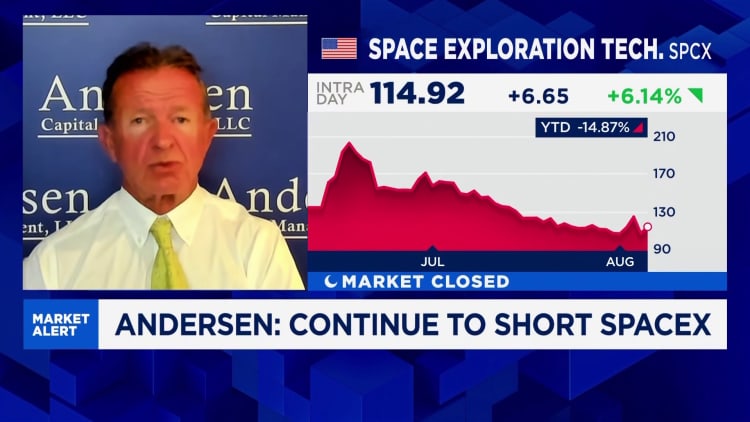
Tesla shares fell 3% on Thursday and are now down 17% for the year. SpaceX plunged 9%, erasing Wednesday’s gains and taking the stock below its opening price that followed the company’s June IPO.
Analysts at William Blair wrote in a note Thursday that Musk’s quest for a merger was primarily about control, not about strengthening his business.
“We fully respect the potential for overlap and collaboration, but we view this as a truly unique case where Musk runs the two companies almost as if they were already a single entity,” the analysts wrote. “We are struggling to find a material opportunity that could only be obtained through an official combination.”
Tesla and SpaceX did not respond to requests for comment.
Voting power
At SpaceX, it is Musk who takes the lead. The richest person in the world has 10-to-1 voting stock and nearly 80 percent voting control. Because it is a “controlled company,” Class A shareholders do not enjoy the same “protections afforded to shareholders of companies subject to all corporate governance requirements” of Nasdaq, SpaceX said in its IPO prospectus.
Tesla is another story. According to the company’s latest proxy filing, Musk beneficially owns 19.8% of the shares. During SpaceX’s earnings call, Musk said at Tesla, “we’re going to need a vote of 50% of all the shares – not just those who vote – but of all the shareholders, and that’s a big hurdle.”
He said he was a “conflicting party” and could not participate in discussions between the two sides.
SpaceX currently has a market capitalization of almost $2 trillion, while Tesla is valued at around $1.5 trillion. That would make SpaceX the acquiring company in a stock swap and potentially give Musk the best chance of controlling a combined entity.
Eric Talley, a law professor at Columbia University and an expert on corporate law, told CNBC that a merger could ease shareholder concerns about how Musk spends his time and his companies’ resources.
Talley said one of the concerns from both investor bases was which entity should house various initiatives around robotics and AI, as the two have converged in those areas.
“This caused dyspeptic feelings among shareholders, as well as lawsuits,” Talley said. “I think shareholders of both companies stand to gain from resolving this issue, and it also protects them from litigation over divided loyalties.”

Even if the respective boards reach an agreement in favor of a merger, the regulatory hurdles could be considerable, experts say.
Former Tesla board member Steve Westly told CNBC’s David Faber on Thursday that he believes the companies will move quickly to announce a merger proposal, ideally “before the election if they can.” The midterm elections, in less than two weeks, could tilt Congress in favor of the Democrats.
The big question will be: “What will regulators say and what will SpaceX have to do to get there,” Westly said.
Outside of the United States, Westly said companies need to deal with China. This is a critical market for Tesla in terms of vehicle manufacturing, and it also accounted for 22% of the company’s revenue last year.
Talley noted that China’s national security regulator would likely be particularly interested in such a deal because there are “probably hundreds of thousands of Teslas, computers on wheels, driving around right now,” he said. Meanwhile, SpaceX has satellites in its Starlink constellation that constantly provide data to the U.S. government, he said.
Kevin Li, an analyst at Counterpoint Research in Beijing, said in an email: “Antitrust oversight, national security considerations (given SpaceX’s military contracts), and cross-border regulatory reviews all present significant challenges. »

Tesla and SpaceX Stocks Over the Past Month
Although Musk did not provide a timeline for reaching a deal, he has been very transactional lately, including bringing his own companies together. Earlier this year, SpaceX acquired xAI from Musk in a deal that valued the combined entity at $1.25 trillion and paved the way for a record IPO. Last year, Musk brought together xAI and X, formerly known as Twitter, which he bought for $44 billion in 2022.
And in August, SpaceX completed its $60 billion purchase of AI coding startup Cursor.
Last Thursday, just days before Musk floated the merger idea, he unveiled a prototype of Tesla’s refreshed Roadster, which relies on SpaceX technology to be able to hover. The event was broadcast live from a SpaceX test site, reinforcing speculation about a merger that had been building for months.
Before SpaceX’s IPO in June, Chief Operating Officer Gwynne Shotwell told CNBC that a merger “might make Elon’s life a little easier.”
“There’s a convergence of what we’re all trying to accomplish going forward,” Shotwell said. “But right now, I’m focused on keeping the lights on here.”
WATCH: Oppenheimer Analyst Says SpaceX-Tesla Merger ‘Pretty Inevitable’

Gn bussni


