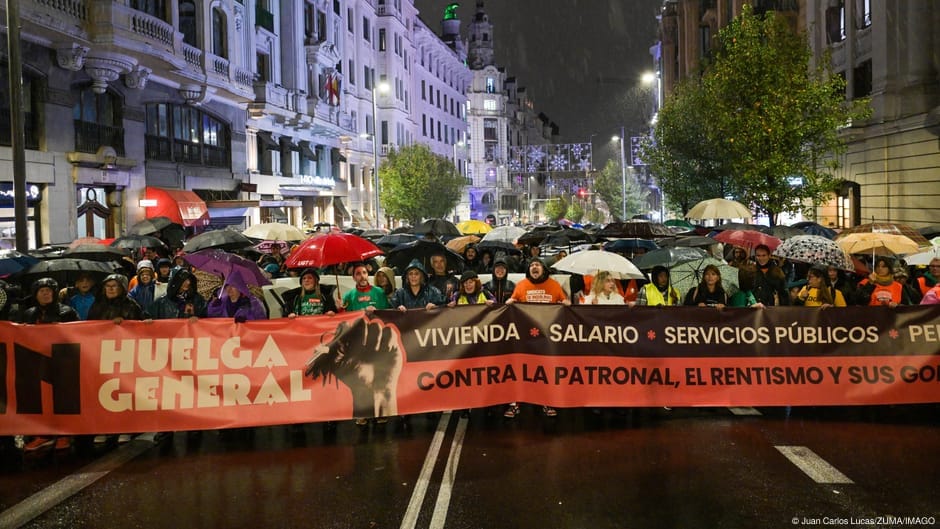
Spanish authorities say that despite pouring rain, some 120,000 citizens took to the streets of the capital Madrid on Wednesday evening after millions of strikers paralyzed Europe’s fourth-largest economy under the slogan “Wages. Housing. Prices” in the country’s first general strike in 14 years earlier in the day.
This massive participation came in response to the housing shortage and unbearable rents.
Barcelona city officials said 55,000 people attended nightly marches, marching behind a huge banner that read “Live. Not just survive.” Housing activists in the city said the turnout was much higher, saying 400,000 people took to the streets.
As has been the case recently in other protests across Europe, the peaceful protests then gave way to small groups of marauding young men who smashed shop windows on Barcelona’s main shopping street. They also set dumpsters on fire and fired fireworks at police when they arrived.
What happened during the general strike in Spain?
Earlier on Wednesday, workers across Spain gathered en masse, demonstrating and establishing picket lines despite stormy weather in many parts of the country.
Symbolized by the expulsion and death of Maricarmen Abascal, 87, in Madrid earlier this year, the crisis also triggered early elections set for November 29.
The government of left-wing Prime Minister Pedro Sanchez tried to pass a law to ease the plight of tenants, but was blocked in parliament by opposition parties. Lacking the power to pass legislation, Sanchez called an early vote in hopes of gaining more support.
Sanchez’s government ended up approving two extraordinary decrees introducing measures similar to the housing reforms rejected by Parliament.
“We will not stop until we transform the housing model of this country from the ground up so that houses are intended for living instead of serving the minority (of owners),” said Alicia del Rio, spokesperson for the Madrid Tenants Union.
While most protests were peaceful, strikers outside Madrid’s Mercamadrid wholesale market said police used pepper spray on the crowd, prompting at least 13 people to seek medical attention.
Some airlines subsequently reported disruptions to flights to and from Spain, with some airport and airline employees taking part in the strike.
How big is the housing crisis in Spain?
The country has a deficit of around 750,000 housing units, which is expected to reach more than a million by 2028, according to central bank estimates.
With fewer people and families able to purchase a home, the number of renters in the country has risen sharply. According to the Spanish Youth Council, the average rent is 1,176 euros ($1,315). This is equivalent to 99% of the average young person’s salary.
The general strike came a day after railway workers went on strike following two major and fatal train accidents this year, making dilapidated infrastructure another major issue in the upcoming parliamentary elections.
How did political leaders react to the strike?
The Spanish government supported Wednesday’s strike, saying it was organized “in favor of rights” rather than against anyone. Sources close to Sánchez’s entourage go so far as to say that he is “against the opposition”.
Alberto Nunez Feijoo, leader of the conservative Popular Party (PP), had a different opinion, saying that if it was indeed a “strike against the opposition”, it was an “absurdity that does not exist in any other country in the European Union”.
Although the UGT union – one of the organizers of the strike – and Sanchez’s PSOE socialist party are two separate institutions, they share a historic founder in Pablo Iglesias Posse.
Strike supported by the government in place, think many in Spain
Nicole Ris, a journalist at DW in Madrid, closely followed the strike on Wednesday:
Here in Madrid, apparently, a lot of people are still showing up for work, and the people I know have made it clear that they won’t strike because they don’t see much sense in it – even though they are all suffering from the cost of living crisis and the housing crisis.
There is also debate whether this strike would be an “election strike” which could benefit the current government.
“I’m not taking part in it. It’s absurd. The government supports it because it hopes to get enough votes on the 29th to be able to continue,” a Madrid doorman told me.
The government supports the strike, saying it is being carried out “in favor of rights” rather than against anyone. Sources close to Sánchez’s entourage went so far as to say that it was “against the opposition”, according to local media.
Gn world