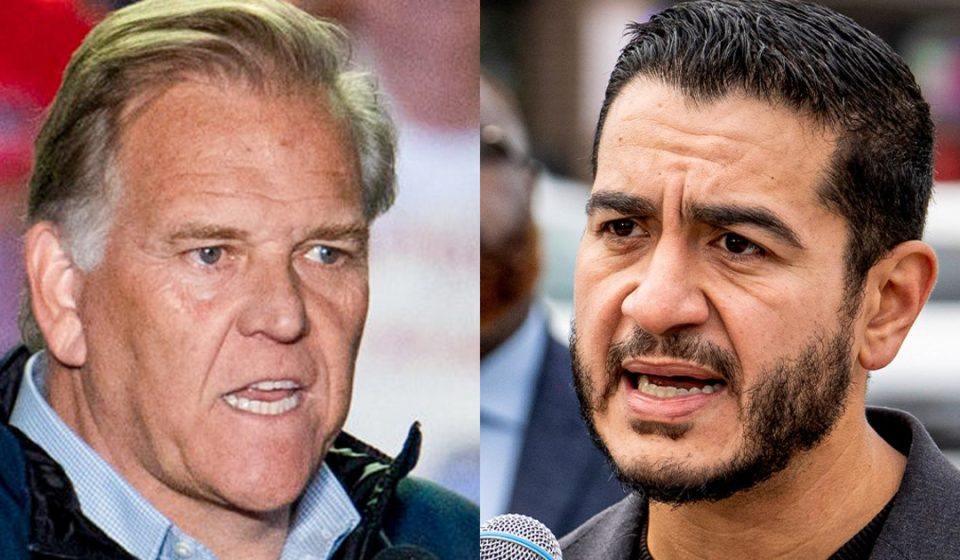

GRAND RAPIDS, Mich. — The two candidates vying for Michigan’s open Senate seat clashed here Thursday over the war in Iran, gas prices and tariffs in a debate that often devolved into petty tug-of-war.
Democrat Abdul El-Sayed sought to portray his Republican rival, former Rep. Mike Rogers, as a weak loyalist to President Donald Trump who has recently changed his positions on some issues out of political necessity.
Rogers tried to portray El-Sayed as a “crook” who makes promises he cannot pay without raising taxes or other costs.
Each repeatedly mocked the other about real estate — a house Rogers owns in Florida and a property El-Sayed’s wife owns in the United Arab Emirates. The debate, hosted by NBC affiliate WOOD of Grand Rapids, became so forceful at times that moderator Rick Albin pleaded for the candidates to curb their attacks.
“I would also like to participate in the debate,” Albin intervened at one point.
Michigan’s Senate race is one of the most competitive and closely watched in the country, and the results could help determine partisan control of the House. Sen. Gary Peters, a Democrat, is not seeking re-election.
Backed by progressive luminaries such as Sen. Bernie Sanders, I-Vt., and Rep. Alexandria Ocasio-Cortez, D-N.Y., El-Sayed emerged from a nasty primary against Rep. Haley Stevens, who positioned herself as a more moderate Democrat. Since then, Republicans eager to win a state Senate seat for the first time since 1994 have tried to portray El-Sayed as an extremist.
The debate opened with Albin asking both candidates whether, in an era of high gas prices linked to the war with Iran, they would support a pause on the federal gasoline tax. Both said they would support a pause, but the issue led to further discussion about the conflict. Rogers, who initially supported the war, recently said he wanted it to end quickly.
“I would support suspending the federal gas tax, but there is one thing that is causing this: the war in Iran, a war that has been encouraged by my opponent from the beginning,” El-Sayed said. “It’s called ‘win, win, win.’ I don’t know about you, but when I go to the gas tank, I don’t feel like I’m winning. I don’t feel like our country is winning.
Rogers responded by moving towards El-Sayed’s support for “Medicare for All,” a proposal that Sanders and others on the left have championed for years. Such a policy, Rogers argued, would force people to forgo the private insurance they would prefer, while leading to higher taxes and gas prices.
“It’s a disaster,” Rogers said. “We can’t afford to buy Abdul.”
At another point, Rogers said, “Listen to this guy and what he’s trying to sell here today. You’re going to find out this guy isn’t who he says he is. He’s actually selling the best scam I think I’ve ever seen.”
Albin then turned the discussion to tariffs – another area where Rogers has recently tried to distance himself from Trump.
New tariffs put in place by Trump took effect last month, imposing duties of 15 to 50 percent on $20 billion of U.S. goods exported to Canada. Customs tariffs are a major problem in Michigan, which borders and trades with Canada. Rogers, who once supported Trump’s efforts, released an ad this week calling for an end to the trade war.
“I actually called the White House this week and talked to the Secretary of Commerce about getting the deal done,” Rogers said during the debate. “Canada still has high tariffs on American products, and they did that before they started. Those should be eliminated. There are tariffs that I think are too high and don’t help us. We should get rid of them. So it’s about getting the best deal possible. I’d like to see that end.”
El-Sayed countered by pointing to Rogers’ initial support and a study estimating how costly the rates have been for Michigan households.
“Look, you’re hearing from someone who has, once again, pushed a Canadian tariff policy that we pay $5,600 a year for,” El-Sayed said. “The reason he’s flip-flopping has nothing to do with politics, has nothing to do with your costs. It has everything to do with falling poll numbers.”
El-Sayed added moments later: “Weak, cowardly, he will not resist until his poll numbers decline.” »
The debate featured other contrasts between the candidates, including differences over U.S. Immigration and Customs Enforcement, which El-Sayed has called for to be abolished. When asked by Albin if he thought the Trump administration’s immigration enforcement strategy had gone too far, Rogers responded that this year’s very public operation in Minneapolis, which resulted in the shooting and death of two U.S. citizens by federal agents, was “probably not appropriate.”
“I actually did fugitive raids when I was an FBI agent in Chicago,” he said. “You always want to stay put, catch the bad guy, leave the neighborhood for less trouble. To me, that was something they could have done differently.”
El-Sayed was pressed by his criticism of Israel and his recent refusal, in an interview with NewsNation, to say whether he considered Israel or Iran a greater threat to the United States. Despite Albin’s urging, El-Sayed again refused to offer a direct answer.
“I’m just going to say that’s a ridiculous assumption, because here’s what’s happening right now: Our apparent ally in Israel has been pressuring us to go to war with Iran,” he responded.
“We’ve seen Iran respond by bombing all kinds of countries in the Middle East and then choking off the world’s energy supply. So that’s a situation I don’t think we should be involved in. I don’t want to be pushed into war by Israel,” he added. “I want our money spent here to buy schools, health care and daycare here. I don’t understand why that’s so inconceivable.”
This debate was the first of two planned debates between El-Sayed and Rogers, but the candidates have been going in circles for months. The two engaged in schoolyard taunts, with Rogers mocking El-Sayed’s height and El-Sayed challenging Rogers to a game of “no pads” football.
Nationally, Republicans have attempted to make El-Sayed, with his progressive views and alliances, the new face of the Democratic Party. In their efforts to vilify El-Sayed, they also focused on his ethnicity and Muslim faith.
Vice President JD Vance, for example, urged Republicans who are “running against a Democrat who’s not that crazy” to mention El-Sayed instead. And Trump referred to El-Sayed on Truth Social Wednesday night as “Mohammed” and described him as someone who “goes back to the days of Jihad.”
Earlier Thursday, during lunch with Michigan Gov. Gretchen Whitmer at a Grand Rapids restaurant, El-Sayed mocked Trump’s antics, including the way Trump pronounces his real name.
“Get it right,” El-Sayed said, “because we’re going to teach you how to say it correctly with the word “senator” in front.
He added, referring to Trump and Vance: “They continue to point the finger at my name and my faith because they think they can distract us from the issues that affect us all – because my name and my faith are not the reason you can’t afford a tank of gas.” »
Gn usa