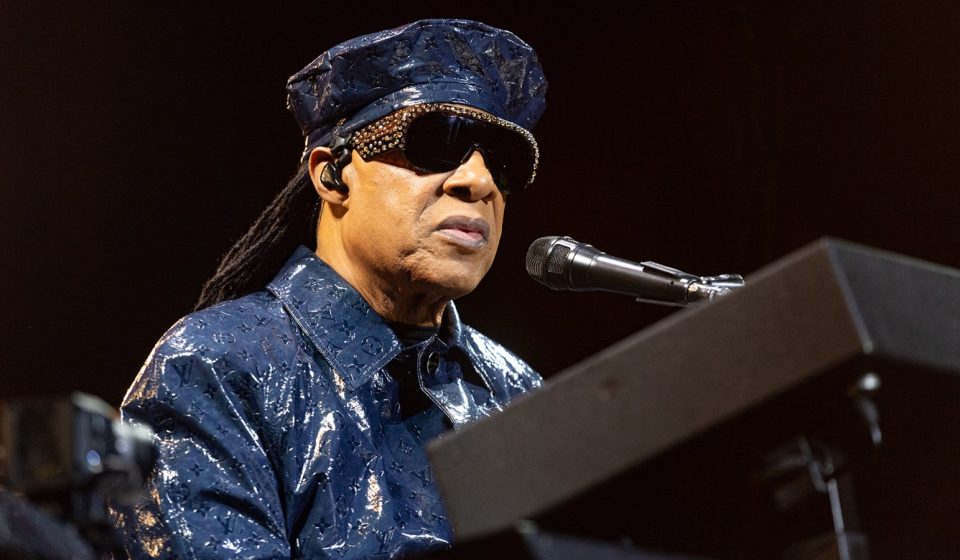
“The universe is aligned,” Stevie Wonder said, sitting at his keyboard at Madison Square Garden Thursday night, a beret emblazoned with a Yankees logo on his head. “But on this planet, we are not.”
However, for the duration of his show, that complaint wasn’t entirely true, at least inside the arena. In the first U.S. stop of a brief 50th anniversary tour, Wonder and a vast group of virtuoso, multi-generational musicians – including several of his children – recreated the entirety of 1976. Songs in the Key of Lifean album that has always been a kingdom unto itself and has appealed to audiences as one. As Wonder delved deeper into the songs, his voice strangely strong at 76, it was impossible not to feel a renewed sense of awe at the album’s emotional and musical scope, its density of ideas, its relentless brilliance. Wonder’s sunglasses in the first series had a jeweled starfield in the lenses, as if, in place of conventional vision, he had opened a portal to the cosmic afterlife. It seemed right to me.
Wonder’s stated goal, right from the title, was to create work that encompassed life, the universe, and everything. There are songs both dark and uplifting about being black in America, being human on Earth, being a parent and child, and, of course, being a 205-year-old man on Saturn resting among “rainbow moonbeams and orange snow.” Then there’s the more progressive-than-progressive jazz-fusion instrumental, “Contusion,” on which he unleashed his musicians at MSG, and another vocal-less piece, the pastoral, transcendent, jazz-chord-laden “Easy Goin’ Evening (My Mama’s Call),” played onstage with Wonder’s own chromatic harmonica joined by a second harmonica player, Frederic Yonet, and melodica played by musical director Greg Phillinganes.
Wonder squeezed more chords into individual songs than some rock bands have managed in their entire career, and the performances were a reminder that even the album’s most famous songs contain musical surprises — the melody and sentiment of “Isn’t She Lovely” can obscure its complexity, with its funky synthesized bass, aching harmonica and those airtight, dizzying drum fills. “Sir Duke” was incredibly dynamic, powered by some of the greatest horn riffs ever written and the strutting lines of longtime Wonder bassist Nathan Watts, who also played on the original recordings. Watts dug even deeper on the next song, “I Wish,” as did drummer Stanley Randolph, achieving unity with two percussionists, Senfaub Stoney and Aaron Draper. The farthest corners of the album also shone: the acid-funk of “All Day Sucker”, the rhythmic explosions of “Black Man” or “Ebony Eyes” which featured a battle between talkbox guitar and saxophone.
Even after five decades, the album’s resurrection had little to do with nostalgia; Wonder was so present in the music that he wiped away tears during the opener, “Love’s in Need of Love Today.” After this song, he shouted about the power of democracy, mentioning the “new mayor” of New York. And on the always harrowing “Village Ghetto Land,” with its brutal juxtaposition of “Eleanor Rigby”-style strings (played on synth by Wonder on the album, and by a real string section in concert) with visceral descriptions of the horrors of ghetto poverty, he added an interjection: “still in 2026!” »
Phillinganes, who later worked with Michael Jackson and many others, played on the original album when he was 18 and helped Wonder remake Songs in the Key of Life on stage since 2014. He brings the same scholarly intensity to the recreation that the late Brian Wilson’s band gave to Animal soundsand these performances deserve a live album and, in an ideal world, the Sphere’s sharper sound system – some of the carefully crafted details are inevitably obscured in echoing arenas.
In his recent live shows, Wonder has a penchant for covers, medleys, call-and-responses, and freestyle jams, all of which are mostly kept at bay by the album-recreation format. Early in the set, he strayed from the set list long enough to run through welcome segments of “Overjoyed” and “Uptight (Everything Is Alright),” combined with more original tracks: the chorus of “Born in the USA” (by one of his fellow “We Are the World” singers) and a fairly extended version of “Love Me Do.” (It later emerged that Paul McCartney and Bruce Springsteen were in the house, in a luxury box alongside Spike Lee and Dave Chappelle.)
In the post-album encore, with a curfew approaching, Wonder managed to deliver segments of “My Cherie Amour,” “Do I Do” and “Living for the City” before launching into a fuller version of “Superstition” that went past the venue’s strict stopping time of 11 p.m. “I love you so much,” Wonder told the crowd multiple times, and it sounded like more than just an onstage joke. “Take care of each other.”
Gn entert