Updated November 23, 2026, 9:25 a.m. ET
Over the past two years, stock market skeptics have continually talked about an artificial intelligence bubble.
AI stock seemed overpriced. Stock prices were based on massive, even unrealistic, revenue and profit expectations for the AI giants. And the entire AI industry was built on billions of borrowed dollars.
Month after month, stock traders mostly ignored these concerns and stock prices continued to rise.
Has the AI bubble finally burst?
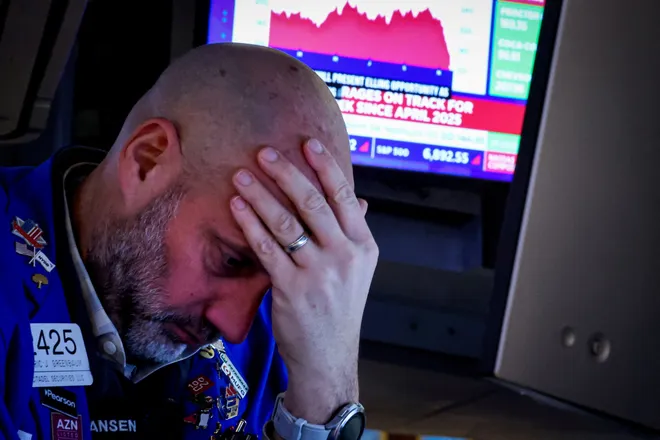
The stock market fell deep into “correction” territory during the week ending November 20. The S&P 500 ended the week at 6,910, down about 12% from its record of 7,845. The Dow Jones fell to 48,147, down 12% from its record of 54,744. And the tech-heavy Nasdaq, which is closest to the drain, ended the week at 22,618, down about 18 % from its peak of 27,723.
Stock futures, however, saw a rocky rally before markets opened on Nov. 23, offering a glimmer of hope after a dreadful week on Wall Street.
AI stocks have already faded. Stock indices entered the correction zone at the end of March 2026 in response to the war in Iran. Stocks fell harder in April 2025 after President Donald Trump signed drastic tariffs on imports into law.
But these declines followed specific geopolitical events, and investors eventually moved beyond them. Trump lifted his most punitive tariffs. The market eventually adapted to the war in Iran.

What triggered the stock sell-off?
This time, the trigger for the stock sell-off is less obvious.
Democrats won the midterm elections in November and signaled their intention to crack down on AI data centers, projects that most Americans now oppose. Some stock analysts say data center backlash could be the biggest factor driving stocks lower.
“I really think this is building an AI data center,” said Anders Bylund, technology analyst at The Motley Fool.
But Democrats were widely expected to take back Congress, and many of them ran with a handle on data centers. Where was the surprise?
A second major factor that sent stocks lower, analysts say, was the ouster of Jensen Huang as CEO of Nvidia, an AI giant, due to an affair with an alleged Chinese spy.
This setback could prove temporary. Nvidia surprised the world on November 23 by announcing that it had reinstated Huang. The move delighted Wall Street and triggered a sharp rise in stock prices before trading began.
Regardless of Huang’s final fate, Nvidia also announced spectacular third-quarter financial results on November 17. And companies generally recover from the loss of a CEO.
A third factor weighing on stocks, analysts say, is the expectation of higher interest rates. The Federal Reserve is strongly expected to raise rates at its December meeting. Higher rates will make it harder for AI giants to grow.
“Higher rates reduce the present value of AI companies’ far-flung profits,” said Mark Zandi, chief economist at Moody’s Analytics. “And they increase the cost of financing AI development, which increasingly relies on borrowing.”
But this rate increase was also envisaged well before the current liquidation.

“Events that pile up on top of each other”
So back to our question: why do stock prices fall?
“I would say it’s all these events piling on top of each other,” said Dominic Pappalardo, chief multi-asset strategist at Morningstar Wealth.
“You start piling up all these headlines,” Pappalardo said. “We finally get to a point where the markets start to react and trend downward.”
Or the problem could be even broader. The market suddenly seems gripped by a fundamental pessimism about AI, where previously it was gripped by boundless optimism.
Remember: Stocks of major AI companies have been overvalued for years, as evidenced by the relationship between stock prices and company earnings.
Price-to-earnings ratios tell you if a stock is overvalued. A common metric, the cyclically adjusted price-to-earnings ratio, or CAPE ratio, stands at 36.44 for the S&P 500 as of November 20. Before the recent sell-off, the index was above 40.
The only time it increased was at the height of the dotcom bubble, in 1999-2000. The CAPE ratio also peaked in 1929, just before the Great Depression.
The overvalued stocks have sparked recurring talk of an AI bubble, a rise in technology stock prices fueled by enthusiasm for artificial intelligence.
As AI stocks continued to rise in 2024, 2025 and much of this year, traders knew they could fuel an AI bubble. Most of them didn’t care.
This may be changing.
“The stock market sell-off is due to a confluence of factors,” Zandi said, but the biggest is “the so far stretched valuations of AI-related stocks. Investors expected a lot from AI companies, and then some. It’s not surprising that investors are disappointed, even though most AI companies are performing very well.”
Traders suddenly seem concerned about the warning signs of AI that they had previously overlooked: overvalued stocks, growing debt and their own overly optimistic expectations for corporate success.
Big AI stocks, such as Nvidia, were “priced to perfection,” Pappalardo said, invoking an investor term that suggests a stock might be priced too high. “It doesn’t take that much to trigger the slowdown.”

Wall Street’s crisis of AI confidence focuses on Nvidia
Once the most valuable company in the world, Nvidia now ranks fourth, behind tech and AI giants Apple, Microsoft and Alphabet.
Huang’s ouster, while seemingly temporary, has raised questions about the company’s future, some of which predated the scandal: Can Nvidia continue to earn, spend and grow at the same meteoric pace? Will government regulators cut Nvidia’s chip sales to China, reducing its future revenue?
“These questions are not new,” Pappalardo said, “but for the first time we are seeing evidence” that Nvidia’s meteoric growth “may not be able to continue.” He spoke before Huang was reinstated.
The stock market’s new pessimism extends into the future. Analysts note that most of the factors driving stocks lower — the midterm elections, the Federal Reserve’s actions on interest rates — are not fleeting. The Fed generally does not raise interest rates, only to lower them again. The next parliamentary elections will take place in two years.
“Huang will not come back,” Pappalardo said, speaking before his surprise reinstatement. “Election results don’t change.”
AI bubble or not, stock market corrections are widely considered a “healthy feature” of investment markets, Bylund said.
A 10% reduction in a stock index can, in theory, “correct” overvalued stocks, creating value for investors willing to buy.
“Before going down, down, down, stocks were going up, up, up for a long time,” Bylund said. “Maybe it was time for a correction.”
Gn headline