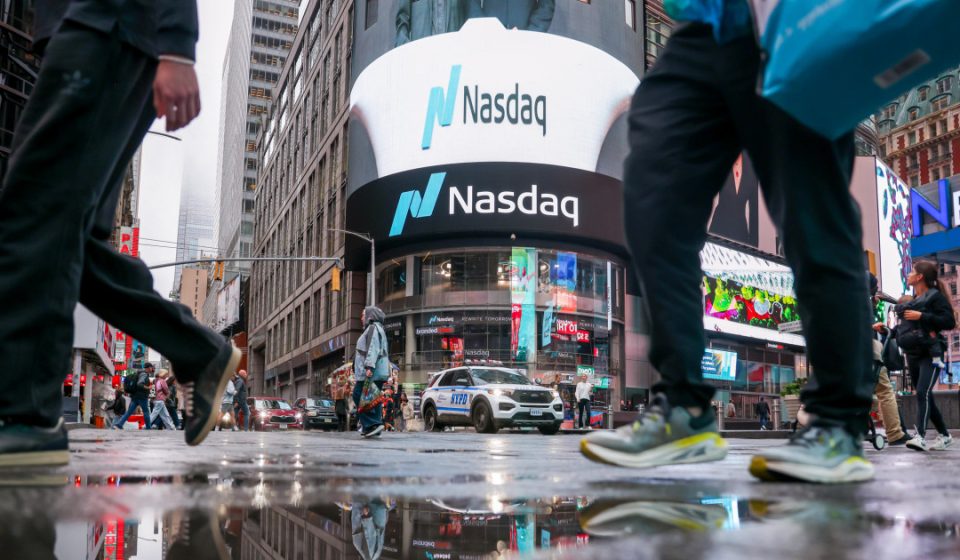

Stocks fell Thursday as a blue wave of victories by anti-AI candidates from Maine to Alaska added to already growing fears about the sustainability of the artificial intelligence boom.
The tech-heavy Nasdaq 100 index fell 6.3%, wiping out $2.3 trillion in market value, as investors took a step back to assess new risks for the billions of dollars of investment flowing into the AI sector.
The S&P 500 plunged 4.4%, wiping $2.8 trillion from the index’s value. Both indexes had their worst day since April 2025, when global tariffs imposed by President Donald Trump shook markets.
The broader Nasdaq Composite Index, which isn’t limited to tech stocks, fell more than 5.5% and fell into “correction” territory, which is when a stock or index declines at least 10%.
Markets widely expected Democrats to gain a majority in Congress. But they didn’t anticipate the magnitude of the victories, or the upset victories of candidates like Gov.-elect Gina Hinojosa in Texas, the nation’s largest data center market.
Democrats still hope to win Senate seats in Mississippi and Alaska. But already, hundreds of candidates who pledged to rein in AI data centers have been elected, raising the prospect of increased regulation of an industry that is the main engine of U.S. economic growth.
Trump weighed in Thursday to blame the fall in stocks on Democrats.
“The stock market had one of the worst days in history due to the election results. It’s so sad to watch!” Trump wrote in an article on Truth Social. “It took so much work to get us to a level that no one had ever seen before, and then this. So your 401(k)s went down. Remember, it wasn’t the Republicans, it was the Democrats. Fear not, though, we will soon, one way or another, BIGGER AND STRONGER THAN EVER.”
Tech stocks have surged in recent years as enthusiasm for artificial intelligence has fueled billions of dollars of investment in and by companies that make the chips and infrastructure needed for AI to develop and operate.
Since Election Day 2024, the Nasdaq Composite Index is still up more than 30%, despite recent fears that have sharply driven down values of chip, memory and other AI and cloud computing-related stocks.
But the question of whether AI will enable the kind of productivity needed to generate returns on these investments has grown louder in recent months.
“I don’t think this is an AI bubble bursting,” said Ed Yardeni, a longtime market watcher and president of Yardeni Research. “I think this is an AI bubble that is losing air very, very quickly, and I think it reduces the likelihood that we have a bubble that bursts, which would have detrimental consequences for the economy and the financial system as a whole.”
Sales continued as Asian markets opened Thursday evening. Korea’s Kospi index plunged 8%, triggering a market-wide trading halt. AI data center providers Samsung and SK Hynix fell at least 9% in early trading. Japan’s Nikkei 225 index fell 3%.
Mid-term market blues
Democratic victories across the country in Tuesday’s midterm elections hit investors hard Thursday, after stocks initially rallied, with many calling it a relief that the midterm election results were projected quickly and clearly.
Many Democrats who won elections for governor, attorney general, and Senate and House seats have pledged to slow or stop the construction of AI data centers.
Texas, Ohio, Michigan and Georgia were of particular concern because they are all large data center markets.
Democrats who won other state and federal offices have also expressed concerns about the industry and its businesses.
“Today was the cold shower I expected after a blue wave situation,” Yardeni said.
Elon Musk’s companies SpaceX and Tesla each fell nearly 10%, largely in reaction to mid-term results. But both companies are also engaged in AI development, and SpaceX has recently become a data center developer.
On paper, Musk’s two companies have lost more than $400 billion since Tuesday’s election results.
Musk, the world’s first billionaire, has spent hundreds of millions to help elect Republican candidates in the midterms. Until Tuesday’s rout, he was seen as one of the biggest potential beneficiaries of Republican victories.
Now that voters have so roundly rejected the Republican Party, Musk and his companies face the prospect of stricter regulations and even potential investigations at the state and federal levels.
Chip stocks lead to losses
The sell-off was triggered by two reports on poor results from major chipmakers, Qualcomm and Arm Holdings, released late Wednesday. Both companies reported results that investors generally considered mixed.
Arm Holdings slipped 13%, while Qualcomm fell 9.5%.
The Philadelphia semiconductor index fell 12.3%, its worst day since March 2020, when the coronavirus pandemic began to cripple the economy. The “DRAM” ETF, which tracks companies that make computer memory, fell nearly 18%.
Such earnings reports have rattled investors in recent months due to the hundreds of billions of dollars invested in the AI sector.
SanDisk shares fell 22%, Micron, Western Digital and AMD fell 17%, while Seagate fell 16%. All of these companies were among the worst-performing stocks in the S&P 500.
Oil prices rebounded from Wednesday’s decline. Brent crude oil ended the day up 3.8%. US crude oil rose 2.7% on Thursday.
Yields on the U.S. Treasury, which has faced some competition from tech giants that have tapped bond markets to raise money for their AI ambitions, were slightly lower.
Following the market moves, traders backed away from betting that the Federal Reserve would raise rates at its Dec. 8-9 meeting. The odds are currently around 60%.
The Dow Jones Industrial Average fell 1,833 points or 3.4%. The main contributor to the Dow Jones decline was Nvidia, which fell 9.2%, its largest one-day decline since April 2025.
Nvidia is the largest vendor of any AI company, but as investors question returns, the sector’s euphoria is fading. Nvidia shares have fallen 15% over the past three months.
Major established cloud computing providers Alphabet, Meta, Amazon and Microsoft also fell, but less than the overall market decline.
Dow components Cisco and Caterpillar, both of which are major AI data center providers, also fell about 6%.
Gn headline