Suicide by plane or terrorism? Speculation on the motive of the attack on Flight 1073 | Flydubai plane incident

AAround 9:30 a.m. local time on Wednesday morning, Tali Manes was taking her six-year-old daughter, Nina, to the toilet on the scheduled flydubai flight from Dubai to Tel Aviv when she heard a series of loud bangs on the cockpit door.
Manes, an Israeli bank executive, immediately told a flight attendant sitting nearby that something was wrong. When he didn’t react, she shouted at him, “There’s something going on in there!” Seconds later, the man “just walked towards the (cockpit) door and opened it,” Manes told Israel’s Channel 12 TV.
Inside, the scene resembled travelers’ nightmares: blood was spurting on the walls of the cockpit and a brutal struggle was taking place between the seriously injured pilot and the co-pilot, armed with some kind of sharp weapon. There was no one at the controls of the Boeing 737.
Manes shouted again: “He’s stabbing the pilot, he’s stabbing the pilot, come help!”
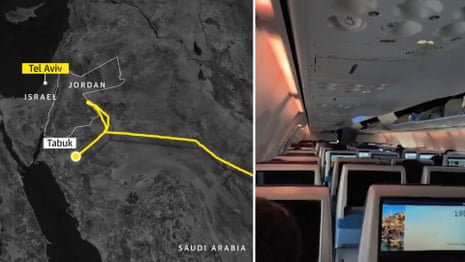
Many details of what happened on Flight FZ 1073 are not yet clear, but what happened next is well documented by eyewitness accounts and videos.
As the plane plunged steeply, losing 16,000 feet of altitude in about a minute, most of the 182 passengers screamed, prayed and desperately tried to reassure the panicked children. But a small group rushed to the cockpit and overpowered the co-pilot. One of them, a plumber, copied an action seen in television documentaries on plane crashes to pull the plane out of its dive.
Two pilots from the off-duty flight, both among the handful of non-Israeli passengers, then took control of the now nearly rudderless plane and ultimately guided it to a landing 90 minutes later in Tabuk, Saudi Arabia. Meanwhile, Manes had helped tie up the co-pilot with a telephone cord while a dentist treated the injured Indian pilot, Smit Machchhar. It was a “great miracle,” Manes said as he finally arrived in Tel Aviv on an emergency flight 10 hours later.
In a video call with Indian Prime Minister Narendra Modi, broadcast live by television channels, Machchhar, who is recovering in an Abu Dhabi hospital, said he had “fought for my life”.
The pilot managed to send an alarm to air traffic control reporting the attack, then, as his strength diminished, he managed to unlock the cockpit security door.
“I had so many injuries. I had fallen,” Machhchar said. “At some point I realized that if I didn’t get up… then the passengers would lose their lives.”
At the moment, the identity of the co-pilot who attacked Machchhar is unknown, although regional sources say he was an Omani national who joined flydubai – which is owned by the United Arab Emirates (UAE) government – between five and nine months ago.
The co-pilot was banned from flying to Oman because he feared he had espoused extremist views, the Associated Press cited a source as saying on Saturday, and was later hired by flydubai.
In Israel, there is little doubt about the co-pilot’s intentions. “The co-pilot is a terrorist who tried to either hijack the plane or bring it down by suicide. The worst-case scenario is that he was trying to enter Israel,” said Arik Arad, president of aviation cybersecurity consultancy Cyviation and former El Al security chief at Ben Gurion Airport.
Benjamin Netanyahu, the Israeli Prime Minister, claimed the co-pilot was exposed to “radical Islamist indoctrination,” saying Israeli investigators found evidence on social media that he wanted to “kill Jews.”
“The attacker shouts to the crew: ‘Kill me, kill me,’” Netanyahu told Fox News, adding that it was “clear he was suicidal.”
Experts have said there have been only a handful of cases of airplane suicide — cases where the pilot’s motivation is primarily to kill themselves by crashing the plane, rather than using the plane as a weapon, as in the Sept. 11 attacks.
In 2015, the co-pilot of a German budget airline flight who had hidden evidence of psychiatric illness from his employers deliberately crashed, killing himself and 150 other people. Suggestions that the crash of an AirIndia 787 in Ahmedabad last year was the result of a pilot deliberately cutting off fuel to the engines have been fiercely contested.
Terrorism experts are skeptical that the flydubai co-pilot’s sole motivation was to end his life. “The chances of a pilot deciding to commit suicide and ending up flying a plane full of Israelis are pretty low,” said Colin Clarke, a terrorism expert at the respected Soufan Center in New York.
“Netanyahu has a strong interest in it being terrorism, but the best explanation is probably the most obvious (i.e. terrorism),” he said. “The question… is: Was (the co-pilot) recruited by a group or organization… or was he radicalized on his own? If so, what excited him, given that he was piloting a plane full of Israelis? Could it be Gaza?”
Security services have warned of a wave of radicalization across the Middle East sparked by the war in Gaza, which ended a year ago with a fragile ceasefire. But there is little evidence so far that violent Islamist extremist groups have gained support through the conflict.
Terrorism experts said the most obvious group that could be involved in such an attack would be Al-Qaida in the Arabian Peninsula (AQAP), which is based in Yemen and has a history of efforts to shoot down planes. They said AQAP had recently sought to initiate or inspire violence internationally.
“Aviation remains classic propaganda through deeds,” Clarke said. “They say terrorism is theater, and nothing is more theatrical than shooting down a plane. You get a body count, you get media coverage, you get your point across, and that makes a plane the ultimate spectacular terrorist attack.”
Questions related to aviation security are now numerous. Post-9/11 aircraft design changes that allowed pilots to lock cockpit doors from the inside have long been controversial among experts. If Machchhar’s desperate efforts to provide access to the cockpit had failed, there is no doubt that all of FZ 1073’s passengers would have died.
There are also questions about driver selection. This can cost airlines dearly and could deprive them of valuable crew if too many fail in their more rigorous efforts to denounce psychiatric illnesses or extremist views. Pilots may be reluctant to use routes on which they are subject to stricter control, and some may hide physical or psychological problems for fear of being grounded.
Arad said: “The important problem… is that obviously the pilots are not being vetted enough. There is a lot more to be done.”
Dubai International Airport, the world’s busiest airport for international passenger traffic, has built part of its appeal on its reputation for security in a volatile region, said Philip Baum, a visiting professor of aviation security at Coventry University in England.
“They are very conscious of the fact – much like Israel in many ways – that they cannot afford to have a terrorist attack happen on a flight leaving there,” he said.
The United Arab Emirates ordered investigators to “collect information and evidence to determine the veracity of the incident, its circumstances, details and motives, and to verify the extent of its connection with terrorist activity or objective, or the existence of prior planning or direction,” its attorney general, Hamad Saif al-Shamsi, said on Thursday.
Arad foresees growing threats to civil aviation from cyberattacks and malicious use of AI, which could allow multiple aircraft to be targeted simultaneously. But other experts stressed that such sophistication was not necessary to pose a threat.
Clarke said: “Whether or not it’s a self-radicalized attacker or part of a group, keeping things simple is always the best way to carry out an attack, and this came really close. »
Gn headline